Last updated: 10 September 2026 · Content curated by Dr. Shabnam Choudhary · Medically reviewed by Dr. Saffiyyah Chaudhary
Quick Answer
Liver resection in Delhi NCR is planned against the India catalog range of $10,000–$26,000 for the hepatectomy as quoted, anaesthesia and a stay of 7–14 nights. We do not publish a separate NCR tariff, because campus tier, extent and ICU course move the letter more than the city label.
Budget on top for NCR geography and a companion who can stay two to three weeks. Staging CT or MRI if repeated, systemic therapy and extra bile-leak days remain separate quotes unless named.
- India cost range
- $10,000–$26,000
- Typical starting point
- $10,000
- Typical hospital stay
- 7–14 nights
- Procedure time
- approximately 2–6 hours
- Recovery
- Inpatient 7–14 nights, then hotel step-down. Varies by patient.
Major cost factors: extent of resection, tumour location and number of lesions, cancer type and disease stage, liver function and underlying liver disease. International patients should also budget for accommodation, airport transfers, a medical visa, medicines and follow-up.
Often quoted separately: staging imaging and biopsy; systemic therapy, radiation and ablation; extra icu, bile-leak care and re-operation; blood products; molecular pathology.
Why request a cost through GAF rather than a hospital?
Writing to one campus gets you that campus’s package. A GAF request is reviewed against your records and returned as suitable doctor and hospital options with an indicative, itemised estimate. There is no obligation to book.
- Doctor review first. The number follows a reading of your imaging, test results and clinical records, not a brochure range.
- Hospital options. You can compare listed campuses before you travel, instead of starting over with each international desk.
- International-patient coordination. Visa letters, records routing and companion logistics sit with the same request.
Liver Resection in Delhi NCR
Delhi NCR is where most international hepatectomy dossiers on this site are first compared, because the named liver-resection listing is the widest, and because triphasic imaging, remnant volumetry, HPB theatre and bile-leak-aware ICU can usually be discussed in the same metro without a second visa.
Gurugram holds Medanta, Fortis Memorial, Artemis and Paras. South Delhi holds Indraprastha Apollo and Max Saket. Fortis Shalimar Bagh and Fortis Escorts add further tagged names. That split is a hotel fact: daily ward visits from Aerocity to Gurugram is a poor pairing for a 7-to-14-night admission.
The live question on camera is not 'do you do liver surgery' as a product. It is lesion count, segment, remnant volume, whether the parenchyma is cirrhotic or chemotherapy-affected, and whether the honest sitting is a wedge or a right hepatectomy. Surgical-oncology names with liver-cancer or hepatectomy tags include Dr. Asit Arora (Apollo Delhi) and Dr. Tapan Singh Chauhan (Artemis). GI listings with explicit Liver Resection/Hepatectomy tags include Dr. Arvinder Singh Soin, Dr. Adarsh Chaudhary, Dr. Azhar Perwaiz and Dr. Prashant Vilas Bhangui at Medanta, Dr. Amit Javed at Fortis Memorial, Dr. Deepak Govil, Dr. Dinesh Singhal and colleagues at Apollo Delhi, Dr. Giriraj Bora and Dr. Shyam Sunder Mahansaria at Artemis, and Dr. Mukesh Kumar at Max Saket. Transplant-programme names that also carry a resection tag are still resection listings, not a ranking of transplant volume.
NCR quotations split more often than in smaller cities because remnant CT, interventional radiology for a bile leak, and theatre can sit in different buildings. Ask whether volumetry is billed by radiology or packaged with admission, and how many ICU nights the letter actually names.
Medanta's HPB cluster is useful as a starting shortlist for remnant and transplant-adjacent questions, not as a league table. An Apollo south-Delhi letter and a Gurugram Fortis letter are different hotel belts and different ICU floors even when both say hepatectomy.
Winter air quality is a planning issue after a long abdominal sitting if you or your attendant has respiratory disease and you remain for two weeks. It does not change the surgeon's fee. It changes whether step-down in a Gurugram hotel is livable.
International-patient desks in NCR are used to African, Gulf and Central Asian files. Invitation letters that mention a possible extra week after major hepatectomy are routine — use that, then still meet the operating surgeon on camera with the triphasic CT open.
If colorectal metastases are the indication, NCR also holds colectomy and rectal lists. A sequenced bowel-then-liver or liver-then-bowel plan is a second-opinion car ride, not a second visa. Neighbouring colectomy and rectal cancer surgery sheets on this site are different letters.
For a traveller, the metro's size is a tool and a trap. You can put Medanta, Apollo, Artemis and Fortis Memorial on one shortlist. You can also lose a companion to the wrong hotel belt once twice-daily ward visits start. Coordinators who know NCR start with the surgeon, then the campus that holds that surgeon's ICU, then the hotel.
Treat Gurugram, south Delhi, Shalimar Bagh and Faridabad as different quotations even when the brand name matches. A south Delhi Apollo letter and a Gurugram Medanta letter are not interchangeable for a two-week attendant stay after a right hepatectomy.
What liver resection typically costs in Delhi NCR
Flagship letters from Gurugram or south Delhi sit toward the upper half of the national band when a senior HPB surgeon, a major hepatectomy, laparoscopic or robotic access, a private room and named high-dependency nights are in the plan. A satellite unit under the same brand can come in lower for an uncomplicated peripheral wedge.
Companion living costs in Aerocity or Gurugram for two to three weeks are typically among the higher of the five cities. The hotel line can rival the difference between two surgical estimates.
Gurugram, south Delhi and Shalimar Bagh are not a blended average. Ask which belt the letter is written against, then rent in that belt.
What moves the quote in Delhi NCR
- Densest named HPB listing
- Multiple NCR surgical oncologists and surgical-gastroenterology listings are tagged to liver resection or liver cancer surgery. Confirm who would actually resect.
- Which NCR campus holds remnant imaging and ICU
- Gurugram, south Delhi and Shalimar Bagh are not interchangeable quotes, hotel belts or bile-leak floors.
- Wedge versus major hepatectomy on the letter
- Extent follows remnant volume and tumour location. A wedge letter is not a right-hepatectomy letter.
- Transplant-programme adjacency
- Some listed names also work on transplant floors. That is a catalog fact, not a promise that transplant is in the plan or in the price.
- Two-week geography
- Pin lodging to the operating campus. Aerocity is convenient to the airport, not to daily step-down visits after a major cut.
Medical travel through Delhi NCR
Arrival is almost always IGI, then a 40 to 90 minute transfer. Do not schedule theatre for the morning after a 2 a.m. landing.
Write the medical visa for 7–14 nights plus hotel recovery and a possible extra week after major hepatectomy. Attendants typically travel on a companion visa. Visa issuance is not guaranteed.
English is the working language of the international counters. Hindi is the ward language.
Second opinions inside NCR are a day trip if you already live next to one campus. They become a hotel-change if you treat Gurugram and south Delhi as one catchment.
Hospitals and units listed in Delhi NCR
Listed NCR campuses for this pathway include Medanta, Indraprastha Apollo, Fortis Memorial, Artemis, Max Saket, Fortis Shalimar Bagh, Fortis Escorts and others on the cost sheet. Accreditation is shown on each profile as published.
Ask whether the ICU has managed bile leaks after hepatectomy, whether remnant CT sits on the same plot, and which address is on the letter. Listing with the procedure family is not a claim of resection volume.
Doctor cards below are NCR-filtered from the catalog. They are not a ranking of Delhi liver surgeons.
Liver Resection doctors in Delhi NCR · Liver Resection hospitals in Delhi NCR · Liver Resection cost in India
What is liver resection (hepatectomy)?
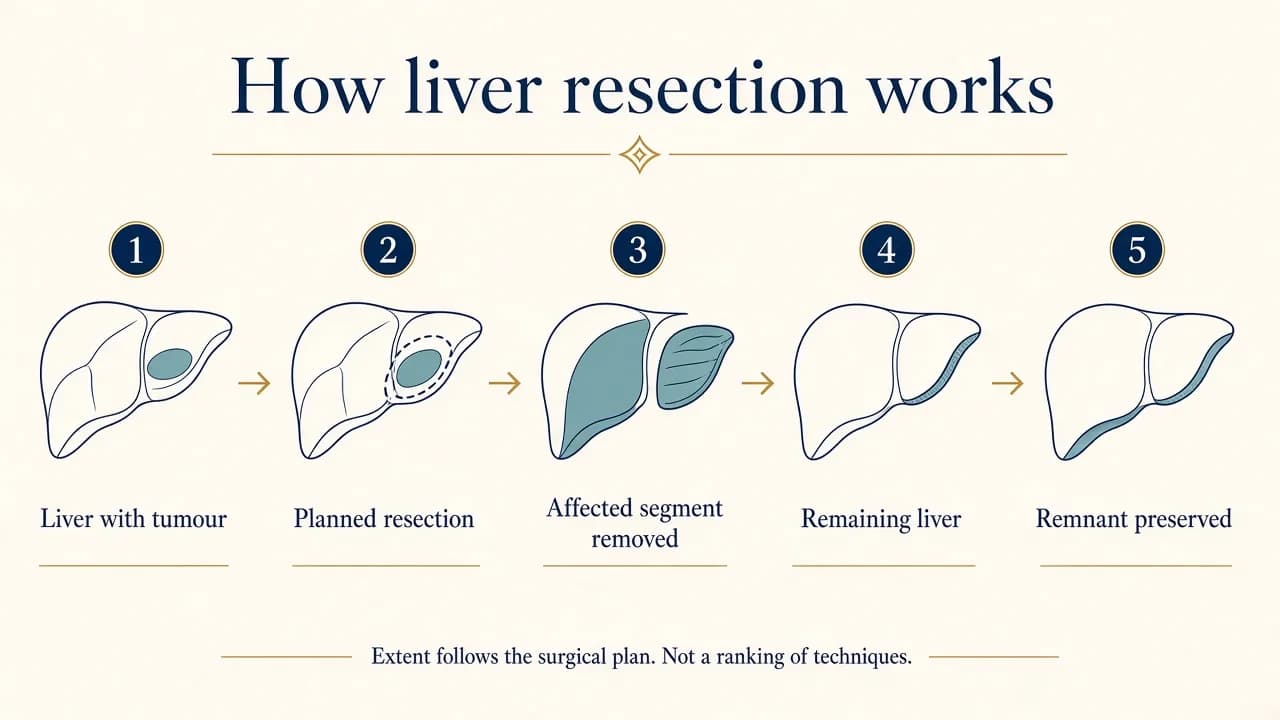
Liver resection, or hepatectomy, removes a diseased portion of the liver — tumour or selected benign disease — with a margin, while preserving enough functioning remnant to support recovery. The liver can later increase in volume; that regeneration is not a copy of the piece that was taken out.
The exact operation depends on tumour location, size, number of lesions, liver function, underlying liver disease, relationship to blood vessels and bile ducts, cancer type, previous treatment, overall health and the surgeon's assessment. GAF Healthcare does not decide on this page whether resection is appropriate. Treatment plans are determined by qualified doctors after evaluation.
When is liver resection performed?
Resection may be considered for selected primary liver cancers (including HCC and some intrahepatic cholangiocarcinomas), selected benign tumours, colorectal metastases, and other carefully selected metastatic lesions. It is not the first or only treatment for every liver tumour. Extrahepatic disease, inadequate remnant or poor liver function often mean a different conversation — systemic therapy, ablation, transplant assessment or non-operative care.
This page does not diagnose and does not recommend hepatectomy, ablation or non-operative care for an individual patient. Eligibility depends on imaging, liver function and clinical assessment.
How the operation is performed, recovery and variations →
Liver Resection (Hepatectomy) cost in India
There is no single hepatectomy price in India. The $10,000–$26,000 band is a planning range for a liver resection — theatre, anaesthesia, the named surgeon's fee, the quoted room, routine inpatient drugs, ICU as written into the estimate, and histopathology. The lower end typically reflects a straightforward peripheral wedge or single-segment resection at a mid-tier NABH campus, in a patient with good remnant function, toward the shorter end of 7–14 nights. The upper end typically reflects a flagship JCI campus, a senior HPB surgeon, a right or extended hepatectomy, laparoscopic or robotic access where used, a private room, named high-dependency nights, and a stay toward 14 nights.
Treat that band as an order of magnitude until a surgeon who actually resects liver has seen triphasic CT or MRI, liver-function tests, and whether chemotherapy has already changed the parenchyma. Same procedure name is not the same surgical plan. Wedge is not right hepatectomy. A healthy remnant is not a cirrhotic remnant. A letter written for one is not a letter written for another.
Surgery cost is not total liver-cancer treatment cost. Staging, systemic therapy, ablation and later surveillance sit on neighbouring estimates. City is a weaker driver than families expect. Campus tier, remnant volume planning, named ICU nights and whether a bile leak extends stay move the bill more than the metro name. GAF Healthcare matches centres that already run HPB lists — that is a matching rule, not a ranking of hospitals.
What moves the number most is extent (wedge versus major hepatectomy), tumour number and location, liver function, open versus minimally invasive access, named ICU nights, campus tier and the named consultant. International patients should budget the weeks around the knife — and any oncology that sits in the same visa window — not only the theatre block.
Liver Resection (Hepatectomy) cost breakdown in India
Component prices are rarely published as a public tariff. The lines below describe what typically sits inside a surgical estimate, not a dollar amount for each row.
- Surgeon fee and surgical team
- Usually bundled for the named HPB, GI or surgical-oncology consultant. Confirm who is in theatre. An HPB listing is not automatically a robotic major hepatectomy.
- Hospital and operating-room charges
- Theatre time, energy devices, staplers where used, and recovery. Laparoscopic or robotic access, when used, lengthens or reprices this block. Campus tier moves this line more than the city name.
- Anaesthesia
- Anaesthetist fee and drugs for a case lasting typically two to six hours. Cardiopulmonary comorbidity and major blood-loss planning may add a pre-operative clearance billed outside.
- ICU and critical-care monitoring
- Early high-dependency or ICU care is common after major hepatectomy or comorbidity. Nights inside the quoted stay may be bundled; extra days after bleeding, bile leak or liver dysfunction are typically extra.
- Diagnostic investigations
- Standard bloods, coagulation and ECG are often inside the admission. CT, MRI, PET-CT, tumour markers and biopsy are frequently extra if not already done at home.
- Pathology
- Processing of the specimen and margins. Molecular assays, when ordered, are often billed later.
- Medicines and nutrition
- Inpatient analgesia, antibiotics, DVT prophylaxis and routine drugs during the quoted stay. Dietitian follow-up after discharge is frequently extra. This page does not set a diet.
- Room charges and nursing
- Written against a room category and a stated number of nights — typically 7–14 nights. Companion beds change the nightly rate.
- Postoperative care and follow-up
- Liver-function monitoring, wound care and the first clinic review before you fly are commonly included. Later oncology visits and imaging are typically separate.
Planning range or quotation?
The $10,000–$26,000 figure is an indicative planning range. A final hospital quotation is itemised, issued after a consultant reviews your records, and still subject to what is found clinically.
Get a Personalized Cost Estimate
What is usually included in a Liver Resection package?
No two hospitals draw the line in the same place, so read an estimate for what it excludes as carefully as for what it covers. The pattern below is what listed campuses typically bundle into a surgical estimate for this procedure. Anything not written into your estimate should be assumed to be extra until the hospital confirms otherwise.
Usually included
Usually included
Consultation that leads into the admission
The in-person pre-operative review with the named surgeon, where bundled. Remote review before travel is arranged separately.
Usually included
Surgery by the named consultant
The resection as written on the estimate — not an unnamed robotic extended hepatectomy unless the letter says so.
Usually included
Anaesthesia and operating room
The anaesthesia team, theatre time, standard consumables and recovery for the scheduled case.
Usually included
Hospital stay as quoted
Bed charges, nursing and routine ward care for the room category and nights written into the estimate — typically 7–14 nights, including ICU nights if the letter names them.
Usually included
Routine tests
Standard bloods, coagulation, ECG and anaesthetic fitness assessment, where bundled.
Usually included
Pathology of the specimen
Processing of the resected liver and margins, where histopathology is bundled.
Usually included
Medicines during admission
Analgesia, antibiotics and routine drugs administered during the quoted stay.
May be charged separately
May be separate
Staging imaging and biopsy
CT, MRI, PET-CT, ultrasound-guided biopsy and tumour-marker panels are frequently extra when ordered in India.
May be separate
Systemic therapy, radiation and ablation
Chemotherapy, targeted therapy, immunotherapy, radiotherapy and ablation are neighbouring quotes.
May be separate
Extra ICU, bile-leak care and re-operation
Nights and theatre beyond the quoted stay, including treatment of bleeding or bile leak, are typically a new event.
May be separate
Blood products
Transfusion, when required, is commonly billed per unit.
May be separate
Molecular pathology
NGS, mismatch-repair and other assays, when ordered, are frequently extra.
May be separate
Rehabilitation and later imaging
Physiotherapy after discharge and surveillance CT or MRI are typically separate visits.
May be separate
Travel, accommodation and visa-related expenses
Flights, medical visa fees, hotel after discharge, local transport and companion living costs sit outside every hospital estimate.
Catalog inclusions listed for this pathway: surgical oncology consultation and records review; named surgeon on camera before travel; theatre, anaesthesia and inpatient stay as quoted; histopathology of the specimen; discharge summary to your home oncologist.
What can increase the cost?
These are the drivers that actually move a bill for this operation, in rough order of how often they do it. Most of them are clinical decisions rather than commercial ones, which is why an honest estimate is written after a records review rather than before it.
- Extent of resection
- Wedge, segmentectomy, hemihepatectomy and extended resection are different sittings. Extent follows anatomy and remnant volume, not a brochure upgrade.
- Tumour location and number of lesions
- A peripheral lesion and a lesion sitting on the vena cava are not the same theatre. Multiple sites can mean a longer sitting or a two-stage plan.
- Cancer type and disease stage
- HCC, intrahepatic cholangiocarcinoma and colorectal metastases are planned differently. Extrahepatic disease can take resection off the table.
- Liver function and underlying liver disease
- Cirrhosis, steatosis and chemotherapy-associated liver injury change how much remnant is safe. That assessment is why two patients with the same diagnosis receive different letters.
- Surgical complexity
- Vascular or biliary reconstruction, repeat hepatectomy and emergency bleeding lengthen theatre and ICU. Ask what the letter assumes.
- Surgeon and multidisciplinary team
- The estimate should name the consultant. HPB surgery, medical oncology and interventional radiology are billed differently. That is not a ranking.
- Hospital category and campus tier
- Flagship versus satellite units sit at different price levels. Ask which address and which ICU the letter is written against.
- City and companion logistics
- Surgical fees cluster more tightly across the five metros than hotel bills for two to four weeks. City choice matters most after discharge.
- Open versus laparoscopic surgery
- Laparoscopic access, when offered, changes theatre time and consumables. No separate GAF sheet — ask whether it is actually available that week.
- Robotic assistance
- Robotic-assisted hepatectomy, where clinically offered, is a different resource envelope. There is no separate GAF robotic-hepatectomy tariff.
- ICU requirement and length of stay
- Packages are written for 7–14 nights, including some high-dependency care if named. Extra nights after bile leak, bleeding or liver dysfunction are usually billed fresh.
- Pathology and complications
- Specimen processing may be bundled. Molecular tests, bile-leak drains, transfusion and re-operation are new events unless the contract says otherwise.
- Additional cancer treatment
- Chemotherapy, targeted therapy, immunotherapy, radiation or ablation, when used, are neighbouring quotes. Surgery cost is not total treatment cost.
Types of liver resection
Extent is chosen to clear the lesion with a margin and leave a safe remnant — not to sell a named operation. GAF Healthcare publishes a planning range only for liver resection as one cost sheet. The rows below describe relative complexity. They are not a menu of add-on prices, and none is universally better.
Selection depends on tumour location, size, number, liver function, vascular and biliary anatomy and the operating team's assessment. This page does not recommend wedge, major or minimally invasive hepatectomy for an individual patient.
Swipe to compare surgical approaches →
| Approach | Relative complexity | GAF planning range | Notes |
|---|---|---|---|
| Wedge resection | Peripheral lesion; smallest typical sitting | No separate GAF sheetRelative complexity only | A non-anatomic sliver of liver around a surface lesion. Not a substitute for a formal section when deeper vessels are involved. No separate GAF sheet. |
| Segmentectomy / sectionectomy | One or more Couinaud segments | No separate GAF sheetRelative complexity only | Anatomic removal of a segment or section. Remnant volume still has to be enough. No separate GAF price. |
| Left hepatectomy | Left hemiliver removed when indicated | No separate GAF sheetRelative complexity only | Typically segments 2–4. Different remnant from a right-sided sitting. Same national planning band unless the letter names extras. |
| Right hepatectomy | Right hemiliver; larger parenchymal cut | No separate GAF sheetRelative complexity only | Typically segments 5–8. Often a longer sitting and a closer remnant conversation. Not automatically 'better'. |
| Extended / central hepatectomy | More liver, or a central corridor, when anatomy requires it | No separate GAF sheetRelative complexity only | Extended right or left, or selected central resections. Higher resource use. No separate GAF extended-hepatectomy tariff. |
| Multiple or two-stage resection | Selected multi-site disease | No separate GAF sheetRelative complexity only | More than one cut, or a staged plan, when the team judges remnant and disease allow it. Ask whether both stages are on one letter. |
| Laparoscopic liver resection | Same oncological jobs through ports when offered | No separate GAF sheetRelative complexity only | Theatre and device costs can sit toward the upper part of the band. Not automatically better, and not priced as a separate GAF sheet. |
| Robotic-assisted liver resection | Where offered — different resource envelope | No separate GAF sheetRelative complexity only | Not universally available and not priced as a separate GAF hepatectomy sheet. Ask whether it is actually offered for your lesion that week. |
Planning ranges appear only where GAF Healthcare already publishes a cost sheet for that operation. Other rows describe relative clinical complexity and should not be read as prices.
Open vs laparoscopic vs robotic liver resection
Surgical access is how the team reaches the liver. It is not a separate cancer operation. Open, laparoscopic and robotic-assisted sittings can all be used to perform a wedge, a sectionectomy or a hemihepatectomy when the treating team judges them suitable. None is universally better, and minimally invasive access is not suitable for every patient.
Suitability depends on the tumour, anatomy, complexity, surgeon expertise, hospital resources and patient factors — including prior surgery, a very posterior lesion or emergency bleeding. There is no separate GAF price sheet for laparoscopic or robotic hepatectomy.
Swipe to compare surgical access →
| Approach | Surgical access | General approach | Hospital-resource differences | Recovery considerations | Cost considerations |
|---|---|---|---|---|---|
| Open | One abdominal incision, often a rooftop or midline cut | Direct handling of the liver. Still used when ports are not honest or not available. | Standard theatre; no robotic console. ICU follows the sitting, not the incision length. | Wound recovery can be slower. Liver-function watch, bile-leak watch and fatigue still dominate the stay. | Often the lower theatre-consumable line. Not automatically the cheaper total bill if the sitting is a major hepatectomy. |
| Laparoscopic | Several small ports, sometimes with a small extraction incision | Same oncological jobs — identification, vascular control, parenchymal transection — through ports when offered. | Laparoscopic stack, energy devices and a trained team. Conversion to open remains possible. | Some patients mobilise sooner. Bile leak, bleeding and remnant function are not removed by ports. | Theatre time and devices can sit toward the upper part of the band. No separate GAF laparoscopic-hepatectomy tariff. |
| Robotic-assisted | Ports plus a robotic console where the hospital actually offers it that week | Wristed instruments for selected lesions. Still a hepatectomy — not a different cancer. | Console time, trained team and often a higher consumable envelope. Not universally available. | Recovery still follows remnant volume, bile leak and prior chemotherapy — not the brand of robot. | A different resource envelope. There is no separate GAF robotic-hepatectomy tariff. Paying more does not by itself make a remnant safer. |
Suitability depends on the patient, the tumour, anatomy, surgeon expertise and clinical circumstances. None of these approaches is universally better, and this table is not a price list.
How does liver anatomy affect the surgery?
Surgeons describe the liver in segments — usually eight Couinaud segments — grouped into a right and a left hemiliver, with a central corridor around the middle hepatic vein. A tumour in a peripheral left-lobe segment is a different conversation from one sitting between the hepatic veins or against the bile-duct confluence.
Proximity to the portal vein, hepatic artery, hepatic veins and bile ducts decides whether a wedge is honest or whether a formal sectionectomy or hemihepatectomy is required. Imaging maps that relationship before a date is offered. This page is not an anatomy textbook and does not assign a segment to a named patient.
Liver resection for cancer
Surgery may be discussed for selected hepatocellular carcinoma, selected intrahepatic cholangiocarcinoma, selected colorectal liver metastases, and occasionally other metastatic or neuroendocrine lesions. The same word — hepatectomy — covers those settings. The staging conversation does not.
Decisions depend on cancer type, stage, number and location of lesions, liver function, whether disease sits outside the liver, and a multidisciplinary review that typically includes an HPB or GI surgical oncologist, medical oncologist, radiologist and pathologist. This page does not provide an individualized treatment plan.
Liver resection for colorectal cancer metastases
Colorectal cancer can spread to the liver through the portal circulation. Some patients with a limited number of liver metastases, adequate remnant and no unresectable extrahepatic disease may be considered for liver-directed surgery — sometimes after chemotherapy, sometimes before, sometimes with the bowel primary in a sequenced plan.
Not every patient with liver metastases is eligible for resection. Imaging and staging have to show that a complete, safe clearance is plausible. Neighbouring GAF sheets exist for colectomy and rectal cancer surgery when the primary is still part of the pathway. Chemotherapy, when used, is a neighbouring quote. This page does not decide eligibility.
Liver resection for hepatocellular carcinoma
For selected HCC, resection is one local option among others that teams may discuss — including ablation or transplant in different clinical settings. Liver function, tumour size and number, location, and underlying chronic liver disease all feed the conversation. A tumour that looks resectable on a scan may not be resectable in a decompensated cirrhotic remnant.
Multidisciplinary evaluation is the honest next step, not a brochure comparison of techniques. This page does not publish eligibility scores or recommend resection, ablation or transplant for a named patient.
Why does liver function matter before hepatectomy?
The team plans to leave enough functioning liver — the future liver remnant — to avoid postoperative liver failure. Underlying cirrhosis, fatty liver, and chemotherapy-related liver injury all shrink how much can safely come out. Blood tests, imaging volumetry and, in selected patients, additional remnant-function tests inform that plan.
Surgeons plan the cut to preserve remnant when possible. A larger operation is not automatically better. This page does not calculate remnant volume for an individual.
Does the liver grow back after resection?
The liver has significant regenerative capacity. Remaining tissue can increase in volume and function over weeks to months. That is not the same as the removed piece physically growing back as it was. Underlying liver health influences how well the remnant recovers.
Regeneration does not cancel bile-leak risk, fatigue or the need for pathology-led oncology. It is a reason remnant volume is planned carefully — not a promise of a normal liver by a calendar date.
Liver Resection (Hepatectomy) cost: India vs other medical tourism destinations
The table below is a planning comparison for liver resection as a surgical episode, not a claim that every country uses the same extent or bundles ICU the same way. India and United States figures come from the GAF Healthcare catalog. Other markets are modelled from the India midpoint using relative private-care cost levels, and are labelled as indicative planning estimates — not hospital quotations.
India is often less expensive for a self-funding patient. That is not the same as 'always cheapest' or 'best'. Insurance coverage at home can reverse the arithmetic overnight. Hospital, surgeon, extent, surgical approach, liver function, ICU, length of stay, oncology treatment and what the package includes still decide the real bill in every country.
Swipe to compare destinations →
| Country | Approximate cost | Relative cost position | Important cost considerations |
|---|---|---|---|
| India | $10,000–$26,000 | Baseline | Catalog planning range. Named HPB and liver-resection listings can be met on camera before travel. Listed consultants currently sit in Delhi NCR, Mumbai, Bengaluru, Chennai and Hyderabad. |
| Turkey | $18,000–$32,500Indicative planning estimate* | ≈1.4× India | Packaged medical-travel market. Verify whether ICU nights, bile-leak management, remnant imaging and systemic therapy are inside the bundle. |
| Thailand | $21,500–$39,500Indicative planning estimate* | ≈1.7× India | Private-hospital tourism. Established international desks; ICU extras and major hepatectomy can sit well above India. |
| United Arab Emirates | $36,000–$61,000Indicative planning estimate* | ≈2.7× India | Regional premium private care. Short flights from much of Africa and West Asia; private HPB pricing is closer to Western self-pay. |
| Singapore | $47,000–$79,000Indicative planning estimate* | ≈3.5× India | High-cost private hub. Mature multidisciplinary process at premium private tariffs. Local subsidised and international private bills differ. |
| Germany | $39,500–$75,500Indicative planning estimate* | ≈3.2× India | Certified European HPB units. Structured MDT process and longer inpatient norms; self-pay deposits are typical for visitors. |
| United Kingdom | $32,500–$61,000Indicative planning estimate* | ≈2.6× India | Private self-pay (NHS generally not for visitors). NHS care is not available to most overseas visitors. Private self-pay applies; oncology is quoted separately. |
| United States | $45,000–$110,000 | ≈4.3× India | Highest self-pay outlier. Facility, surgeon, ICU, pathology and later oncology bills often arrive separately. Compare against actual insurance liability. |
*Figures other than India and the United States are modelled planning estimates scaled from the India catalog band, not hospital quotations. International treatment costs vary by hospital, surgeon, extent of hepatectomy, surgical approach, liver function, disease complexity, length of stay, ICU requirements, oncology treatment and what is included in the package. These figures are intended for preliminary comparison only and are not final quotations. Figures other than India and the United States are modelled planning estimates. They are not GAF quotations and not competitor quotes reproduced as ours.
Why do international patients consider India for liver resection?
International patients consider India for liver resection when they are self-funding a hepatectomy, when they want a named HPB surgeon before they fly, and when they need remnant-volume planning, ICU that has managed bile leaks, and the next oncology conversation in the same city.
Cost is the most visible reason. The catalog range $10,000–$26,000 sits well below typical US cash-pay of $45,000–$110,000, because theatre, ward and consultant time are priced on a different cost base — not because the operation is a lesser product by definition. Several listed metros can hold an MDT conversation in one week. English is the working language of most international desks. Laparoscopic and robotic access are offered in some listed houses; availability is a diary question.
None of that means India is the right country for every patient, and none of it is a claim of 'best liver surgeons in the world', guaranteed remnant recovery or 'cheapest in the world'. Someone whose insurance covers the pathway at home, who cannot stay for a slow remnant recovery, or whose staging shows resection is not honest, may be better treated locally.
Liver Resection Hospitals in Delhi NCR
Campuses on GAF Healthcare where this surgical-oncology pathway is listed, with accreditation as published by the hospital. Listing with the procedure family is not a claim of hepatectomy volume or a ranking. Choose on the surgeon you met on camera, whether the house runs HPB lists and remnant-aware ICU, and whether staging can stay in the same city — not on a brand slogan.
Indraprastha Apollo Hospital
 JCI Accredited
 NABH Accredited
- Radiation Oncology
- Surgical Oncology
- Medical Oncology
- Hematology
7 listed doctors for this pathway
Languages listed: English, Hindi
Artemis Hospital
- JCI Accredited
- NABH Accredited
- DHADHA
- Radiation Oncology
- Surgical Oncology
- Medical Oncology
- Hematology
3 listed doctors for this pathway
Languages listed: English, Hindi
BLK-Max Super Speciality Hospital
- JCI Accredited
- NABH Accredited
 NABL Accredited
- Radiation Oncology
- Surgical Oncology
- Medical Oncology
- Hematology
1 listed doctor for this pathway
Languages listed: English, Hindi
Fortis Memorial Research Institute
- JCI Accredited
- NABH Accredited
- NABL Accredited
- Radiation Oncology
- Surgical Oncology
- Medical Oncology
- Hematology
1 listed doctor for this pathway
Languages listed: English, Hindi
Fortis Hospital, Shalimar Bagh
- JCI Accredited
- NABH Accredited
- NABL Accredited
- Radiation Oncology
- Surgical Oncology
- Medical Oncology
- Hematology
2 listed doctors for this pathway
Languages listed: English, Hindi
Max Super Speciality Hospital, Saket
- JCI Accredited
- NABH Accredited
- NABL Accredited
- Radiation Oncology
- Surgical Oncology
- Medical Oncology
- Hematology
1 listed doctor for this pathway
Languages listed: English, Hindi
Medanta - The Medicity
- JCI Accredited
- NABH Accredited
- NABL Accredited
- Radiation Oncology
- Surgical Oncology
- Medical Oncology
- Hematology
10 listed doctors for this pathway
Languages listed: English, Hindi
Paras Hospitals, Gurugram
- JCI Accredited
- NABH Accredited
- NABL Accredited
- Radiation Oncology
- Surgical Oncology
- Medical Oncology
- Hematology
1 listed doctor for this pathway
Languages listed: English, Hindi
Liver Resection hospitals in Delhi NCR · Talk to a treatment coordinator
Liver Resection Surgeons in Delhi NCR
These are consultants listed on GAF Healthcare whose catalog procedures include liver resection, hepatectomy or liver cancer surgery. Profiles show training, campus and procedures as held in the catalog. There are no rankings here, and no fee is paid for placement. Named listings currently sit in Delhi NCR, Mumbai, Bengaluru, Chennai and Hyderabad.

Dr. Adarsh Chaudhary
Surgical Gastroenterology
15+ years Experience
Whipple Procedure · Pancreatic Cancer (surgical management) · Complex HPB Tumor Surgery
English, Hindi
Dr. Amit Javed
Surgical Gastroenterology
27+ years Experience
Gastric Cancer Surgery — advanced surgica… · Colorectal Cancer Surgery — comprehensive… · Liver Resection/Hepatectomy — complex hep…
English, Hindi
Dr. Arvinder Singh Soin
Surgical Gastroenterology
38+ years Experience
Deceased Donor Liver Transplant · Pediatric Liver Transplant · Liver Retransplantation
English, Hindi
Dr. Azhar Perwaiz
Surgical Gastroenterology
27+ years Experience
Liver Transplantation · Liver Resection (Hepatectomy) · Whipple Procedure (Pancreaticoduodenectom…
English, Hindi
Dr. Deepak Govil
Surgical Gastroenterology
30+ years Experience
Liver Transplantation · Liver Resection (Hepatectomy) · Whipple Procedure (Pancreaticoduodenectom…
English, Hindi
Dr. (MAJ) Siddharth Mishra
Surgical Gastroenterology
20+ years Experience
Liver Transplantation · Liver Resection (Hepatectomy) · Whipple Procedure (Pancreaticoduodenectom…
English, Hindi
Dr. Alok Kumar Pandey
Surgical Gastroenterology
13+ years Experience
Liver Resection/Hepatectomy · Deceased Donor Liver Transplant · Whipple Procedure
English, Hindi
Dr. Ankur Atal Gupta
Surgical Gastroenterology
18+ years Experience
Liver Transplantation · Liver Resection (Hepatectomy) · Whipple Procedure (Pancreaticoduodenectom…
English, Hindi
Liver Resection doctors in Delhi NCR (29 listed) · Get a personalized cost estimate
Liver Resection cost by city in India
City names below are working filter URLs — the same destination, city, specialty and procedure keys the rest of the site already uses. Open Delhi NCR, Mumbai, Bengaluru, Chennai or Hyderabad for the city overlay and the filtered doctor and hospital cards.
We do not invent a different surgical tariff for each metro. The approximate cost column uses the India planning band of $10,000–$26,000 unless a researched city figure exists. What does change is the named consultant list, whether HPB ICU sits on the same plot, airport access and how expensive a multi-week companion stay actually feels.
Swipe to compare Indian cities →
Delhi NCR
$10,000–$26,000
India planning band — not a city quote
Typical stay 7–14 nights
Ask which NCR campus the letter is written against, whether the sitting is a wedge or a major hepatectomy, how many high-dependency nights are named, and whether remnant CT is on the same invoice. Campus tier inside NCR moves the letter more than the city label.
11 hospitals · 29 doctors
Mumbai
$10,000–$26,000
India planning band — not a city quote
Typical stay 7–14 nights
Surgical estimates sit on the national band. The Mumbai-specific extra is usually the hotel for two to three weeks and the harbour commute — among the highest companion costs of the five cities.
1 hospital · 3 doctors
Bengaluru
$10,000–$26,000
India planning band — not a city quote
Typical stay 7–14 nights
Surgical estimates sit on the national band of $10,000–$26,000. Bengaluru-specific extras are usually restaging CT or MRI if you arrive without discs, and transfer-plus-hotel time between KIAL and Bannerghatta or a Gleneagles unit.
3 hospitals · 8 doctors
Chennai
$10,000–$26,000
India planning band — not a city quote
Typical stay 7–14 nights
Surgical estimates sit on the national band. Chennai-specific extras are usually restaging imaging if discs will not open, and a radiation or proton course if the MDT still wants one after pathology — neighbouring quotes.
3 hospitals · 4 doctors
Hyderabad
$10,000–$26,000
India planning band — not a city quote
Typical stay 7–14 nights
Ask which Hyderabad campus will hold remnant CT, theatre and ICU. Split-campus pathways add taxi days that never appear in the surgery range.
4 hospitals · 5 doctors
Costs vary considerably by hospital, specialist, clinical complexity, insurance, room or day-care category, and what is included in the package.
Choosing a city for liver resection
What should international patients budget beyond the surgery?
The surgical estimate is only one line in a medical-travel budget. Surgery cost is not total liver-cancer treatment cost and is not total medical-tourism cost. Staging scans, systemic therapy, extra ICU, hotel after discharge, flights and a companion who can stay are the rest of the trip.
Ask the coordinator to quote each stage separately. Do not invent flight or hotel prices from this page. Add your own numbers: surgery + quoted stay including named ICU nights + staging tests + oncology if in India + flights + visa + hotel nights × rate + local transport + attendant costs + a contingency for extra nights or bile-leak days.
- Staging and liver-function work-up
- CT, MRI, PET-CT where indicated, bloods, coagulation, remnant assessment. Often extra if done in India.
- Systemic therapy or ablation, if used
- Neighbouring cost sheets. Can add weeks in the city.
- The operation
- Resection, anaesthesia, ICU as quoted, 7–14 nights and pathology. This is the $10,000–$26,000 line when the letter matches that scope.
- Extra ICU, bile-leak care, transfusion
- Beyond the quoted nights. Ask what happens if hospitalization is extended.
- Adjuvant oncology
- Further drugs, targeted therapy or radiation if pathology and the MDT advise it.
- Flights and visa
- Patient and attendant. Medical visa duration should cover extra nights if remnant recovery is slow. Issuance is not guaranteed.
- Accommodation after discharge
- Hotel or apartment near the campus until the surgeon is content you can fly.
- Treatment episode$10,000–$26,000
- Pre-operative testsOften inside the estimate — confirm
- Hospital stay7–14 nights typically bundled
- Additional procedures or extended careQuoted separately if advised
- Accommodation for companionVaries by city and length of stay
- Local transportationAirport and daily hospital transfers
- FlightsDepends on origin
- Medical visaFee set by the issuing consulate
Planning estimate — not a hospital quotation.
Get a Personalized Treatment Estimate
What does medical travel for liver resection in India involve?
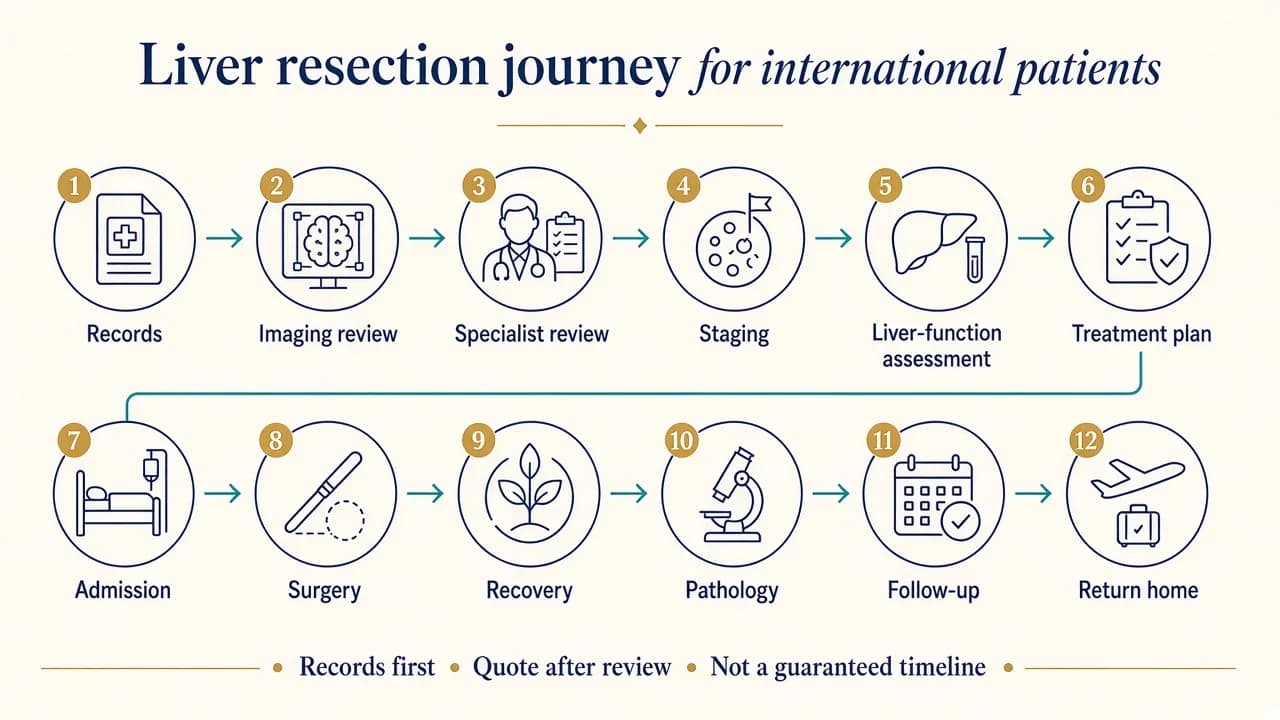
The sequence below is how a records-first pathway normally runs. The order matters: everything before arrival exists so that you are not making decisions in an unfamiliar hospital corridor with a suitcase beside you.
Submit medical records
CT or MRI, liver-function tests, biopsy if done, a medicine list and a note on prior chemotherapy.
Imaging and pathology review
A surgeon who resects liver reads the actual films and histology, not a coordinator's paraphrase.
Specialist assessment
On camera: whether resection now, systemic therapy first, ablation, transplant assessment, or a non-operative path is the honest next step.
Liver-function and staging review
Remnant volume and extrahepatic disease are checked before a date is offered.
Multidisciplinary treatment planning
Surgical, medical and, where relevant, interventional radiology agree sequence.
Preliminary treatment plan and cost estimate
An itemised surgical letter. Extent, approach, ICU nights and oncology quoted separately if in view.
Hospital selection
Compare the surgeon you met, whether the campus runs HPB lists and ICU that has managed bile leaks, and how long a companion can stay.
Travel planning
A hospital invitation typically supports a medical visa. Write duration for 7–14 nights plus hotel recovery. Visa issuance is not guaranteed.
Hospital admission
Usually a day or two before theatre after in-person examination and any missing tests.
Surgery
Two to six hours depending on extent. Combined vascular or biliary work lengthens the sitting.
Postoperative recovery
Ward or high-dependency across 7–14 nights. Extra nights are a clinical decision, not a package failure.
Pathology and further treatment
Specimen results feed adjuvant planning. Do not fly before that conversation if further treatment in India is likely.
Follow-up and return-home planning
Operative note, pathology and a written handover. Fly when the named surgeon is content.
Documents to prepare
- Triphasic CT or MRI of the liver, plus PET-CT if already done
- Liver-function tests, blood count and coagulation
- Biopsy histopathology if a sample has already been taken
- Colonoscopy report if colorectal metastases are in view
- Chemotherapy or targeted-therapy summary if treatment has started
- Prior liver surgery or ablation notes
- Cardiac and pulmonary test results, if available
- Current medication list, allergies, and alcohol / viral-hepatitis history
- Passport, and a hospital invitation letter for the medical visa application
Clinical detail
How the procedure is performed
Pre-operative assessment confirms imaging, liver function, remnant volume, cardiopulmonary fitness and the planned extent. Anaesthesia is general.
Surgical access may be an open incision or laparoscopic or robotic ports when the team offers them. The lesion is identified, often with intraoperative ultrasound. Relevant vessels and bile ducts are controlled. The planned segment or section is removed. Bleeding is controlled and a bile-leak check is made where appropriate. You wake on a ward or in high-dependency care. Pathology arrives days later and feeds the next oncology conversation. This page does not describe graphic operative detail.

Main variations
- Wedge and segmental resections
- Smaller anatomic or non-anatomic removals when a peripheral lesion and remnant allow it.
- Left or right hepatectomy
- Removal of one hemiliver when tumour location requires it. Different remnant, different resource use.
- Extended or central resection
- Used in selected anatomy. Not a default upgrade. Suitability is a surgical decision after volumetry.
- Open versus laparoscopic versus robotic access
- Ports instead of, or in addition to, an open incision when the team offers it. Oncological goals remain clearance and a safe remnant. None is universally better.
Preparation
Expect liver-function tests, blood count, coagulation, CT and/or MRI, and cardiopulmonary review. Ultrasound, tumour markers and PET-CT are used where clinically relevant. Home investigations can often be reviewed rather than repeated if discs open.
Bring prior chemotherapy dates, a note on alcohol and viral hepatitis history, and any prior liver surgery or ablation notes. Arrive with enough days before theatre for anaesthetic review. Do not book a same-week international flight after a long-haul landing into a major hepatectomy.
Hospital stay and recovery
Hospital stay is typically 7–14 nights. Early days watch liver tests, drains, pain, nutrition and mobility. Complex sittings may start in ICU. This page does not set a diet or a discharge date.
Bleeding, infection, bile leak, fluid collections, liver dysfunction, clots, respiratory problems and wound issues can extend stay. Risk varies with remnant, liver disease, extent and fitness. Individual percentages are not published here.
Pathology review decides further oncology. International patients often need further hotel days after discharge before a long-haul flight. Ranges on this page are not promises of recovery time.
How to compare Liver Resection quotes from Indian hospitals
Print these and work through them on the video call. A house that answers without hedging is telling you something useful about how it will behave when something goes wrong.
- Is the surgeon's fee included, and is the person on this call the person in theatre?
- Is this a wedge, segmentectomy, left or right hepatectomy, or an extended sitting — and is that named on the letter?
- What future-liver-remnant volume is the letter written against?
- Is the approach open, laparoscopic or robotic-assisted, and is that named?
- How many ICU or high-dependency nights are included, and what happens if I need more?
- Are operating-room energy devices and consumables included?
- Is anaesthesia included for a two-to-six-hour case?
- Are CT, MRI, PET-CT, biopsy and cardiopulmonary tests included?
- Is pathology of the specimen included? Molecular tests?
- Is chemotherapy, targeted therapy, immunotherapy, radiation or ablation included?
- How many hospital nights and which room category?
- What happens if a bile leak, bleeding or extra hospitalization occurs?
- Is follow-up before I fly included?
Why your final Liver Resection cost may be different
The figure on this page is a planning range. The figure on a hospital letter is an estimate written against a named extent, a named surgeon, a stated number of nights, and a remnant plan. Those two documents are not supposed to match to the dollar.
The term liver resection can describe operations of very different complexity. Cost may change because of wedge versus major hepatectomy, tumour location and number, cancer type, liver function, open versus minimally invasive or robotic access, vascular or biliary work, ICU, pathology, extra nights and complications.
If two hospitals quote different numbers, read the line items before you assume one is overcharging. One letter may include named high-dependency nights and intraoperative ultrasound; the other may bill them later. Higher cost is not a measure of better treatment.
Frequently asked questions
What is the cost of liver resection in Delhi NCR?
Plan against $10,000–$26,000 for the hepatectomy as quoted and a stay of 7–14 nights. Delhi NCR does not have a separate verified city tariff on this page. Campus tier, extent and ICU nights move the estimate more than the city name.
Which doctors in Delhi NCR are listed for hepatectomy?
Named catalog listings include surgical oncology at Apollo Delhi and Artemis, plus GI HPB names at Medanta, Fortis Memorial, Apollo Delhi, Artemis and Max Saket. Placement is not a league table. Meet the person who would operate.
Should we stay in Gurugram or south Delhi?
Stay next to the campus that holds theatre and ICU. A 7-to-14-night admission after major hepatectomy does not forgive an Aerocity-to-Gurugram commute.
Is laparoscopic liver resection available in Delhi NCR?
Some listed campuses offer minimally invasive hepatectomy. Ask whether it is offered for your lesion that week. There is no separate GAF laparoscopic tariff.
Can colorectal liver metastases be compared in NCR?
Often yes, because both colorectal and HPB lists sit in this metro. That is a clinical second opinion, not a price trick. Colectomy and rectal cancer surgery are neighbouring cost sheets.
How long should we stay in Delhi NCR after hepatectomy?
Hospital stay is typically 7–14 nights. Plan further hotel days until the named surgeon is content you can fly.
What is the cost of liver resection in India?
Plan against $10,000–$26,000 for the planned hepatectomy, anaesthesia, stay of 7–14 nights and specimen pathology. Typical US self-pay is $45,000–$110,000. The final figure is an itemised hospital estimate after a surgeon reviews imaging and liver function. Systemic therapy and extra bile-leak days are usually separate.
What is the cost of hepatectomy in India?
Hepatectomy is the same family of operations as liver resection on this sheet. Use the GAF planning range of $10,000–$26,000. Extent — wedge versus major — still has to be named on the letter.
How much does liver cancer surgery cost in India?
When the billed episode is a resection, plan against $10,000–$26,000. Complete liver-cancer treatment can also include imaging, systemic therapy, ablation and surveillance — neighbouring quotes unless a letter combines them.
What is included in liver resection cost?
A typical surgical estimate covers the named surgeon, anaesthesia, theatre, quoted ward or ICU nights, routine inpatient medicines and specimen pathology. Confirm devices, extra ICU, imaging and drugs.
What is the difference between partial and major hepatectomy?
Partial usually means a smaller anatomic or wedge removal. Major usually means a hemihepatectomy or more. The cut follows remnant volume and tumour location. Neither is universally better.
What is a wedge resection?
A non-anatomic sliver of liver around a peripheral lesion. It is still a hepatectomy. It is not a substitute for a formal section when deeper vessels are involved.
What is a right hepatectomy?
Removal of the right hemiliver — typically segments 5 to 8 — when tumour location requires it. Remnant planning is a larger part of the conversation than after a small wedge.
What is a left hepatectomy?
Removal of the left hemiliver — typically segments 2 to 4 — when that is the honest anatomic sitting. It is a different remnant from a right-sided resection, not a cheaper product by definition.
Does laparoscopic liver resection cost more?
It can, because of theatre time and devices, but GAF Healthcare does not publish a separate laparoscopic-hepatectomy tariff. Ask whether laparoscopic access is actually offered for your lesion.
Does robotic liver surgery cost more?
Robotic assistance, where offered, is a different resource envelope. There is no separate GAF robotic-hepatectomy price. Do not treat a neighbouring robotics sheet as this operation's quote.
Can liver resection be performed for colorectal cancer metastases?
In selected patients, yes — after staging shows limited, resectable liver disease and an adequate remnant. Not every patient with metastases is eligible. Chemotherapy, when used, is a separate estimate.
How long is hospital stay after liver resection?
Typically 7–14 nights on this sheet. Bile leak, bleeding or remnant dysfunction extend that. This page does not promise a discharge date.
How long does recovery take after hepatectomy?
Fatigue and activity limits often last weeks after discharge. Regeneration of remnant volume continues over months. Individual recovery varies. This page does not set a return-to-work date.
How long should international patients stay in India?
Plan the inpatient 7–14 nights plus further hotel days until the named surgeon is content you can fly. Slow remnant recovery or extra oncology lengthens that.
What tests are needed before liver resection?
Typically liver-function tests, blood count, coagulation, CT and/or MRI, and anaesthetic assessment. PET-CT, tumour markers and biopsy are used where clinically relevant. The exact work-up varies.
What costs may be excluded from a liver surgery package?
Often: CT, MRI, PET-CT, biopsy, systemic therapy, extra ICU, bile-leak management, transfusion, molecular tests, hotel, flights and visa-related expenses. Read the exclusions as carefully as the inclusions.
How do I choose a liver surgeon?
Use listed consultants whose catalog procedures include liver resection, hepatectomy or liver cancer surgery, compare training and campus on the profile, and insist on speaking to the person who would operate. Placement is not a league table.
How do I choose a hospital for liver surgery?
Start with the surgeon you can meet on camera, then the campus where that surgeon actually operates, whether ICU has managed bile leaks, and whether remnant imaging can stay on the plot. There is no ranking here.
How should I compare liver resection quotations?
Line by line: surgeon, extent, remnant plan, approach, ICU nights, devices, pathology, extra-night and bile-leak policy, imaging and oncology. Same procedure name is not the same surgical plan.
Dr. Shabnam Choudhary, BDS, is a dental professional who graduated from Al-Ameen Medical College, Bijapur, Karnataka. She contributes to the curation and development of medically informative healthcare content, helping ensure that information is structured clearly and presented in a patient-friendly manner.
Content Curator
Dr. Shabnam Choudhary
BDS
Al-Ameen Medical College, Bijapur, Karnataka
Rajiv Gandhi University of Health Sciences (RGUHS), Bengaluru

Dr. Saffiyyah Chaudhary, BDS, is a dental professional who graduated from Al-Ameen Medical College, Bijapur, Karnataka. She provides medical review of healthcare content to help ensure that clinical information is accurate, understandable, and appropriately presented for patients and their families.
Medically Reviewed By
Dr. Saffiyyah Chaudhary
BDS
Al-Ameen Medical College, Bijapur, Karnataka
Rajiv Gandhi University of Health Sciences (RGUHS), Bengaluru

Related treatment costs
Colectomy cost in India
$7,000–$18,000 · stay 5–10 nights
Rectal Cancer Surgery cost in India
$8,000–$20,000 · stay 6–12 nights
Gastrectomy cost in India
$9,000–$22,000 · stay 7–14 nights
Esophagectomy cost in India
$12,000–$28,000 · stay 10–18 nights
Liver Transplantation cost in India
$28,000–$55,000 · stay 14–28 nights; outpatient follow-up in-city
Whipple Procedure cost in India
$14,000–$32,000 · stay 10–18 nights
Chemotherapy cost in India
$1,500–$8,000+ · stay Outpatient cycles · 3–6 months typical
Targeted Therapy cost in India
$8,000–$30,000 · stay Oral or infusion · months of therapy
Immunotherapy cost in India
$15,000–$45,000 · stay Outpatient q2–6 weeks
Intensity-Modulated Radiotherapy (IMRT) cost in India
$6,500–$14,500 · stay 4–7 weeks of fractions
Further reading: surgical oncology costs in India · surgical gastroenterology costs in India · medical oncology costs in India · colectomy cost in India · rectal cancer surgery cost in India · gastrectomy cost in India · esophagectomy cost in India · liver resection surgeons in India · liver resection hospitals in India
Planning your liver resection treatment in India
Liver resection in India is typically planned in the $10,000–$26,000 band for the hepatectomy as quoted and the inpatient stay, against $45,000–$110,000 self-pay in the United States. The variables that actually move that band are extent, remnant function, approach, campus tier, the named surgeon and whether chemotherapy or other oncology is completed in the same trip.
Delhi NCR, Mumbai, Bengaluru, Chennai and Hyderabad each have listed campuses for this surgical-oncology pathway. Named catalog consultants for liver resection currently sit in all five cities. Doctor and hospital cards on this page link only to profiles that already exist in the catalog.
A personalized quotation, written after records review, is the document you should travel on. Cost ranges on this page are intended for preliminary planning and comparison only. Final treatment costs vary according to the patient's clinical condition, treatment plan, hospital, surgeon, surgical approach, length of stay and other factors. A personalized quotation should be obtained before making treatment or travel decisions.
Get a Personalized Cost EstimateTalk to a Treatment Coordinator
Cost note
Cost ranges on this page are for preliminary planning and comparison only. The final treatment cost depends on the patient's diagnosis, treatment plan, hospital, doctor, procedure complexity and other clinical factors. A personalized quotation should be obtained before making treatment or travel decisions.
This page is general information about treatment costs and pathways. It is not a diagnosis, a treatment recommendation or a substitute for an individualised medical opinion. Decisions about whether this procedure is appropriate for you belong to a qualified doctor who has reviewed your records.
Last updated 10 September 2026. Cost data is maintained separately from this article and refreshed as listed campuses revise their planning ranges.
Liver Resection (Hepatectomy) cost sheet · All treatment costs in India · Surgical Gastroenterology costs