Treatment Overview

Radical nephrectomy in India is a major uro-oncology operation that removes the entire kidney containing a tumour, usually with surrounding fatty tissue and, when imaging or findings justify it, nearby lymph nodes or the adrenal gland. It is most often used for renal cell carcinoma when removing the whole kidney is more honest than kidney-sparing surgery.
The same product can be delivered through an open incision, laparoscopic ports or a surgeon-controlled robotic platform. Tumour size, location, stage, vein involvement, remaining kidney function and the team's experience decide the approach. A brochure that names “robotic kidney surgery” is not a quotation.
This page is the named radical-nephrectomy product. It is not partial nephrectomy, ablation, surveillance or systemic treatment for metastatic disease. There is no live GAF kidney-cancer, partial-nephrectomy, ablation or cytoreductive-nephrectomy-only treatment page. Neighbouring uro-oncology lists sit on Radical Prostatectomy in India and Prostate Cancer Treatment in India. Those sheets must not be used as a kidney-cancer quotation.
GAF Healthcare planning for radical nephrectomy is $7,500–$18,000 (typically 4–8 nights). US comparison is $30,000–$70,000. Neighbouring partial nephrectomy is $7,000–$16,000 (typically 3–6 nights) when a useful remnant can honestly be saved. Neighbouring radical prostatectomy is $7,000–$18,000 when the product is prostate cancer, not a kidney mass. These are planning ranges from partner hospital cost sheets, not hospital quotations.
International patients comparing radical nephrectomy surgeons commonly start with Delhi NCR, Mumbai, Bengaluru, Chennai and Hyderabad. Partner urology hospitals in Delhi NCR, Mumbai and Bengaluru, and in Chennai and Hyderabad, are a typical first filter because this work needs named vessel control, pathology and ICU cover. City sheets include Delhi NCR, Mumbai, Bengaluru, Chennai and Hyderabad. Pune, Kolkata, Ahmedabad and Jaipur may have kidney theatres. They are not live GAF catalog cities on this site.
Medical note: The decision between radical nephrectomy, partial nephrectomy, surveillance, ablation or systemic treatment belongs to a urologist or uro-oncology team after imaging, kidney function, stage and overall health are reviewed. Heavy bleeding, chest pain, severe shortness of breath, very low urine output, high fever or fainting belongs in a local emergency department first. WhatsApp at +91 90443 46292 is for planned record review, not an acute bleed or clot emergency.
What Is Radical Nephrectomy?
Radical nephrectomy removes an entire kidney affected by a tumour.
Unlike partial nephrectomy, where the surgeon removes the tumour and leaves useful remnant tissue, radical nephrectomy takes the kidney as a whole.
Depending on the cancer and anatomy, the specimen may include:
- The affected kidney
- Surrounding perirenal fat
- Gerota's fascia
- Nearby lymph nodes when clinically indicated
- The adrenal gland when there is a specific reason to remove it
- In selected advanced cases, tumour extending into the renal vein or inferior vena cava
The exact extent is individualized. The American Cancer Society notes that not every surrounding structure is automatically removed. The objective is complete cancer removal with the safest possible operation and long-term kidney health in mind.
Why Is Radical Nephrectomy Performed?
The most common indication is renal cell carcinoma, the most common kidney cancer in adults. Surgery is frequently the primary treatment for localized disease. Not every kidney tumour requires removal of the entire kidney.
Radical nephrectomy may be considered when:
- The tumour is large
- The tumour is central or involves a substantial portion of the kidney
- Partial nephrectomy cannot safely remove the tumour
- Location makes kidney-sparing surgery dishonest
- There are multiple tumours in one kidney in selected situations
- The cancer has extended into surrounding structures
- There is tumour in the renal vein or inferior vena cava
- The affected kidney has little useful remaining function
- The team judges that complete removal balances cancer control against remaining renal function
EAU patient guidance describes radical nephrectomy as a standard option for larger localized tumours or when partial nephrectomy is not technically possible.
Radical Nephrectomy vs Partial Nephrectomy

The most important question many patients ask is why the entire kidney should come out if only the tumour is cancerous. The answer depends on that tumour.
For many smaller kidney cancers, partial nephrectomy is preferred when it is technically feasible because it preserves functioning tissue. NCI notes that selected patients can have comparable cancer outcomes with partial nephrectomy while keeping more renal function.
Radical nephrectomy becomes relevant when preserving the kidney would make cancer removal unsafe or compromise control.
| Feature | Radical nephrectomy | Partial nephrectomy |
|---|---|---|
| Kidney removed | Entire kidney | Part of the kidney |
| Main objective | Remove kidney and tumour together | Remove tumour while preserving kidney |
| Kidney preservation | No functional tissue remains in the operated kidney | Maximum feasible tissue preserved |
| Typical use | Larger or complex tumours, or unsuitable anatomy | Selected smaller or localized tumours |
| Kidney-function impact | Greater reduction in total renal reserve | Generally preserves more tissue |
| Approach | Open, laparoscopic or robotic | Open, laparoscopic or robotic |
The decision is not based on size alone. Location, anatomy, renal function, complexity and the surgeon's assessment all matter. There is no live GAF partial-nephrectomy treatment page. The neighbouring planning sheet is partial nephrectomy. Do not use that sheet as a radical-nephrectomy quotation.
Who Is a Candidate?
A patient may be considered after a urologist or uro-oncology team reviews:
- Tumour size. Larger tumours more often need complete removal when sparing would be technically difficult.
- Tumour location. A mass near the hilum or major vessels is harder to spare.
- Complexity. A deeply embedded tumour may make partial nephrectomy less appropriate.
- Stage. Localized and locally advanced disease need different plans.
- Kidney function. Creatinine, eGFR and the opposite kidney's reserve matter.
- Other conditions. Diabetes, hypertension, heart disease and previous abdominal surgery change risk.
- Vein involvement. Renal-vein or IVC thrombus needs a specialized list.
Radical Nephrectomy by Stage
Stage I. The cancer is confined to the kidney and is generally smaller than stage II. Partial nephrectomy, radical nephrectomy, selected surveillance or selected ablation may all be discussed. Kidney preservation is preferred when it is honest.
Stage II. The tumour remains in the kidney but is larger. Radical nephrectomy may be named when partial nephrectomy cannot safely remove it.
Stage III. Nearby structures, nodes or major veins may be involved. Surgery can become substantially more complex. Lymph nodes or tumour thrombus may be removed when indicated. Systemic therapy may be considered after pathology.
Stage IV. Distant spread is present. Radical nephrectomy is not automatic. Treatment may involve immunotherapy, targeted therapy, selected surgery, radiation or combinations. Cytoreductive nephrectomy aims to reduce tumour burden; it is not the same product as potentially curative surgery for localized disease. There is no live GAF cytoreductive-nephrectomy-only treatment page.
Types of Radical Nephrectomy in India
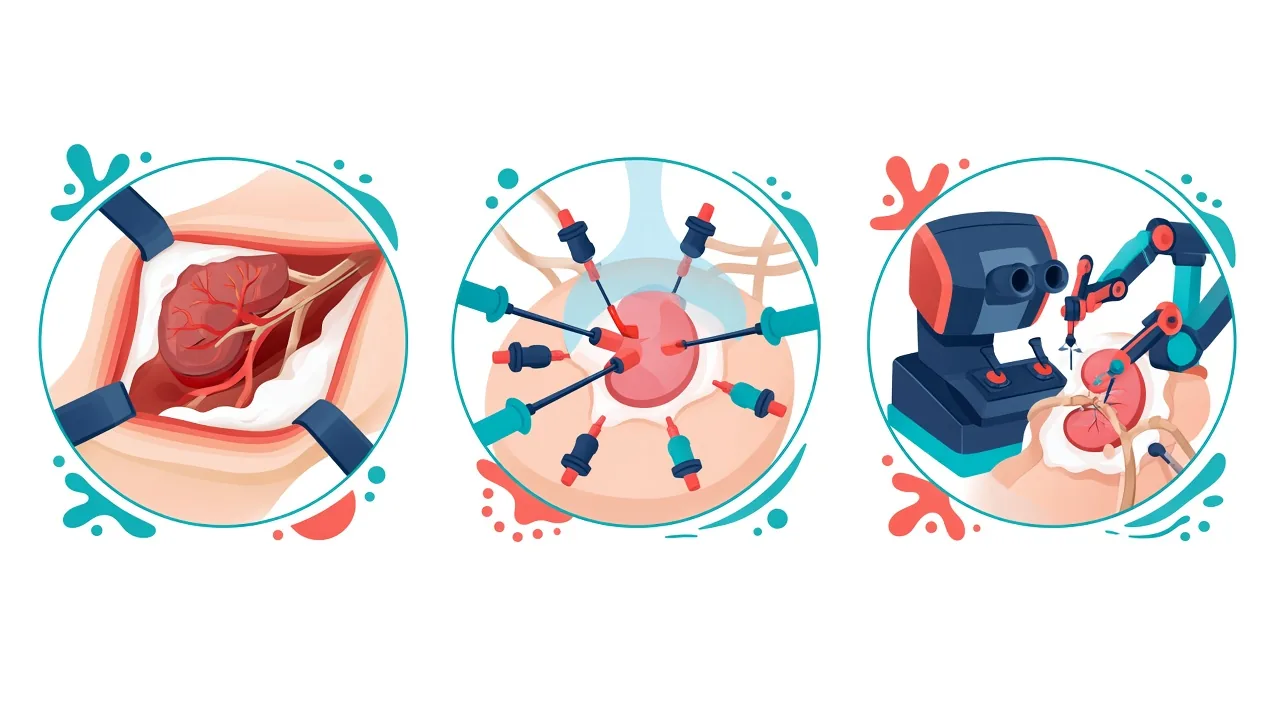
Open radical nephrectomy uses a larger incision. It remains important for very large tumours, locally advanced disease, major-vessel involvement, complex anatomy or cases that need vascular reconstruction.
Laparoscopic radical nephrectomy uses several small ports. Selected patients may have smaller incisions, less early discomfort and a shorter ward stay. Minimally invasive access is not automatically appropriate for every tumour.
Robot-assisted radical nephrectomy uses instruments the surgeon controls throughout. The robot does not operate independently. Enhanced visualization can help selected cases. The named approach still depends on tumour, previous operations, anatomy and experience.
How Is Radical Nephrectomy Performed?

- General anaesthesia. The patient is asleep throughout.
- Access. Open incision or minimally invasive ports.
- Identification. The kidney, fat and vessels are mapped.
- Vessel control. The renal artery and vein are controlled to limit blood loss.
- Removal. The kidney and tumour come out as one specimen.
- Additional tissue. Nodes, adrenal tissue or involved structures are removed only when indicated.
- Pathology. Type, size, grade, stage, margins and node status guide later care.
- Closure. The patient moves to postoperative monitoring.
A straightforward laparoscopic list is a different product from IVC thrombus surgery. A website promising a fixed short theatre time for every kidney is not an honest quotation.
Tests Before Surgery
Removing a kidney permanently reduces total renal reserve. Work-up commonly includes:
- Contrast CT or MRI for size, location, local extension and vessels
- Chest imaging and other staging when spread is possible
- Blood counts, creatinine, eGFR, electrolytes, liver tests, glucose
- Blood group and crossmatch when appropriate
- Urine testing
- ECG, chest and cardiac review when age or history require it
- Anaesthesia consultation
A kidney mass does not automatically need biopsy before surgery. Imaging is sometimes enough to proceed. Biopsy may help when a benign lesion is possible or when non-surgical treatment is being considered.
Adrenal Gland, Lymph Nodes and Tumour Thrombus
The adrenal gland is not automatically removed. It may come out when involvement is suspected or another clinical reason exists. Modern planning avoids unnecessary removal of normal structures.
Nearby nodes may be removed when they look enlarged or when staging needs that information. Routine extensive lymphadenectomy is not required for every patient. NCI notes that the benefit of lymphadenectomy is not established in every setting.
Tumour thrombus in the renal vein or IVC is a different, more complex list. It may need vascular control, reconstruction and, in selected levels, cardiac or vascular colleagues. That work belongs in a centre that already performs advanced renal-cancer surgery. It is not the same quotation as a straightforward laparoscopic radical nephrectomy.
Risks and Complications
Radical nephrectomy is major surgery. Possible risks include bleeding and transfusion, infection, clots, injury to nearby organs or vessels, anaesthesia complications, pneumonia, wound problems, bowel or urinary complications, incisional hernia, reduced kidney function, acute kidney injury, chronic kidney disease, cardiovascular events and, rarely, a return to theatre.
Cleveland Clinic lists bleeding, scarring, clots and a small risk of kidney failure in the remaining kidney among nephrectomy risks. Individual risk depends on health, complexity, baseline function and whether surrounding structures are involved.
Fever with shaking chills, heavy bleeding, chest pain, severe shortness of breath, sudden leg swelling, very low urine output or fainting belongs in a local emergency department.
Living With One Kidney
Many people live long, active lives with one healthy kidney. Johns Hopkins notes that most patients with two previously healthy kidneys do not reach end-stage kidney disease simply because one kidney was removed.
Long-term kidney health still matters. Teams typically watch blood pressure, creatinine, eGFR, urine protein or albumin, diabetes and cardiovascular risk. “One kidney” does not mean there are no precautions. The treating team writes those after function is known.
Recovery
Recovery varies. A minimally invasive list for a straightforward tumour is not the same recovery as open surgery for a large tumour with vascular work.
First few days. Pain control, walking, fluids, urine output, kidney function, wound checks, clot prevention and a gradual return to eating.
First few weeks. Walking and daily activity increase. Heavy lifting and strenuous exercise wait for surgical clearance.
Several weeks onward. Many patients return toward normal activity. Cleveland Clinic notes that many people reach fuller recovery in about 8–12 weeks.
GAF planning for stay is 4–8 nights. Desk work may resume after the surgeon's review. Physically demanding work usually waits longer. Do not book a return flight from an average number.
Radical Nephrectomy Cost in India
GAF Healthcare planning is $7,500–$18,000, typically 4–8 nights. US comparison is $30,000–$70,000. This is a preliminary planning range, not a fixed quotation. It depends on hospital, surgeon, open versus laparoscopic versus robotic access, tumour size, stage, vein involvement, ICU, room category, stay, pathology and whether partial nephrectomy is named instead.
A quotation should state whether the surgeon fee, anaesthesia, theatre, room, medicines, pathology and follow-up are inside the package. ICU, blood products, vascular or cardiac support, extra nights, hotel, flights, visa and later systemic therapy are usually separate.
City name is a weaker driver than tumour anatomy and the named list. Delhi NCR, Mumbai, Bengaluru, Chennai and Hyderabad are the live GAF catalog cities. Published Indian rupee listings vary widely by source and are not used as GAF quotations on this page.
International Patient Pathway
Before travel, share CT or MRI reports and DICOM files, creatinine and eGFR, a biopsy if one exists, chest imaging, the medication list and any previous abdominal surgery. A urologist then decides whether radical nephrectomy, partial nephrectomy, ablation, surveillance, systemic treatment or no India list is honest.
A useful planning framework is 4–8 nights in hospital and a longer total India stay for wound review, pathology discussion and travel clearance. Vein-thrombus lists take longer. The treating surgeon confirms fitness to fly.
- Send records.
- A uro-oncology team reviews whether radical nephrectomy is the named product.
- Approach, expected ICU need and pathology plan are written down.
- An itemized estimate is issued. GAF planning is $7,500–$18,000.
- Stable planned cases travel after that review. Acute bleeding, chest pain or anuria is a local emergency.
- Essential tests are repeated after arrival.
- The named nephrectomy is delivered.
- The patient leaves with pathology timing, kidney-function targets and who will follow them at home.
GAF Healthcare can coordinate records, hospital sharing, appointments, visa documentation, airport transfer, accommodation, interpreter support and follow-up messages. The treating surgeon remains responsible for diagnosis, procedure selection and medical care.
Diet, Exercise and Follow-Up
There is no single one-kidney diet. Advice depends on remaining function, blood pressure, diabetes, weight and cardiovascular risk. A balanced diet, less excess salt and caution with kidney-toxic medicines or supplements are common themes. A renal dietitian helps when function is reduced.
Walking is part of recovery. Heavy lifting waits for clearance. Once healed, many people return to regular activity.
Follow-up may include examination, kidney-function tests, blood pressure, urine tests, CT or MRI and chest imaging. The schedule depends on pathology and recurrence risk. Removal of the affected kidney does not end follow-up.
Conventional chemotherapy has a limited role in typical renal cell carcinoma. Selected higher-risk clear-cell cases may be offered adjuvant immunotherapy such as pembrolizumab. That decision is individualized.
Recurrence is possible. Risk depends on stage, grade, subtype, nodes, vascular invasion and margins. A structured surveillance plan is part of the product.
Questions to Ask Before Surgery
- Why does the entire kidney need to come out?
- Could partial nephrectomy be performed safely?
- What is the tumour size, location and stage?
- Is there vein or IVC involvement?
- Will the adrenal gland or lymph nodes be removed?
- Which approach do you recommend, and why?
- How will the remaining kidney be monitored?
- Will I need immunotherapy afterward?
- How long should I remain in India?
- What symptoms should send me to an emergency department?
Frequently Asked Questions
Is radical nephrectomy a major surgery? Yes. It is major abdominal or urological surgery. Complexity rises when vessels or surrounding structures are involved.
Is radical nephrectomy painful? Discomfort is expected. Anaesthesia and modern pain control help. Minimally invasive lists may hurt less early on for some patients.
Can radical nephrectomy cure kidney cancer? For selected localized cancers, surgery can be potentially curative. Prognosis still depends on stage and pathology.
Is radical nephrectomy better than partial nephrectomy? Neither is universally better. Partial nephrectomy preserves more kidney when it can achieve honest cancer control. Radical nephrectomy is named when the tumour is large, complex or cannot be safely spared.
Can it be performed robotically? Yes, in selected centres and patients. Open or conventional laparoscopic surgery may still be more appropriate.
Can a person live normally with one kidney? Many people can, if the remaining kidney is healthy. Long-term blood-pressure and function checks remain important.
How long does surgery take? It varies. A straightforward minimally invasive list is not the same as IVC thrombus surgery.
Is chemotherapy required afterward? Not routinely. Selected high-risk patients may receive postoperative immunotherapy.
Does radical nephrectomy always remove the adrenal gland? No. The adrenal gland is removed only when there is a clinical reason.
Are lymph nodes always removed? No. Node removal depends on imaging, tumour characteristics and the surgeon's assessment.
How much does radical nephrectomy cost in India? GAF Healthcare planning is $7,500–$18,000, typically 4–8 nights. US comparison is $30,000–$70,000.
Is radical nephrectomy available in Delhi NCR, Mumbai, Bengaluru, Chennai and Hyderabad? Yes. Those five cities are the live GAF catalog cities. The appropriate hospital depends on the named list, vessel experience, ICU and the written package.
Can international patients get radical nephrectomy in India? Yes, after records review, documentation and an appropriate travel plan.
When should I go to an emergency department? Heavy bleeding, chest pain, severe shortness of breath, very low urine output, high fever, sudden leg swelling or fainting belongs in a local emergency department.
Which city in India is right? There is no single preferred city. Delhi NCR, Mumbai, Bengaluru, Chennai and Hyderabad are live GAF catalog cities.
Key Takeaways
- Radical nephrectomy removes the entire affected kidney. It is not automatic for every kidney mass.
- Partial nephrectomy is preferred when a useful remnant can honestly be saved.
- Open, laparoscopic and robotic lists are different products. Vein-thrombus work is another list again.
- Many people live well with one healthy kidney. Function and blood pressure still need follow-up.
- GAF planning in India is $7,500–$18,000, typically 4–8 nights.
- A robotic console in the building is not a substitute for a named radical-nephrectomy list.
Why Choose GAF Healthcare for Radical Nephrectomy in India?
GAF Healthcare coordinates record review, a named nephrectomy list, an itemized estimate, admission support and follow-up planning. The first step is to establish whether radical nephrectomy is honest for this tumour, or whether partial nephrectomy, ablation, surveillance, systemic treatment or no India list should be named instead.
Share CT or MRI, creatinine, eGFR and the medication list for a case-specific assessment.
Planned questions can also go to WhatsApp at +91 90443 46292. Emergency symptoms still belong in a local emergency department.
Medical Disclaimer
This page provides general educational information about radical nephrectomy in India. It does not diagnose kidney cancer or determine whether whole-kidney removal is appropriate for an individual patient.
Treatment decisions should be made with a qualified urologist or uro-oncology team after reviewing imaging, kidney function, stage and overall health.
Published treatment costs are indicative and can change between hospitals, cities, surgical approaches and individual cases. A hospital's written quotation should be obtained before treatment or travel arrangements are finalized.
Treatment Process
- 1
Share records
The patient provides CT or MRI, creatinine, eGFR, chest imaging and the medication list before anyone books travel.
- 2
Uro-oncology review
A urologist reviews whether radical nephrectomy, partial nephrectomy, ablation, surveillance or systemic treatment is the honest product.
- 3
Name the product
The team writes radical nephrectomy only after size, location, vein status and remaining function are reviewed.
- 4
Itemized estimate
GAF radical-nephrectomy planning is $7,500–$18,000. Neighbouring partial nephrectomy is $7,000–$16,000 when a remnant can honestly be saved.
- 5
Travel if fit
Stable planned cases travel after records review. Acute bleeding, chest pain or anuria is a local emergency.
- 6
Repeat essential tests
The receiving unit confirms labs, imaging and fitness after arrival.
- 7
Deliver the named nephrectomy
Open, laparoscopic or robotic radical nephrectomy proceeds only after the list is named.
- 8
Kidney-function care
Urine output, creatinine and wound checks are watched before discharge.
- 9
Pathology and follow-up
The patient leaves with specimen timing, remaining-kidney targets and who will follow them after returning home.