Last updated: 10 September 2026 · Content curated by Dr. Shabnam Choudhary · Medically reviewed by Dr. Saffiyyah Chaudhary
Quick Answer
Cytoreductive surgery in Mumbai is planned against $10,000–$24,000 and 7–14 nights in hospital — the India catalog band, not a Mumbai-only tariff. Named CRS/HIPEC listings currently sit at Apollo Navi Mumbai and Wockhardt.
Budget extra for accommodation. A multi-week companion stay in Mumbai is typically the most expensive of the five listed cities.
- India cost range
- $10,000–$24,000
- Typical starting point
- $10,000
- Typical hospital stay
- 7–14 nights
- Procedure time
- typically 6–12 hours; longer when HIPEC is added
- Recovery
- Inpatient 7–14 nights for CRS as quoted. Longer when HIPEC is named. Varies by patient.
Major cost factors: crs alone versus crs + hipec, cancer type and peritoneal tumour burden, surgical complexity and organ resections, hipec drug and protocol, when used. International patients should also budget for accommodation, airport transfers, a medical visa, medicines and follow-up.
Often quoted separately: hipec drugs, circuit and extra hipec stay; staging imaging and biopsy; systemic therapy and radiation; extra icu, leak care, transfusion and re-operation; travel, accommodation and visa-related expenses.
Why request a cost through GAF rather than a hospital?
Writing to one campus gets you that campus’s package. A GAF request is reviewed against your records and returned as suitable doctor and hospital options with an indicative, itemised estimate. There is no obligation to book.
- Doctor review first. The number follows a reading of your imaging, test results and clinical records, not a brochure range.
- Hospital options. You can compare listed campuses before you travel, instead of starting over with each international desk.
- International-patient coordination. Visa letters, records routing and companion logistics sit with the same request.
Cytoreductive Surgery in Mumbai
Mumbai is the city families choose when they want a named CRS + HIPEC listing on this site and are willing to pay for that in traffic and in three weeks of hotel bills.
Named catalog consultants currently include Dr. Rajesh Shinde at Apollo Hospitals Navi Mumbai, Dr. Amit Chakraborty and Dr. Swapnil Sharma at Wockhardt, and Dr. Richa Ashok Bansal at Apollo Navi Mumbai for gynaecologic cytoreduction. That is a finite private shortlist across the harbour, not an infinite 'Mumbai HIPEC' directory.
The harbour split is the planning fact a stay of 7–14 nights punishes hardest. A Wockhardt letter and a Navi Mumbai apartment are not interchangeable. Ask which address is on the estimate before you rent.
If HIPEC is already named, compare against the dedicated CRS + HIPEC cost sheet. This family band is CRS as quoted.
Companion living costs over three weeks are typically the highest of the five listed cities. That does not change the surgical fee. It changes whether completing systemic therapy here is cheaper than flying home between stages.
Monsoon scheduling is a cost issue for leak-related readmission. If you can choose a date, avoid peak July unless the family will sit tight next to the hospital.
Mumbai rewards the family that rents next to the operating campus. It punishes the family that treats 'Mumbai hospitals' as interchangeable pins across the harbour.
After discharge, local trains are a poor plan for a companion after extensive cytoreduction. If the letter is Navi Mumbai, do not keep the family in Bandra because the restaurants look familiar.
What cytoreductive surgery typically costs in Mumbai
Letters still split on CRS versus HIPEC, tumour burden and named ICU nights. What inflates the trip is living cost across the harbour.
Navi Mumbai quotes should be read as Navi Mumbai logistics.
Monsoon slack is a real line for a leak week.
What moves the quote in Mumbai
- Short named HIPEC list
- Apollo Navi Mumbai and Wockhardt currently carry tagged names. Confirm who would operate and which sitting is planned.
- Mumbai versus Navi Mumbai
- Different campuses, different hotel markets. The estimate should name the operating address.
- CRS versus CRS + HIPEC
- Neighbouring GAF sheet when HIPEC is named.
- Three-week hotel inflation
- Companion living costs here are typically the highest of the five cities.
Medical travel through Mumbai
Most families land at CSMIA and transfer 45 to 90 minutes. Do not book same-week theatre after a long-haul flight into peak traffic.
Write the visa for 7–14 nights plus hotel recovery. Mention a possible extra week.
Harbour geography is the planning fact. A Wockhardt letter and a Navi Mumbai hotel are two cities for a 2 a.m. leak call.
Hospitals and units listed in Mumbai
Listed Mumbai campuses with named CRS/HIPEC tags include Apollo Hospitals Navi Mumbai and Wockhardt Hospital. Accreditation is on each profile as published.
Ask whether the ICU has managed leaks after extensive cytoreduction and whether HIPEC is actually run that week. Listing is not a claim of volume.
Doctor cards below are Mumbai-filtered. They are not a ranking.
Cytoreductive Surgery doctors in Mumbai · Cytoreductive Surgery hospitals in Mumbai · Cytoreductive Surgery cost in India
What is cytoreductive surgery?
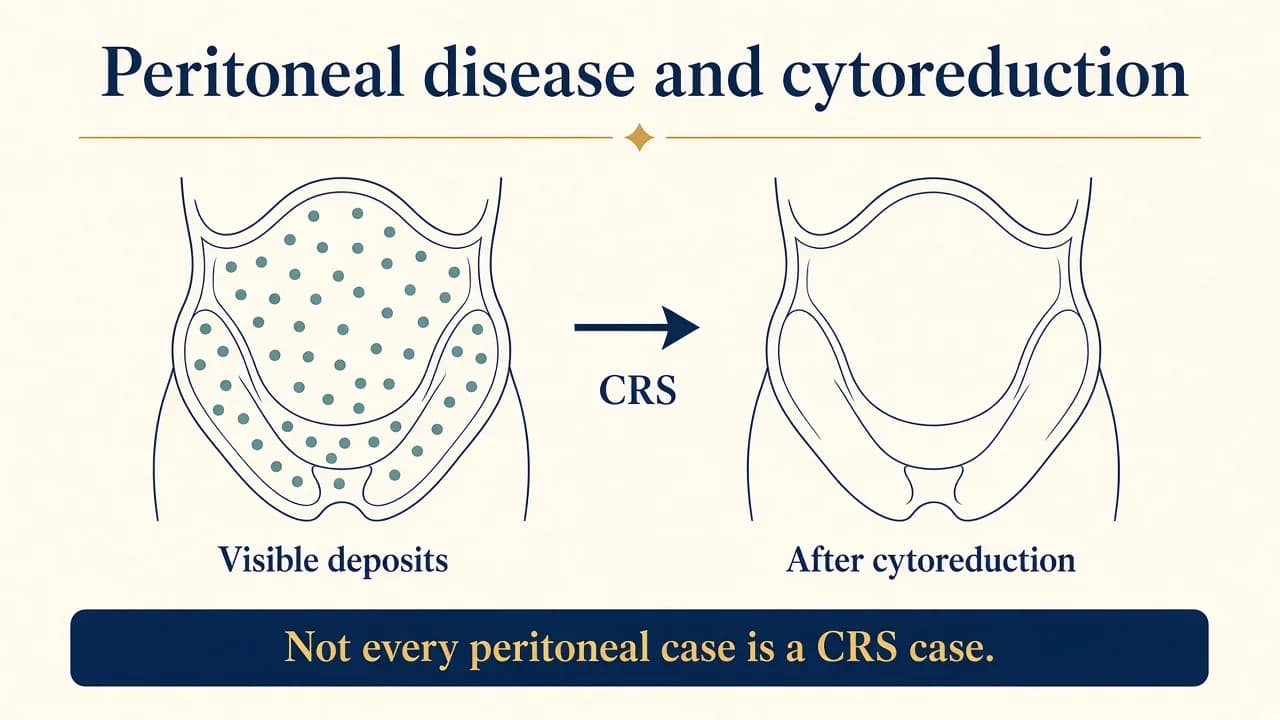
Cytoreductive surgery, often called CRS, is an extensive operation intended to remove visible tumour deposits from the peritoneal cavity in appropriately selected patients. Completeness of cytoreduction — how little visible disease is left — matters more than the length of the incision.
It is not appropriate for every patient with peritoneal cancer. Selection depends on cancer type, distribution, whether a meaningful clearance looks possible, overall health and a multidisciplinary review. GAF Healthcare does not decide eligibility on this page.
Who may be a candidate for cytoreductive surgery?
Eligibility depends on cancer type, extent and distribution of peritoneal disease, ability to achieve meaningful cytoreduction, organ function, previous treatment, disease outside the peritoneal cavity, and fitness for a long sitting and a stay of 7–14 nights. Extra-abdominal metastases often mean a different conversation.
This page does not diagnose and does not recommend CRS, HIPEC, PIPAC or non-operative care for an individual.
How the operation is performed, recovery and variations →
Cytoreductive Surgery cost in India
There is no single CRS price in India, because there is no single peritoneal sitting. The $10,000–$24,000 band is a planning range for cytoreductive surgery as quoted — theatre, anaesthesia, the named surgeon, quoted room and nights, routine inpatient drugs, ICU as written, and histopathology. Limited cytoreduction at a mid-tier campus sits toward the lower end. A complete clearance with several organ resections at a flagship campus sits toward the upper end — still without assuming HIPEC.
CRS + HIPEC is a neighbouring catalog sitting with a different planning range and a longer typical stay. Do not treat this family band as a HIPEC package. Surgery cost is not total cancer treatment cost. Staging, systemic therapy and later surveillance sit on neighbouring estimates.
What moves the number most is CRS alone versus CRS + HIPEC, peritoneal tumour burden, organ resections, named ICU nights, campus tier and the named consultant. International patients should budget the weeks around the knife — not only the theatre block.
Cytoreductive Surgery cost breakdown in India
Component prices are rarely published as a public tariff. The lines below describe what typically sits inside a surgical estimate, not a dollar amount for each row.
- Surgeon fee and surgical team
- Usually bundled for the named surgical oncologist. Confirm who is in theatre and whether a gynaecologic oncologist is billed separately on an ovarian case.
- Hospital and operating-room charges
- Theatre time for a six-to-twelve-hour sitting. HIPEC hardware and drugs, when used, belong on the HIPEC letter unless this estimate names them.
- Anaesthesia
- Anaesthetist fee and drugs for a long case. Cardiopulmonary clearance may be billed outside.
- ICU and critical-care monitoring
- Early high-dependency care is common after extensive cytoreduction. Nights inside the quoted stay may be bundled; extra days after a leak or sepsis are typically extra.
- HIPEC drugs and circuit
- May be included only if the letter is CRS + HIPEC. On this CRS sheet they are typically additional or sit on the neighbouring HIPEC estimate.
- Pathology
- Processing of specimens and margins. Molecular assays, when ordered, are often billed later.
- Room charges and nursing
- Written against a room category and nights — typically 7–14 nights for CRS as quoted.
Planning range or quotation?
The $10,000–$24,000 figure is an indicative planning range. A final hospital quotation is itemised, issued after a consultant reviews your records, and still subject to what is found clinically.
Get a Personalized Cost Estimate
What is usually included in a Cytoreductive Surgery package?
No two hospitals draw the line in the same place, so read an estimate for what it excludes as carefully as for what it covers. The pattern below is what listed campuses typically bundle into a surgical estimate for this procedure. Anything not written into your estimate should be assumed to be extra until the hospital confirms otherwise.
Usually included
Usually included
Consultation that leads into the admission
The in-person pre-operative review with the named surgeon, where bundled.
Usually included
Surgery by the named consultant
Cytoreduction as written on the estimate — not an unnamed HIPEC sitting unless the letter says so.
Usually included
Anaesthesia and operating room
Anaesthesia team, theatre time, standard consumables and recovery for the scheduled CRS case.
Usually included
Hospital stay as quoted
Bed charges, nursing and routine ward care for the room and nights written — typically 7–14 nights, including ICU if named.
Usually included
Routine tests and specimen pathology
Standard bloods, coagulation, ECG and histopathology where bundled.
Usually included
Medicines during admission
Analgesia, antibiotics and routine drugs during the quoted stay. HIPEC agents only if named.
May be charged separately
May be separate
HIPEC drugs, circuit and extra HIPEC stay
Belong on the CRS + HIPEC letter unless this estimate names them.
May be separate
Staging imaging and biopsy
CT, MRI, PET-CT, laparoscopy for staging and biopsy are frequently extra when ordered in India.
May be separate
Systemic therapy and radiation
Chemotherapy, targeted therapy, immunotherapy and radiotherapy are neighbouring quotes.
May be separate
Extra ICU, leak care, transfusion and re-operation
Nights and theatre beyond the quoted stay are typically a new event.
May be separate
Travel, accommodation and visa-related expenses
Flights, hotel after discharge, local transport and companion living costs sit outside every hospital estimate.
Catalog inclusions listed for this pathway: surgical oncology consultation and records review; named surgeon on camera before travel; theatre, anaesthesia and inpatient stay as quoted; histopathology of the specimen; discharge summary to your home oncologist.
What can increase the cost?
These are the drivers that actually move a bill for this operation, in rough order of how often they do it. Most of them are clinical decisions rather than commercial ones, which is why an honest estimate is written after a records review rather than before it.
- CRS alone versus CRS + HIPEC
- HIPEC drugs, circuit time and a longer stay sit on a neighbouring GAF sheet. Ask which sitting the letter names.
- Cancer type and peritoneal tumour burden
- Colorectal, appendiceal, ovarian and gastric peritoneal disease are planned differently. Extent and distribution change theatre time.
- Surgical complexity and organ resections
- Bowel, spleen, gallbladder or peritoneal stripping lengthen the sitting. Ask what the letter assumes.
- HIPEC drug and protocol, when used
- Agent, duration and temperature are a clinical protocol, not a brochure upgrade. Price them only if HIPEC is named.
- Surgeon, hospital and campus tier
- The estimate should name the consultant and the operating address.
- City and companion logistics
- Surgical fees cluster more tightly across the five metros than hotel bills for two to four weeks.
- ICU, length of stay and complications
- Packages are written for 7–14 nights. Extra nights after leak, ileus or infection are usually billed fresh.
- Pathology and additional cancer treatment
- Specimen processing may be bundled. Systemic chemotherapy, radiation and molecular tests are neighbouring quotes unless named.
CRS versus CRS + HIPEC versus PIPAC
These rows are different sittings, not upgrades of the same product. This sheet is cytoreductive surgery. Dedicated catalog sheets exist when HIPEC or PIPAC is named. None is universally better, and none is appropriate for every peritoneal case.
Selection depends on cancer type, peritoneal distribution, whether a complete cytoreduction looks plausible, and the operating team's assessment. This page does not recommend CRS, HIPEC or PIPAC for an individual.
Swipe to compare surgical approaches →
| Approach | Relative complexity | GAF planning range | Notes |
|---|---|---|---|
| Cytoreductive surgery (CRS) | Removal of visible peritoneal deposits, with organ resection where required | $10,000–$24,000Catalog planning range | This sheet's planning range applies when the letter is CRS as quoted, without assuming HIPEC. |
| CRS + HIPEC | Cytoreduction plus heated intraperitoneal chemotherapy in selected cases | $18,000–$40,000Catalog planning range | Different stay, different drugs, different letter. Neighbouring GAF sheet — not bundled into this band. |
| PIPAC | Laparoscopy-based pressurised aerosol chemotherapy in selected peritoneal disease | $7,000–$16,000Catalog planning range | Often a sequence of shorter stays rather than one mega-operation. Neighbouring catalog sheet. |
Planning ranges appear only where GAF Healthcare already publishes a cost sheet for that operation. Other rows describe relative clinical complexity and should not be read as prices.
What is CRS with HIPEC?
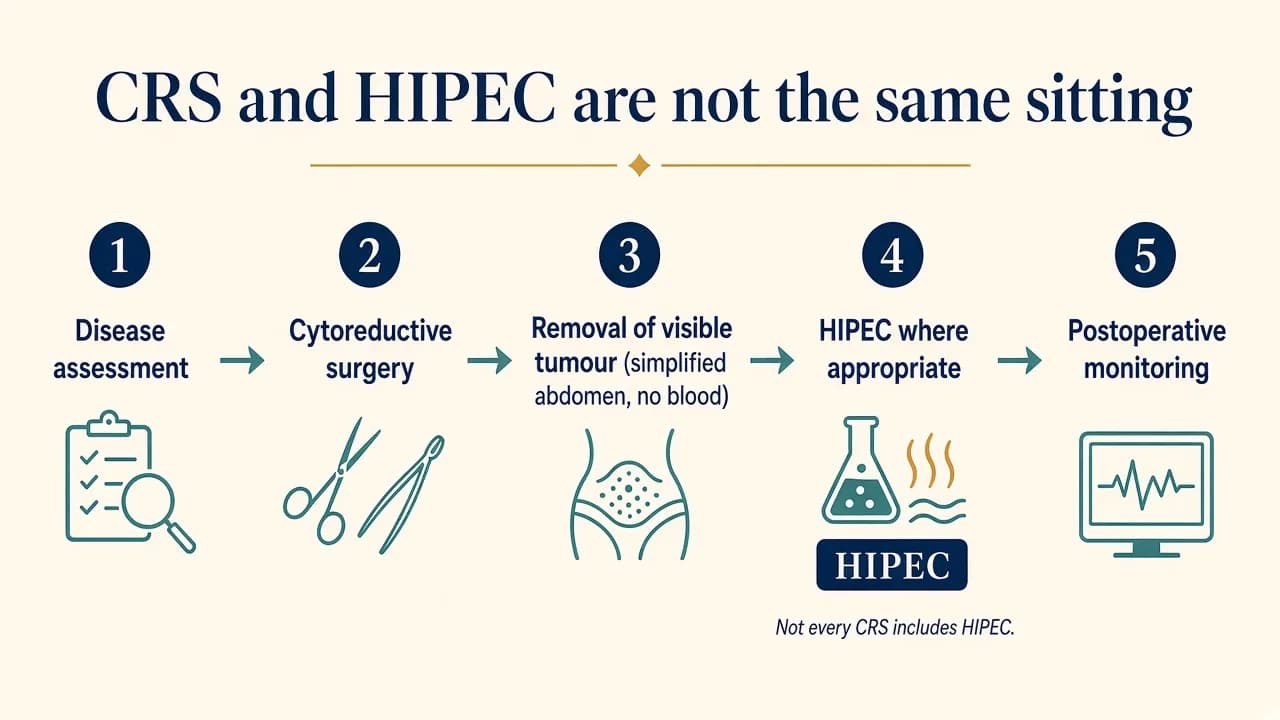
CRS is cytoreductive surgery. HIPEC is hyperthermic intraperitoneal chemotherapy — heated chemotherapy circulated through the abdomen after visible deposits have been removed, in selected patients. The usual sequence is assessment, cytoreduction, then HIPEC if the treating team judges it appropriate, then closure and high-dependency monitoring.
Not every CRS includes HIPEC. Not every peritoneal case is a HIPEC case. Drug, duration and temperature are a protocol, not a menu upgrade. Use the neighbouring Cytoreductive Surgery with HIPEC cost sheet when HIPEC is already named.
Which cancers may be treated with cytoreductive surgery?
CRS may be discussed for selected colorectal peritoneal metastases, selected appendiceal cancers, pseudomyxoma peritonei, selected ovarian cancers, selected gastric cancers, and other carefully chosen abdominal or pelvic malignancies. It is not standard for every patient with these diagnoses.
Neighbouring GAF sheets exist for colectomy, rectal cancer surgery, gastrectomy and ovarian cancer cytoreductive surgery when those sittings are the billed episode. This page does not decide eligibility.
How does peritoneal disease affect treatment planning?
Distribution and tumour burden matter as much as the primary diagnosis. Specialists look at imaging, and often at a Peritoneal Cancer Index (PCI) — a map of how much disease sits in each abdominal region — plus whether a complete cytoreduction looks plausible, whether small bowel is extensively involved, and whether disease sits outside the abdomen.
PCI is a planning tool, not a price list. This page does not calculate a score for a named patient.
How does HIPEC work during cytoreductive surgery?
When HIPEC is part of the plan, heated chemotherapy is circulated through the peritoneal cavity after cytoreduction, then drained, before closure. It is used in selected patients to treat microscopic residual disease. It is not universally superior, and it does not guarantee cancer control.
If HIPEC is not named on the letter, do not assume the drugs or the extra stay are included.
Cytoreductive Surgery cost: India vs other medical tourism destinations
The table below is a planning comparison for cytoreductive surgery as a surgical episode. India and United States figures come from the GAF Healthcare catalog. Other markets are modelled from the India midpoint using relative private-care cost levels, and are labelled as indicative planning estimates — not hospital quotations. CRS and CRS + HIPEC are not priced as the same sitting in every country.
Swipe to compare destinations →
| Country | Approximate cost | Relative cost position | Important cost considerations |
|---|---|---|---|
| India | $10,000–$24,000 | Baseline | Catalog CRS planning range. Named CRS and HIPEC listings can be met on camera. Listed consultants currently sit in Delhi NCR, Mumbai, Chennai and Hyderabad; Bengaluru is matched after records review. HIPEC has a dedicated sheet. |
| Turkey | $17,000–$30,500Indicative planning estimate* | ≈1.4× India | Packaged medical-travel market. Verify whether the sitting is CRS or CRS + HIPEC, and whether ICU nights are inside the bundle. |
| Thailand | $20,500–$37,500Indicative planning estimate* | ≈1.7× India | Private-hospital tourism. Established international desks; complete cytoreduction with HIPEC can sit well above India. |
| United Arab Emirates | $34,000–$58,000Indicative planning estimate* | ≈2.7× India | Regional premium private care. Short flights from much of Africa and West Asia; private CRS pricing is closer to Western self-pay. |
| Singapore | $44,000–$75,000Indicative planning estimate* | ≈3.5× India | High-cost private hub. Mature multidisciplinary process at premium private tariffs. |
| Germany | $37,500–$71,500Indicative planning estimate* | ≈3.2× India | Certified European peritoneal units. Structured MDT process; self-pay deposits are typical for visitors. |
| United Kingdom | $30,500–$58,000Indicative planning estimate* | ≈2.6× India | Private self-pay (NHS generally not for visitors). NHS care is not available to most overseas visitors. Private self-pay applies. |
| United States | $40,000–$100,000 | ≈4.1× India | Highest self-pay outlier. Facility, surgeon, ICU, HIPEC drugs and later oncology bills often arrive separately. |
*Figures other than India and the United States are modelled planning estimates scaled from the India catalog band, not hospital quotations. International treatment costs vary by hospital, surgeon, cancer type, peritoneal tumour burden, whether HIPEC is performed, HIPEC protocol, length of stay, ICU requirements, oncology treatment and what is included in the package. These figures are intended for preliminary comparison only and are not final quotations. Figures other than India and the United States are modelled planning estimates.
The point of this table is not that one country is better. Cost level and treatment-market structure are different things. Compare the named hospital, multidisciplinary support, included care and follow-up pathway as carefully as the headline figure.
Which destination is right for you?
Use this only as a reading guide for the table above. It is not a medical recommendation, and it does not rank countries.
Looking for the lowest overall treatment cost?
IndiaLooking for premium private hospital infrastructure?
Singapore / UAELooking for proximity from the Middle East?
UAE / India / TurkeyLooking for established European oncology systems?
Germany / UK
Why do international patients consider India for cytoreductive surgery?
International patients consider India for cytoreductive surgery when they are self-funding a peritoneal sitting and need the letter to say CRS or CRS + HIPEC before they compare prices. The catalog range $10,000–$24,000 sits well below typical US cash-pay of $40,000–$100,000 because theatre and ward time are priced on a different cost base — not because the operation is a lesser product by definition.
None of that is a claim of 'best HIPEC surgeons in the world', guaranteed clearance or 'cheapest in the world'. Someone whose insurance covers the pathway at home, or whose staging shows complete cytoreduction is not honest, may be better treated locally.
CRS & HIPEC Hospitals in Mumbai
Campuses on GAF Healthcare where this surgical-oncology pathway is listed, with accreditation as published by the hospital. Listing is not a claim of CRS or HIPEC volume or a ranking. Choose on the surgeon you met on camera and whether the house runs peritoneal lists — not on a brand slogan.
Apollo Hospitals, Navi Mumbai
 JCI Accredited
 NABH Accredited
- Radiation Oncology
- Surgical Oncology
- Medical Oncology
- Hematology
2 listed doctors for this pathway
Languages listed: English, Hindi, Marathi
Wockhardt Hospital, Mumbai
- JCI Accredited
- NABH Accredited
- Radiation Oncology
- Surgical Oncology
- Medical Oncology
- Hematology
2 listed doctors for this pathway
Languages listed: English, Hindi, Marathi
Medicover Hospital, Navi Mumbai
- JCI Accredited
- NABH Accredited
- Radiation Oncology
- Surgical Oncology
- Medical Oncology
- Hematology
Consultant match on request
Languages listed: English, Hindi, Marathi
Gleneagles Hospital, Mumbai
- JCI Accredited
- NABH Accredited
 NABL Accredited
- Radiation Oncology
- Surgical Oncology
- Medical Oncology
- Hematology
Consultant match on request
Languages listed: English, Hindi, Marathi
KIMS Hospitals, Thane
- JCI Accredited
- NABH Accredited
- NABL Accredited
- Radiation Oncology
- Surgical Oncology
- Medical Oncology
- Hematology
Consultant match on request
Languages listed: English, Hindi, Marathi
Cytoreductive Surgery hospitals in Mumbai · Talk to a treatment coordinator
Cytoreductive Surgery & HIPEC Specialists in Mumbai
These are consultants listed on GAF Healthcare whose catalog procedures include cytoreductive surgery or CRS + HIPEC. Profiles show training, campus and procedures as held in the catalog. There are no rankings here. Named listings currently sit in Delhi NCR, Mumbai, Chennai and Hyderabad; Bengaluru is matched after records review.

Dr. Amit Chakraborty
Surgical Oncology
12+ Years Experience
Mastectomy · Breast-Conserving Surgery · Breast Biopsy
English, Hindi, Marathi
Dr. Rajesh Shinde
Surgical Oncology
15+ Years Experience
Colorectal Cancer Surgery — specialized f… · Total Mesorectal Excision — advanced rect… · Gastric Cancer Surgery— comprehensive sur…
English, Hindi, Marathi
Dr. Richa Ashok Bansal
Surgical Oncology
10+ Years Experience
Cervical Cancer Surgery · Ovarian Cancer Surgery · Ovarian Cancer Debulking Surgery
English, Hindi, Marathi
Dr. Swapnil Sharma
Surgical Gastroenterology
15+ years Experience
Liver Transplant · Liver Tumor Surgery · Pancreatectomy (Pancreas Removal Surgery)
English, Hindi, Marathi
Cytoreductive Surgery doctors in Mumbai (4 listed) · Get a personalized cost estimate
Cytoreductive Surgery cost by city in India
City names below are working filter URLs. Open Delhi NCR, Mumbai, Bengaluru, Chennai or Hyderabad for the city overlay and the filtered doctor and hospital cards.
We do not invent a different CRS tariff for each metro. The approximate cost column uses the India planning band of $10,000–$24,000 unless a researched city figure exists. What changes is the named consultant list and how expensive a multi-week companion stay feels.
Swipe to compare Indian cities →
Delhi NCR
$10,000–$24,000
India planning band — not a city quote
Typical stay 7–14 nights
Ask which NCR campus the letter is written against, whether it is CRS or CRS + HIPEC, which organ resections are assumed, and how many high-dependency nights are named. Campus tier inside NCR moves the letter more than the city label.
15 hospitals · 15 doctors
Mumbai
$10,000–$24,000
India planning band — not a city quote
Typical stay 7–14 nights
Surgical estimates sit on the national band. The Mumbai-specific extra is usually three weeks of hotel and the harbour commute — among the highest companion costs of the five cities.
5 hospitals · 4 doctors
Bengaluru
$10,000–$24,000
India planning band — not a city quote
Typical stay 7–14 nights
Serviced apartments near the southern campuses often undercut Mumbai or Gurugram hotel rates over a three-week recovery. That only helps if the matched campus actually runs CRS that week.
3 hospitals · consultant match on request
Chennai
$10,000–$24,000
India planning band — not a city quote
Typical stay 7–14 nights
Ask whether the international desk handles visa extensions in-house. Systemic chemotherapy plus CRS plus an extra week often outlasts a short visa window. Proton radiation, if discussed, is a neighbouring quote.
5 hospitals · 6 doctors
Hyderabad
$10,000–$24,000
India planning band — not a city quote
Typical stay 7–14 nights
Extended-stay accommodation is generally more affordable than in Mumbai or NCR. That often changes the total trip more than any difference in surgical fee — after you know which of the two named campuses is operating.
6 hospitals · 2 doctors
Costs vary considerably by hospital, specialist, clinical complexity, insurance, room or day-care category, and what is included in the package.
Choosing a city for cytoreductive surgery
Patients usually pick the treating team first and the city second. The city still affects daily travel, accommodation, companion arrangements and access to follow-up. Here is what genuinely differs between the five cities we list.
What should international patients budget beyond the surgery?
Surgery cost is not total trip cost and is not total cancer treatment cost. Staging, HIPEC if added, systemic therapy, extra ICU, hotel, flights and a companion who can stay are the rest of the budget.
Add your own numbers: CRS as quoted + HIPEC if named + quoted stay + staging tests + oncology if in India + flights + visa + hotel nights × rate + attendant costs + contingency for extra nights. Do not invent a total from this page.
- Staging and peritoneal assessment
- CT, MRI or PET-CT where indicated; sometimes a staging laparoscopy. Often extra if done in India.
- The CRS sitting
- Cytoreduction, anaesthesia, ICU as quoted, 7–14 nights and pathology. This is the $10,000–$24,000 line when the letter matches that scope.
- HIPEC, if used
- Neighbouring cost sheet. Different stay.
- Systemic therapy
- Before or after surgery in selected patients. Neighbouring quotes.
- Flights, visa and hotel after discharge
- Patient and attendant. Visa issuance is not guaranteed. Write duration for 7–14 nights plus hotel recovery.
- Treatment episode$10,000–$24,000
- Pre-operative testsOften inside the estimate — confirm
- Hospital stay7–14 nights typically bundled
- Additional procedures or extended careQuoted separately if advised
- Accommodation for companionVaries by city and length of stay
- Local transportationAirport and daily hospital transfers
- FlightsDepends on origin
- Medical visaFee set by the issuing consulate
Planning estimate — not a hospital quotation.
Get a Personalized Treatment Estimate
What does medical travel for cytoreductive surgery in India involve?
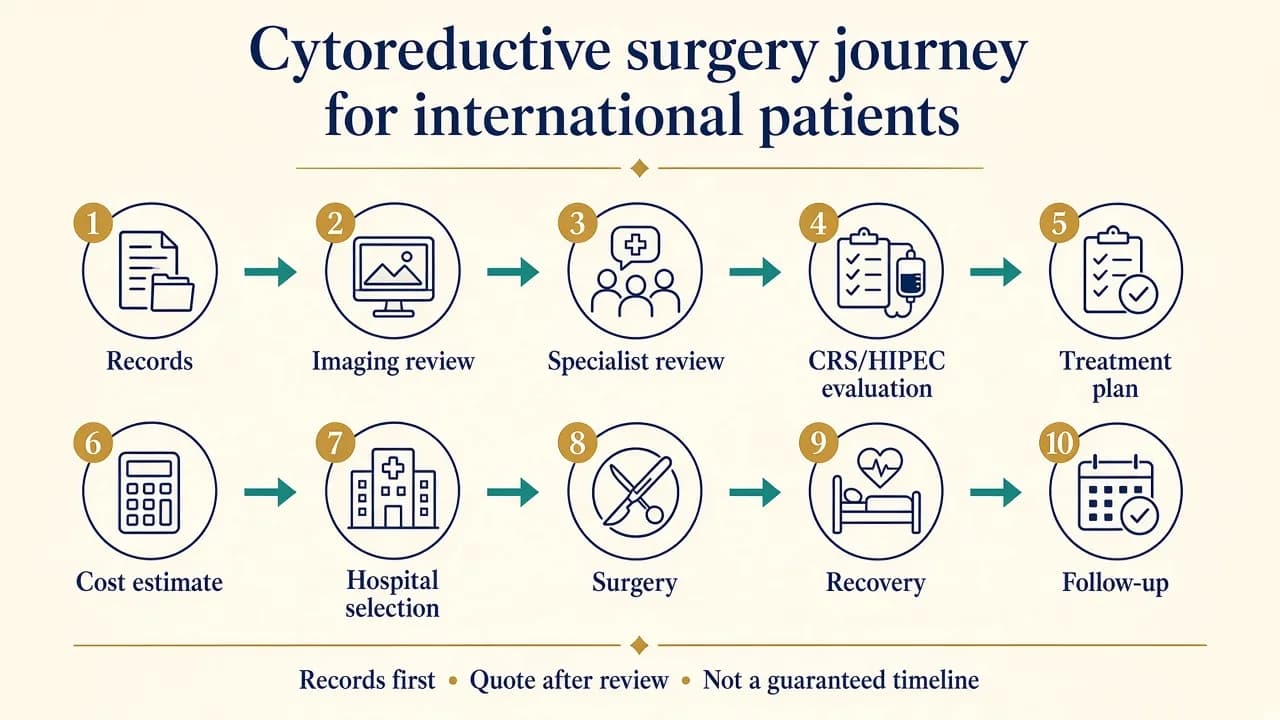
The sequence below is how a records-first pathway normally runs. The order matters: everything before arrival exists so that you are not making decisions in an unfamiliar hospital corridor with a suitcase beside you.
Submit medical records
CT or MRI, pathology, chemotherapy dates, prior operative notes.
Imaging and specialist review
A surgeon who performs CRS reads the films and says whether CRS, CRS + HIPEC, PIPAC or a non-operative path is honest.
Peritoneal disease and suitability review
Distribution, PCI where used, extra-abdominal disease and fitness are checked before a date is offered.
Plan, estimate and hospital selection
An itemised letter that names CRS or CRS + HIPEC. Compare the surgeon you met and leak-aware ICU.
Travel, admission and surgery
Visa issuance is not guaranteed. Theatre time follows tumour burden and whether HIPEC is added.
Recovery, pathology and return
Fly when the named surgeon is content. Extra nights are a clinical decision, not a package failure.
Documents to prepare
- Recent CT or MRI of the abdomen and pelvis, plus PET-CT if already done
- Pathology of the primary tumour or peritoneal biopsy if taken
- Chemotherapy summary if treatment has started
- Prior abdominal operative notes
- Blood count, coagulation, kidney and liver function
- Cardiac and pulmonary test results, if available
- Current medication list and allergies
- Passport, and a hospital invitation letter for the medical visa application
Clinical detail
How the operation is performed
Anaesthesia is general. The abdomen is assessed. Visible peritoneal deposits are removed. Organs may be resected where clinically necessary. Reconstruction follows. HIPEC is added only if it is part of the written plan. You wake in high-dependency or ICU care. Pathology feeds the next oncology conversation. This page does not describe graphic operative detail.
Main variations
- CRS without HIPEC
- Cytoreduction as the billed sitting. This sheet.
- CRS + HIPEC
- Neighbouring catalog sheet. Different drugs, stay and quotation.
- PIPAC
- Selected peritoneal disease as a laparoscopy-based sequence. Neighbouring sheet.
- Ovarian cytoreduction
- May be primary or interval after chemotherapy. Neighbouring gynaecologic sheet when that is the billed episode.
Preparation
Expect bloods, coagulation, CT and anaesthetic assessment. MRI, PET-CT, staging laparoscopy and biopsy are used where they change the plan.
Bring prior chemotherapy dates, operative notes if you have already had abdominal surgery, and a current medicine list. Do not book same-week theatre after a long-haul landing.
Hospital stay and recovery
Hospital stay for CRS as quoted is typically 7–14 nights. CRS + HIPEC often sits longer on its own sheet. Early days watch drains, nutrition, mobility and infection. This page does not set a diet or a discharge date.
Infection, bleeding, bowel leak or ileus, fluid collections, nutritional problems, clots and respiratory complications can extend stay. Risk varies with tumour burden, organs resected and fitness. Individual percentages are not published here.
Pathology review decides further oncology. International patients often need further hotel days before a long-haul flight.
How to compare Cytoreductive Surgery quotes from Indian hospitals
Print these and work through them on the video call. A house that answers without hedging is telling you something useful about how it will behave when something goes wrong.
- Is this letter CRS alone or CRS + HIPEC?
- Is the person on this call the person in theatre?
- Are HIPEC drugs and circuit included?
- Which organ resections does the letter assume?
- How many ICU nights are included, and what happens if I need more?
- Are CT, PET-CT, staging laparoscopy and biopsy included?
- Is pathology included? Molecular tests?
- Is systemic chemotherapy included?
- What happens if a leak, ileus or extra hospitalization occurs?
Why your final Cytoreductive Surgery cost may be different
The figure on this page is a CRS planning range. The figure on a hospital letter is an estimate written against a named sitting — CRS or CRS + HIPEC — and a stated tumour burden. Those two documents are not supposed to match to the dollar.
Cytoreductive surgery can describe operations of very different complexity. Cost may change because of cancer type, PCI or tumour burden, organ resections, HIPEC, ICU, extra nights and oncology.
If two hospitals quote different numbers, read whether they are pricing the same sitting. Higher cost is not a measure of better treatment.
Frequently asked questions
How much does cytoreductive surgery cost in Mumbai?
Plan against $10,000–$24,000 for CRS as quoted and stay of 7–14 nights. Mumbai does not have a separate verified city tariff.
Which doctors in Mumbai are listed for CRS/HIPEC?
Named catalog listings currently sit at Apollo Navi Mumbai and Wockhardt. Meet the person who would operate.
Is Navi Mumbai the same as Mumbai for this stay?
No. Different campuses and hotel markets. The letter should name the operating address.
Should we use the HIPEC page?
If the written plan includes HIPEC, yes. This page is CRS as quoted.
How long should we stay in Mumbai?
Hospital stay is typically 7–14 nights for CRS as quoted. Plan further hotel days until the named surgeon is content you can fly.
What is the cost of cytoreductive surgery in India?
Plan against $10,000–$24,000 for CRS as quoted, anaesthesia, stay of 7–14 nights and specimen pathology. Typical US self-pay is $40,000–$100,000. HIPEC is a neighbouring sheet when named. The final figure is an itemised hospital estimate after records review, not this planning band.
What is cytoreductive surgery?
An extensive operation intended to remove visible peritoneal tumour deposits in selected patients. It is not appropriate for every peritoneal cancer. Completeness of clearance matters more than incision length. A treating team decides whether a meaningful cytoreduction looks possible before a date is offered.
What does CRS mean?
CRS means cytoreductive surgery — the same family of operations as this sheet. The letters describe removal of visible peritoneal disease, not a standard package. CRS is not automatically CRS + HIPEC; those are different letters, different stays and different cost sheets.
What is HIPEC?
HIPEC is hyperthermic intraperitoneal chemotherapy: heated chemotherapy circulated through the abdomen after cytoreduction in selected patients. It is not universally used, is not a menu upgrade, and does not guarantee cancer control. Drug, duration and temperature are a clinical protocol.
Is CRS the same as CRS + HIPEC?
No. HIPEC adds drugs, circuit time and typically a longer stay. Neighbouring GAF sheet: Cytoreductive Surgery with HIPEC. Do not compare a CRS letter with a HIPEC letter as if they were the same sitting. Ask which one the estimate names before you travel.
Which cancers may be treated with CRS and HIPEC?
Selected colorectal, appendiceal, ovarian and gastric peritoneal disease, and selected pseudomyxoma peritonei, among others. Not every patient with those diagnoses is eligible. Distribution, tumour burden and fitness matter as much as the primary name on the pathology report. This page does not assign a diagnosis.
Who may be considered for CRS/HIPEC?
Patients whose treating team judges that a meaningful cytoreduction looks possible, with acceptable fitness and without unresectable extra-abdominal disease. Selection is multidisciplinary. Extra-abdominal metastases often mean a different conversation. This page does not decide eligibility for a named patient.
How is cytoreductive surgery performed?
Under general anaesthesia the abdomen is assessed, visible peritoneal deposits are removed, and organs may be resected where necessary. HIPEC is added only if the written plan names it. You wake in high-dependency or ICU care. This page does not describe graphic operative detail.
How long does cytoreductive surgery take?
Typically about six to twelve hours, longer when HIPEC is added. Tumour burden and organ resections change theatre time. A limited cytoreduction can be shorter; a complete clearance with several organs is longer. This page does not promise duration for a named patient.
How long is the hospital stay?
Typically 7–14 nights for CRS as quoted on this sheet. CRS + HIPEC often sits longer on its own sheet. Leaks, ileus or infection extend that. International patients should add hotel days after discharge. This page does not promise a discharge date.
Is HIPEC included in the surgical cost?
Not on this CRS sheet unless the letter names it. Ask whether the quotation is CRS or CRS + HIPEC, and whether the HIPEC drug and circuit are inside. Extra stay after HIPEC is often a different line. Do not assume the neighbouring sheet is bundled here.
What is included in a CRS/HIPEC quotation?
A typical CRS estimate covers the named surgeon, anaesthesia, theatre, quoted nights, routine inpatient medicines and pathology. HIPEC drugs only if named. Confirm organ resections, extra ICU, imaging and what happens if hospitalization runs longer than written. Anything not on the letter is extra until confirmed.
What costs may be additional?
Often: HIPEC if not named, CT or PET-CT, biopsy, molecular tests, systemic chemotherapy, radiation, extra ICU, leak management, transfusion, rehabilitation, hotel, flights, visa-related expenses and attendant living costs. Surgery cost is not total trip cost and is not total cancer treatment cost.
How do I choose a CRS/HIPEC surgeon?
Use listed consultants whose catalog procedures include cytoreductive surgery or CRS + HIPEC, and insist on speaking to the person who would operate. Ask about peritoneal burden and whether HIPEC is actually planned. Placement on this page is not a league table.
How do I choose a hospital?
Choose on the named surgeon, whether the campus actually runs peritoneal lists that week, leak-aware ICU, and the address on the letter. Accreditation on a profile is as published by the hospital. Listing is not a ranking or a volume claim.
Can international patients send records before travelling?
Yes. Submit recent CT or MRI, pathology, chemotherapy dates and prior operative notes so a listed CRS or HIPEC surgeon can say whether CRS, CRS + HIPEC, PIPAC or a non-operative path is honest before you fly. Visa issuance is not guaranteed by that review.
How long should international patients plan to stay in India?
Plan the inpatient 7–14 nights plus further hotel days until the named surgeon is content you can fly. HIPEC and slow gut recovery lengthen that. Write the visa letter for a possible extra week rather than the shortest quoted stay. Visa issuance itself is not guaranteed.
Dr. Shabnam Choudhary, BDS, is a dental professional who graduated from Al-Ameen Medical College, Bijapur, Karnataka. She contributes to the curation and development of medically informative healthcare content, helping ensure that information is structured clearly and presented in a patient-friendly manner.
Content Curator
Dr. Shabnam Choudhary
BDS
Al-Ameen Medical College, Bijapur, Karnataka
Rajiv Gandhi University of Health Sciences (RGUHS), Bengaluru

Dr. Saffiyyah Chaudhary, BDS, is a dental professional who graduated from Al-Ameen Medical College, Bijapur, Karnataka. She provides medical review of healthcare content to help ensure that clinical information is accurate, understandable, and appropriately presented for patients and their families.
Medically Reviewed By
Dr. Saffiyyah Chaudhary
BDS
Al-Ameen Medical College, Bijapur, Karnataka
Rajiv Gandhi University of Health Sciences (RGUHS), Bengaluru

Related treatment costs
Cytoreductive Surgery with HIPEC cost in India
$18,000–$40,000 · stay 10–21 nights
PIPAC cost in India
$7,000–$16,000 · stay 2–5 nights
Ovarian Cancer Cytoreductive Surgery cost in India
$8,000–$20,000 · stay 6–12 nights
Colectomy cost in India
$7,000–$18,000 · stay 5–10 nights
Rectal Cancer Surgery cost in India
$8,000–$20,000 · stay 6–12 nights
Gastrectomy cost in India
$9,000–$22,000 · stay 7–14 nights
Chemotherapy cost in India
$1,500–$8,000+ · stay Outpatient cycles · 3–6 months typical
Neoadjuvant Chemotherapy cost in India
$2,500–$10,000 · stay Cycles before surgery · 2–4 months
Intraperitoneal Chemotherapy cost in India
$5,000–$14,000 · stay Tied to cytoreduction or IP ports
Further reading: CRS + HIPEC cost in India · PIPAC cost in India · ovarian cancer cytoreductive surgery cost in India · colectomy cost in India · rectal cancer surgery cost in India · gastrectomy cost in India · surgical oncology costs in India · cytoreductive surgery specialists in India · CRS and HIPEC hospitals in India
Planning your cytoreductive surgery treatment in India
Cytoreductive surgery in India is typically planned in the $10,000–$24,000 band for CRS as quoted and the inpatient stay, against $40,000–$100,000 self-pay in the United States. The first variable that actually starts the letter is whether HIPEC is included.
Delhi NCR, Mumbai, Chennai and Hyderabad currently have named catalog consultants for this pathway. Bengaluru is matched after records review. Doctor and hospital cards link only to profiles that already exist in the catalog.
A personalized quotation, written after records review, is the document you should travel on. Cost ranges on this page are intended for preliminary planning and comparison only. Final treatment costs vary according to the patient's clinical condition, cancer type and extent, treatment plan, hospital, surgeon, whether HIPEC is performed, length of stay and other factors. A personalized quotation should be obtained before making treatment or travel decisions.
Get a Personalized Cost EstimateTalk to a Treatment Coordinator
Cost note
Cost ranges on this page are for preliminary planning and comparison only. The final treatment cost depends on the patient's diagnosis, treatment plan, hospital, doctor, procedure complexity and other clinical factors. A personalized quotation should be obtained before making treatment or travel decisions.
This page is general information about treatment costs and pathways. It is not a diagnosis, a treatment recommendation or a substitute for an individualised medical opinion. Decisions about whether this procedure is appropriate for you belong to a qualified doctor who has reviewed your records.
Last updated 10 September 2026. Cost data is maintained separately from this article and refreshed as listed campuses revise their planning ranges.
Cytoreductive Surgery cost sheet · All treatment costs in India · Surgical Oncology costs