Last updated: 12 September 2026 · Content curated by Dr. Shabnam Choudhary · Medically reviewed by Dr. Saffiyyah Chaudhary
Quick Answer
Haploidentical Stem Cell Transplant in India is typically planned at $35,000–$85,000. The stored stay is 6–10 weeks nearby, but the actual episode depends on eligibility, the procedure-specific plan, complications and discharge criteria.
The related donor provides peripheral-blood stem cells or marrow. Conditioning is followed by graft infusion and protocol-specific immune control, often post-transplant cyclophosphamide with additional immunosuppression. family typing and donor work-up precede a multi-week transplant admission, followed by months of infection, chimerism and GVHD monitoring. A written estimate should use the exact procedure name and state its clinical assumptions.
- India cost range
- $35,000–$85,000
- Typical starting point
- $35,000
- Typical hospital stay
- 6–10 weeks nearby
- Procedure time
- family typing and donor work-up precede a multi-week transplant admission, followed by months of infection, chimerism and GVHD monitoring
- Recovery
- Engraftment, immune recovery and immunosuppressant taper are individual. Viral reactivation, GVHD or delayed count recovery can extend nearby residence.
Major cost factors: family hla typing and donor-specific antibodies, graft source and cell processing, gvhd-prevention platform, conditioning intensity. International patients should also budget for accommodation, airport transfers, a medical visa, medicines and follow-up.
Often quoted separately: testing multiple additional donors; advanced graft manipulation; bridging disease treatment; graft failure, severe infection or gvhd; long-term medicines and monitoring.
Why request a cost through GAF rather than a hospital?
Writing to one campus gets you that campus’s package. A GAF request is reviewed against your records and returned as suitable doctor and hospital options with an indicative, itemised estimate. There is no obligation to book.
- Doctor review first. The number follows a reading of your imaging, test results and clinical records, not a brochure range.
- Hospital options. You can compare listed campuses before you travel, instead of starting over with each international desk.
- International-patient coordination. Visa letters, records routing and companion logistics sit with the same request.
A haploidentical transplant is an allogeneic transplant from a related donor who shares one HLA haplotype, commonly a parent, child or partially matched sibling. It may offer an alternative donor route for selected high-risk blood cancers or marrow disorders when a fully matched donor is unavailable or waiting is clinically undesirable.
Assessment includes high-resolution family HLA typing, donor-specific anti-HLA antibodies, donor health and infection testing, recipient disease status and organ function, and a written graft-versus-host prevention strategy. A readily available relative is not automatically a safe donor. Donor-specific antibodies, infection, disease status, organ fitness and the centre's haploidentical protocol can change selection.
The related donor provides peripheral-blood stem cells or marrow. Conditioning is followed by graft infusion and protocol-specific immune control, often post-transplant cyclophosphamide with additional immunosuppression. Care belongs in a transplant unit experienced with the stated haploidentical platform, with cellular processing, infection surveillance, blood-bank and critical-care support.
The catalog stores $35,000–$85,000 for India, $220,000–$450,000 for typical US self-pay and 6–10 weeks nearby for broad travel planning. These are comparison tokens, not medical acceptance, an outcome forecast or a hospital quotation.
What Is Haploidentical Stem Cell Transplant?
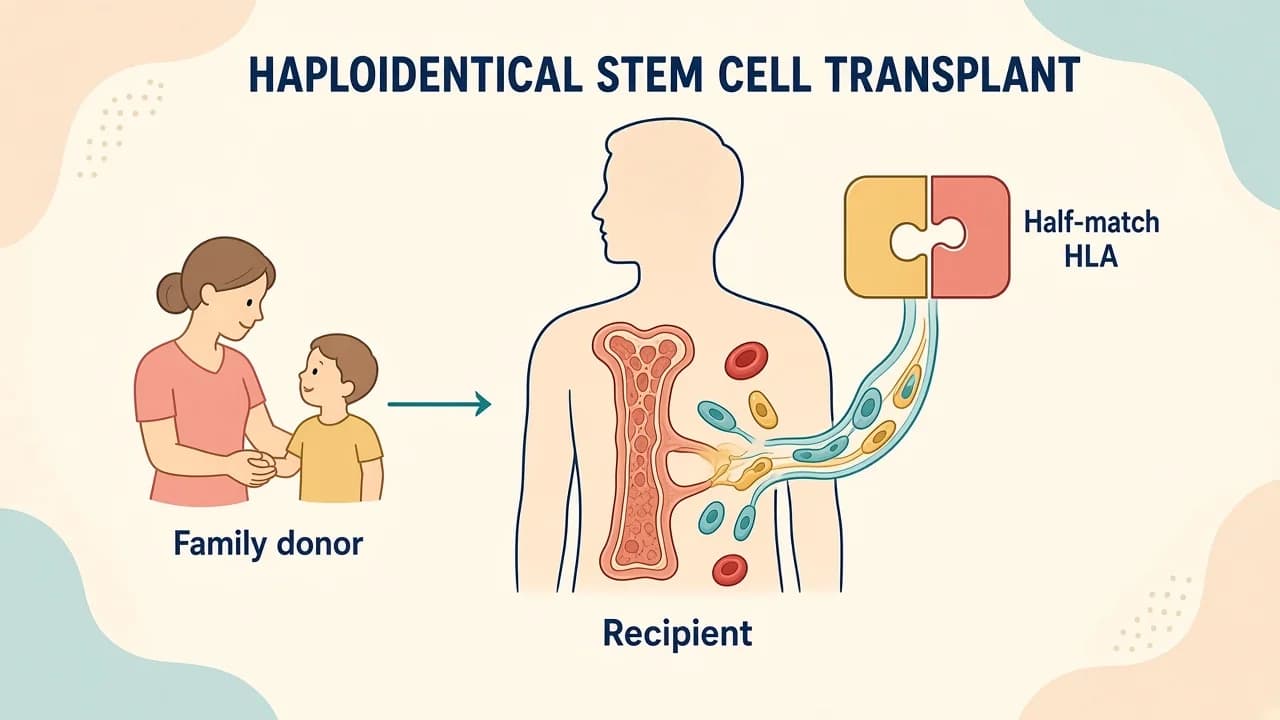
A haploidentical transplant is an allogeneic transplant from a related donor who shares one HLA haplotype, commonly a parent, child or partially matched sibling.
The related donor provides peripheral-blood stem cells or marrow. Conditioning is followed by graft infusion and protocol-specific immune control, often post-transplant cyclophosphamide with additional immunosuppression.
A readily available relative is not automatically a safe donor. Donor-specific antibodies, infection, disease status, organ fitness and the centre's haploidentical protocol can change selection.
When Is Haploidentical Stem Cell Transplant Considered?
It may offer an alternative donor route for selected high-risk blood cancers or marrow disorders when a fully matched donor is unavailable or waiting is clinically undesirable.
Assessment includes high-resolution family HLA typing, donor-specific anti-HLA antibodies, donor health and infection testing, recipient disease status and organ function, and a written graft-versus-host prevention strategy.
How treatment is given, monitored and adapted →
Haploidentical Stem Cell Transplant cost in India
The $35,000–$85,000 value is the stored national planning range for haploidentical stem cell transplant. It may cover only the items expressly named in a hospital letter and does not establish a tariff for any city or provider.
Important drivers include family hla typing and donor-specific antibodies, graft source and cell processing, gvhd-prevention platform, conditioning intensity, viral surveillance, engraftment and complications. A changed donor, graft, conditioning plan, laboratory work-up or complication can describe a materially different episode.
Do not divide the national range into invented city prices. Compare itemized estimates after record review, and budget travel, caregiver lodging and care after return separately.
Care belongs in a transplant unit experienced with the stated haploidentical platform, with cellular processing, infection surveillance, blood-bank and critical-care support. Travel home waits for stable graft function, manageable immunosuppression and a receiving clinician able to monitor infection, chimerism and GVHD.
Haploidentical Stem Cell Transplant cost breakdown in India
Component prices are rarely published as a public tariff. The lines below describe what typically sits inside a treatment estimate, not a dollar amount for each row.
- Recipient and family HLA assessment
- The relatives and antibody testing expressly named.
- Selected donor work-up and collection
- Health screening, source and collection allowance as written.
- Graft processing
- Routine or manipulated processing only when specified.
- Conditioning and haploidentical GVHD prophylaxis
- Named medicines, including post-transplant cyclophosphamide if planned.
- Ward, engraftment and quoted surveillance
- Defined nights, chimerism and viral monitoring.
Planning range or quotation?
The $35,000–$85,000 figure is an indicative planning range. A final hospital quotation is itemised, issued after a consultant reviews your records, and still subject to what is found clinically.
Get a Personalized Cost Estimate
What is usually included in a Haploidentical Stem Cell Transplant package?
No two hospitals draw the line in the same place, so read an estimate for what it excludes as carefully as for what it covers. The pattern below is what listed campuses typically bundle into a hematology estimate for this treatment. Anything not written into your estimate should be assumed to be extra until the hospital confirms otherwise.
Usually included
Usually included
Recipient and family HLA assessment
The relatives and antibody testing expressly named.
Usually included
Selected donor work-up and collection
Health screening, source and collection allowance as written.
Usually included
Graft processing
Routine or manipulated processing only when specified.
Usually included
Conditioning and haploidentical GVHD prophylaxis
Named medicines, including post-transplant cyclophosphamide if planned.
Usually included
Ward, engraftment and quoted surveillance
Defined nights, chimerism and viral monitoring.
May be charged separately
May be separate
Testing multiple additional donors
Extra family typing, antibody work or desensitisation outside the allowance.
May be separate
Advanced graft manipulation
Cell selection or depletion not named in a standard quote.
May be separate
Bridging disease treatment
Therapy needed before conditioning.
May be separate
Graft failure, severe infection or GVHD
Second graft, ICU or prolonged high-cost therapy.
May be separate
Long-term medicines and monitoring
Immunosuppression, viral tests and survivorship after the quoted period.
Catalog inclusions listed for this pathway: haematology consultation and records review; named consultant on camera before travel; donor search or collection plan as quoted; inpatient transplant or day-care procedure as indicated; discharge summary to your home haematologist.
What can increase the cost?
These are the drivers that actually move a bill for this procedure, in rough order of how often they do it. Most of them are clinical decisions rather than commercial ones, which is why an honest estimate is written after a records review rather than before it.
- Family HLA typing and donor-specific antibodies
- Several relatives may need testing before selection.
- Graft source and cell processing
- Marrow, peripheral blood and manipulated products are not one invoice.
- GVHD-prevention platform
- Post-transplant cyclophosphamide and ex-vivo strategies use different resources.
- Conditioning intensity
- Disease and fitness determine regimen and toxicity.
- Viral surveillance, engraftment and complications
- Extended monitoring and admission can dominate the final bill.
Clinical pathways related to Haploidentical Stem Cell Transplant
A readily available relative is not automatically a safe donor. Donor-specific antibodies, infection, disease status, organ fitness and the centre's haploidentical protocol can change selection. The alternatives below are selected clinically, not as price upgrades.
A Transplant hematologist should explain why the proposed pathway fits the diagnosis and what finding could change it.
Swipe to compare treatment approaches →
| Approach | Relative complexity | GAF planning range | Notes |
|---|---|---|---|
| Post-transplant cyclophosphamide platform | Selected from diagnosis, fitness and laboratory findings | No separate GAF sheetRelative complexity only | A common approach using cyclophosphamide after graft infusion plus additional immune suppression. |
| Ex-vivo graft manipulation | Selected from diagnosis, fitness and laboratory findings | No separate GAF sheetRelative complexity only | Selected centres deplete particular cells; laboratory scope and cost differ materially. |
| Fully matched donor route | Selected from diagnosis, fitness and laboratory findings | No separate GAF sheetRelative complexity only | A matched sibling or unrelated donor may remain preferable when timing and clinical factors allow. |
Planning ranges appear only where GAF Healthcare already publishes a cost sheet for that procedure. Other rows describe relative clinical complexity and should not be read as prices.
Risks and safety considerations for Haploidentical Stem Cell Transplant
Risks include graft failure or rejection, severe infection, cytokine-related complications, acute or chronic GVHD, viral reactivation, organ toxicity, relapse and treatment-related death.
This is not an exhaustive consent list and does not assign likelihood. Individual risks depend on diagnosis, current blood counts, comorbidity and the actual protocol.
A Transplant hematologist must discuss alternatives, uncertainty and the signs that need urgent assessment; no page can promise success or an uncomplicated recovery.
Haploidentical Stem Cell Transplant cost: India vs other medical tourism destinations
India and United States values use stored GAF ranges. Other country rows are modelled relative private-care bands, not official tariffs or proof that a centre will accept the case.
International comparisons are unreliable unless diagnosis, donor or specimen work, protocol, ward scope, medicines and complication coverage match.
Swipe to compare destinations →
| Country | Approximate cost | Relative cost position | Important cost considerations |
|---|---|---|---|
| India | $35,000–$85,000 | Baseline | GAF catalog planning range. The stored India value is a planning band. A named Hematology specialist must review diagnosis, disease status, donor or graft details and organ fitness before a case-specific quotation. |
| Turkey | $66,000–$108,000Indicative planning estimate* | ≈1.4× India | Private international-care market. Confirm donor work, graft procurement, laboratory testing, ward isolation, complications and outpatient monitoring rather than comparing a headline package. |
| Thailand | $78,000–$132,000Indicative planning estimate* | ≈1.8× India | Private international hospitals. International-patient support does not establish transplant eligibility, donor availability, laboratory scope or a safe handover after return. |
| United Arab Emirates | $132,000–$216,000Indicative planning estimate* | ≈2.9× India | Regional premium private care. Travel may be shorter for some families, while professional fees, graft services, medicines and complication care may remain separate. |
| Singapore | $168,000–$288,000Indicative planning estimate* | ≈3.8× India | High-cost specialist private care. Request an international self-pay estimate tied to the diagnosis, protocol and donor or specimen work rather than a general haematology package. |
| Germany | $150,000–$270,000Indicative planning estimate* | ≈3.5× India | European elective specialist care. Eligibility, donor-registry access, professional billing and post-treatment arrangements vary and must be established before travel. |
| United Kingdom | $132,000–$240,000Indicative planning estimate* | ≈3.1× India | Private self-pay for many visitors. Overseas patients should verify acceptance, donor or laboratory access, quote boundaries and who provides follow-up after discharge. |
| United States | $220,000–$450,000 | ≈5.6× India | Stored self-pay reference. Hospital, specialist, donor, laboratory and pharmacy charges may be billed separately; $220,000–$450,000 is a comparison range, not one bundled quotation. |
*Figures other than India and the United States are modelled planning estimates scaled from the India catalog band, not hospital quotations. All values are planning information. Disease status, donor or graft source, testing, medicines, complications, currency and length of stay can change the final amount; no row predicts safety or outcome.
The point of this table is not that one country is better. Cost level and treatment-market structure are different things. Compare the named hospital, multidisciplinary support, included care and follow-up pathway as carefully as the headline figure.
Which destination is right for you?
Use this only as a reading guide for the table above. It is not a medical recommendation, and it does not rank countries.
Looking for the lowest overall treatment cost?
IndiaLooking for premium private hospital infrastructure?
Singapore / UAELooking for proximity from the Middle East?
UAE / India / TurkeyLooking for established European oncology systems?
Germany / UK
Why do international patients consider India for haploidentical stem cell transplant?
Some international patients compare India for access to a named Transplant hematologist and a self-pay planning range below typical United States figures. Price alone is not a reason to travel.
Clinical acceptance, exact quote scope, emergency capacity, caregiver logistics and continuity after return need direct confirmation.
Urgent illness, uncontrolled infection, lack of a safe caregiver plan or funded appropriate care near home may make international travel unsuitable.
Hematology hospitals for haploidentical stem cell transplant in India
Hospital cards should follow live entity relationships. A general oncology or accreditation label does not establish current transplant beds, apheresis, donor access, haematopathology scope, ICU support or outcomes.
Indraprastha Apollo Hospital
 JCI Accredited
 NABH Accredited
- Radiation Oncology
- Surgical Oncology
- Medical Oncology
- Hematology
1 listed doctor for this pathway
Languages listed: English, Hindi
Apollo Hospital, Jubilee Hills, Hyderabad
- JCI Accredited
- NABH Accredited
- Radiation Oncology
- Surgical Oncology
- Medical Oncology
- Hematology
1 listed doctor for this pathway
Languages listed: English, Telugu, Hindi
Artemis Hospital
- JCI Accredited
- NABH Accredited
- DHADHA
- Radiation Oncology
- Surgical Oncology
- Medical Oncology
- Hematology
2 listed doctors for this pathway
Languages listed: English, Hindi
BLK-Max Super Speciality Hospital
- JCI Accredited
- NABH Accredited
 NABL Accredited
- Radiation Oncology
- Surgical Oncology
- Medical Oncology
- Hematology
1 listed doctor for this pathway
Languages listed: English, Hindi
Fortis Memorial Research Institute
- JCI Accredited
- NABH Accredited
- NABL Accredited
- Radiation Oncology
- Surgical Oncology
- Medical Oncology
- Hematology
1 listed doctor for this pathway
Languages listed: English, Hindi
Fortis Hospital, Noida
- JCI Accredited
- NABH Accredited
- NABL Accredited
- Radiation Oncology
- Surgical Oncology
- Medical Oncology
- Hematology
1 listed doctor for this pathway
Languages listed: English, Hindi
Fortis Hospital, Shalimar Bagh
- JCI Accredited
- NABH Accredited
- NABL Accredited
- Radiation Oncology
- Surgical Oncology
- Medical Oncology
- Hematology
1 listed doctor for this pathway
Languages listed: English, Hindi
Gleneagles Hospitals, Bengaluru
- JCI Accredited
- NABH Accredited
- NABL Accredited
- Radiation Oncology
- Surgical Oncology
- Medical Oncology
- Hematology
1 listed doctor for this pathway
Languages listed: English, Kannada, Hindi
Haploidentical Stem Cell Transplant hospitals in India · Talk to a treatment coordinator
Transplant hematologists for haploidentical stem cell transplant in India
Profiles must be drawn dynamically only when Haploidentical Stem Cell Transplant appears in current procedure relationships. Verify the clinician's Hematology role, responsibility for this pathway, availability and campus. Placement is not a ranking or an experience or outcome claim.

Dr. Ajay Gupta
Hematology
17+ years Experience
Bone Marrow Transplant (BMT) · Autologous Stem Cell Transplant (ASCT) · Haploidentical Bone Marrow Transplant
English, Hindi
Dr. G. Vikram Kumar
Hematology
18+ years Experience
Bone Marrow Transplant (BMT) · Haploidentical Bone Marrow Transplant · Autologous Stem Cell Transplant (ASCT)
English, Telugu, Hindi
Dr. Govind Eriat
Hematology
14+ years Experience
Bone Marrow Transplant (BMT) · Autologous Stem Cell Transplant (ASCT) · Haploidentical Bone Marrow Transplant
English, Kannada, Hindi
Dr. Muralidaran C
Hematology
9+ years Experience
Bone Marrow Transplant (BMT) · Autologous Stem Cell Transplant (ASCT) · Haploidentical Bone Marrow Transplant
English, Hindi, Marathi
Dr. Arun Singh Danewa
Pediatric Hematology
10+ years Experience
Pediatric Bone Marrow Transplant · Haploidentical Bone Marrow Transplant · Bone Marrow Transplant (BMT)
English, Hindi
Dr. K. Karuna Kumar
Hematology
18+ years Experience
Bone Marrow Transplant (BMT) · Autologous Stem Cell Transplant (ASCT) · Haploidentical Bone Marrow Transplant
English, Telugu, Hindi
Dr. Divya Doval
Hematology
11+ years Experience
Allogeneic Bone Marrow Transplant · Autologous Bone Marrow Transplant · Bone Marrow Transplant
English, Hindi
Dr. Karanam Ashok Kumar
Hematology
21+ years Experience
Bone Marrow Transplant (BMT) · Autologous Stem Cell Transplant (ASCT) · Haploidentical Bone Marrow Transplant
English, Telugu, Hindi
Haploidentical Stem Cell Transplant doctors in India (18 listed) · Get a personalized cost estimate
Haploidentical Stem Cell Transplant cost by city in India
Delhi NCR, Mumbai, Bengaluru, Chennai and Hyderabad use $35,000–$85,000 because no verified city tariffs are stored. Their overlays address different airport, commute, climate and caregiver logistics without inventing local prices.
Specialist and hospital cards must resolve from current procedure relationships. This article names no provider and makes no ranking, volume, accreditation or outcome claim.
Swipe to compare Indian cities →
Delhi NCR
$35,000–$85,000
India planning band — not a city quote
Typical stay 6–10 weeks nearby
No verified Delhi NCR-only tariff is stored for haploidentical stem cell transplant. Use $35,000–$85,000 as a national planning range until a named hospital issues an itemized estimate; it is not a guaranteed package.
8 hospitals · 11 doctors
Mumbai
$35,000–$85,000
India planning band — not a city quote
Typical stay 6–10 weeks nearby
No verified Mumbai-only tariff is stored for haploidentical stem cell transplant. Use $35,000–$85,000 as a national planning range until a named hospital issues an itemized estimate; it is not a guaranteed package.
1 hospital · 1 doctor
Bengaluru
$35,000–$85,000
India planning band — not a city quote
Typical stay 6–10 weeks nearby
No verified Bengaluru-only tariff is stored for haploidentical stem cell transplant. Use $35,000–$85,000 as a national planning range until a named hospital issues an itemized estimate; it is not a guaranteed package.
1 hospital · 1 doctor
Chennai
$35,000–$85,000
India planning band — not a city quote
Typical stay 6–10 weeks nearby
No verified Chennai-only tariff is stored for haploidentical stem cell transplant. Use $35,000–$85,000 as a national planning range until a named hospital issues an itemized estimate; it is not a guaranteed package.
0 hospitals · consultant match on request
Hyderabad
$35,000–$85,000
India planning band — not a city quote
Typical stay 6–10 weeks nearby
No verified Hyderabad-only tariff is stored for haploidentical stem cell transplant. Use $35,000–$85,000 as a national planning range until a named hospital issues an itemized estimate; it is not a guaranteed package.
4 hospitals · 5 doctors
Costs vary considerably by hospital, specialist, clinical complexity, insurance, room or day-care category, and what is included in the package.
Choosing a city for haploidentical stem cell transplant
Patients usually pick the treating team first and the city second. The city still affects daily travel, accommodation, companion arrangements and access to follow-up. Here is what genuinely differs between the five cities we list.
What should international patients budget beyond the hematology procedure or treatment?
A complete haploidentical stem cell transplant budget extends beyond $35,000–$85,000. Include record review, tests outside the letter, companion travel, lodging, medicines, complication contingency and follow-up at home.
Travel should follow written clinical acceptance. A visa invitation or directory profile is not medical clearance.
- Recipient assessment
- Confirm disease indication, timing, fitness and matched-donor alternatives.
- Family donor comparison
- Type relatives, assess antibodies and select a medically suitable donor.
- Donor collection and conditioning
- Coordinate graft procurement with the recipient's preparative regimen.
- Graft and immune-control protocol
- Infuse cells and deliver the stated post-graft immune strategy.
- Engraftment and infection monitoring
- Track counts, chimerism, viral reactivation and GVHD.
- Shared long-term follow-up
- Continue immunosuppression, disease review, vaccination and donor-related planning.
- Treatment episode$35,000–$85,000
- Pre-operative testsOften inside the estimate — confirm
- Hospital stay6–10 weeks nearby typically bundled
- Additional procedures or extended careQuoted separately if advised
- Accommodation for companionVaries by city and length of stay
- Local transportationAirport and daily hospital transfers
- FlightsDepends on origin
- Medical visaFee set by the issuing consulate
Planning estimate — not a hospital quotation.
Get a Personalized Treatment Estimate
What does medical travel for haploidentical stem cell transplant in India involve?
The sequence below is how a records-first pathway normally runs. The order matters: everything before arrival exists so that you are not making decisions in an unfamiliar hospital corridor with a suitcase beside you.
Send complete records
Pathology, genetics and current disease assessment; Recipient and available family HLA reports; Donor-specific antibody testing if done; Prior infection and treatment history; Recipient organ-function and donor health records.
Obtain specialist acceptance
A named Transplant hematologist confirms whether the proposed procedure and travel are reasonable from the available evidence.
Clarify alternatives and uncertainty
A readily available relative is not automatically a safe donor. Donor-specific antibodies, infection, disease status, organ fitness and the centre's haploidentical protocol can change selection. Ask what new result could change or cancel the plan.
Compare itemized estimates
Use the same clinical assumptions and compare laboratory, pharmacy, ward, professional and complication terms.
Plan flexible travel
Arrange documents, a capable caregiver when required, refundable travel and accommodation close to the exact campus.
Repeat assessment after arrival
Assessment includes high-resolution family HLA typing, donor-specific anti-HLA antibodies, donor health and infection testing, recipient disease status and organ function, and a written graft-versus-host prevention strategy.
Complete the planned procedure
The related donor provides peripheral-blood stem cells or marrow. Conditioning is followed by graft infusion and protocol-specific immune control, often post-transplant cyclophosphamide with additional immunosuppression.
Monitor recovery
Engraftment, immune recovery and immunosuppressant taper are individual. Viral reactivation, GVHD or delayed count recovery can extend nearby residence. fever, rash, diarrhoea, jaundice, breathing difficulty, bleeding, confusion or missed immunosuppressant doses require prompt review.
Receive discharge records
Carry the procedure summary, laboratory or pathology results, medicine list, emergency contacts and follow-up schedule.
Continue care at home
The plan should name chimerism and viral testing, GVHD assessment, drug-level monitoring, disease surveillance, donor contact and vaccination.

Documents to prepare
- Pathology, genetics and current disease assessment
- Recipient and available family HLA reports
- Donor-specific antibody testing if done
- Prior infection and treatment history
- Recipient organ-function and donor health records
Clinical detail
How the treatment is delivered
The related donor provides peripheral-blood stem cells or marrow. Conditioning is followed by graft infusion and protocol-specific immune control, often post-transplant cyclophosphamide with additional immunosuppression.
Related approaches include Post-transplant cyclophosphamide platform, Ex-vivo graft manipulation, Fully matched donor route; they are not interchangeable package labels.
Care belongs in a transplant unit experienced with the stated haploidentical platform, with cellular processing, infection surveillance, blood-bank and critical-care support. family typing and donor work-up precede a multi-week transplant admission, followed by months of infection, chimerism and GVHD monitoring.

Main variations
- Post-transplant cyclophosphamide platform
- A common approach using cyclophosphamide after graft infusion plus additional immune suppression.
- Ex-vivo graft manipulation
- Selected centres deplete particular cells; laboratory scope and cost differ materially.
- Fully matched donor route
- A matched sibling or unrelated donor may remain preferable when timing and clinical factors allow.
Preparation
Assessment includes high-resolution family HLA typing, donor-specific anti-HLA antibodies, donor health and infection testing, recipient disease status and organ function, and a written graft-versus-host prevention strategy.
The receiving Transplant hematologist should review the complete files, reconcile medicines and explain consent, alternatives and what could postpone or cancel the procedure.
Report fever, active infection, new bleeding, breathing difficulty or a material change in condition promptly; urgent local care should not be delayed for travel.
Hospital stay and recovery
Engraftment, immune recovery and immunosuppressant taper are individual. Viral reactivation, GVHD or delayed count recovery can extend nearby residence. The plan should name chimerism and viral testing, GVHD assessment, drug-level monitoring, disease surveillance, donor contact and vaccination.
The catalog stay of 6–10 weeks nearby is a planning aid, not a discharge promise. Travel home waits for stable graft function, manageable immunosuppression and a receiving clinician able to monitor infection, chimerism and GVHD.
Risks include graft failure or rejection, severe infection, cytokine-related complications, acute or chronic GVHD, viral reactivation, organ toxicity, relapse and treatment-related death.
Seek urgent clinical help for fever, rash, diarrhoea, jaundice, breathing difficulty, bleeding, confusion or missed immunosuppressant doses. Follow the treating team's own emergency thresholds.
How to compare Haploidentical Stem Cell Transplant quotes from Indian hospitals
Print these and work through them on the video call. A house that answers without hedging is telling you something useful about how it will behave when something goes wrong.
- Why is haploidentical stem cell transplant being considered now, and what alternatives were discussed?
- Which diagnosis, pathology or laboratory result drives the recommendation?
- Who is the named Transplant hematologist responsible for the plan?
- At which exact campus will each stage occur?
- What could postpone, change or cancel the procedure after arrival?
- Does the quotation use the exact procedure name and clinical assumptions?
- Which consultations, laboratory tests and imaging are included?
- Which medicines, blood products and supportive care are included?
- How many day-care visits or ward nights are allowed?
- How are intensive care, infection, bleeding and an extended stay billed?
- Which professional, laboratory, pharmacy or donor charges are separate?
- What caregiver presence and nearby accommodation are required?
- What emergency symptoms require return to the unit?
- Who provides care if the patient becomes unwell after returning home?
- When is fitness to fly assessed, and must return travel remain flexible?
- How many family members and which HLA tests are included?
- Is donor-specific antibody testing and any desensitisation included?
- Does the plan use marrow or peripheral blood?
- Is post-transplant cyclophosphamide or ex-vivo manipulation assumed?
- Which viral PCR and chimerism schedule is included?
- What is the contingency if the chosen donor becomes unavailable?
Frequently asked questions
How much does haploidentical stem cell transplant cost in India?
Haploidentical Stem Cell Transplant is typically planned at $35,000–$85,000. This stored range is not a quote; eligibility, the exact pathway and hospital terms determine the final amount.
What is haploidentical stem cell transplant?
A haploidentical transplant is an allogeneic transplant from a related donor who shares one HLA haplotype, commonly a parent, child or partially matched sibling.
When is haploidentical stem cell transplant considered?
It may offer an alternative donor route for selected high-risk blood cancers or marrow disorders when a fully matched donor is unavailable or waiting is clinically undesirable.
Who may not be ready for this procedure?
A readily available relative is not automatically a safe donor. Donor-specific antibodies, infection, disease status, organ fitness and the centre's haploidentical protocol can change selection.
What records are needed before acceptance?
Assessment includes high-resolution family HLA typing, donor-specific anti-HLA antibodies, donor health and infection testing, recipient disease status and organ function, and a written graft-versus-host prevention strategy.
What happens during the procedure?
The related donor provides peripheral-blood stem cells or marrow. Conditioning is followed by graft infusion and protocol-specific immune control, often post-transplant cyclophosphamide with additional immunosuppression.
How long does haploidentical stem cell transplant take?
family typing and donor work-up precede a multi-week transplant admission, followed by months of infection, chimerism and GVHD monitoring. The stored 6–10 weeks nearby is only a travel-planning guide.
Is admission required?
Care belongs in a transplant unit experienced with the stated haploidentical platform, with cellular processing, infection surveillance, blood-bank and critical-care support.
What are the important risks?
Risks include graft failure or rejection, severe infection, cytokine-related complications, acute or chronic GVHD, viral reactivation, organ toxicity, relapse and treatment-related death.
What can change the hospital estimate?
Key drivers include family hla typing and donor-specific antibodies, graft source and cell processing, gvhd-prevention platform, conditioning intensity, viral surveillance, engraftment and complications.
When can an international patient fly home?
Travel home waits for stable graft function, manageable immunosuppression and a receiving clinician able to monitor infection, chimerism and GVHD.
What follow-up is needed?
The plan should name chimerism and viral testing, GVHD assessment, drug-level monitoring, disease surveillance, donor contact and vaccination.
Dr. Shabnam Choudhary, BDS, is a dental professional who graduated from Al-Ameen Medical College, Bijapur, Karnataka. She contributes to the curation and development of medically informative healthcare content, helping ensure that information is structured clearly and presented in a patient-friendly manner.
Content Curator
Dr. Shabnam Choudhary
BDS
Al-Ameen Medical College, Bijapur, Karnataka
Rajiv Gandhi University of Health Sciences (RGUHS), Bengaluru

Dr. Saffiyyah Chaudhary, BDS, is a dental professional who graduated from Al-Ameen Medical College, Bijapur, Karnataka. She provides medical review of healthcare content to help ensure that clinical information is accurate, understandable, and appropriately presented for patients and their families.
Medically Reviewed By
Dr. Saffiyyah Chaudhary
BDS
Al-Ameen Medical College, Bijapur, Karnataka
Rajiv Gandhi University of Health Sciences (RGUHS), Bengaluru

Related treatment costs
Allogeneic Stem Cell Transplant cost in India
$30,000–$80,000 · stay 6–10 weeks nearby
Matched Unrelated Donor Transplant cost in India
$40,000–$95,000 · stay 6–12 weeks nearby
Stem Cell Transplantation cost in India
$22,000–$65,000 · stay Auto or allo · 3–8 weeks
Cost note
Cost ranges on this page are for preliminary planning and comparison only. The final treatment cost depends on the patient's diagnosis, treatment plan, hospital, doctor, procedure complexity and other clinical factors. A personalized quotation should be obtained before making treatment or travel decisions.
This page is general information about treatment costs and pathways. It is not a diagnosis, a treatment recommendation or a substitute for an individualised medical opinion. Decisions about whether this procedure is appropriate for you belong to a qualified doctor who has reviewed your records.
Last updated 12 September 2026. Cost data is maintained separately from this article and refreshed as listed campuses revise their planning ranges.
Haploidentical Stem Cell Transplant cost sheet · All treatment costs in India · Hematology costs