
Last updated: 13 September 2026 · Content curated by Dr. Shabnam Choudhary · Medically reviewed by Dr. Saffiyyah Chaudhary
Quick Answer
ICL (Implantable Collamer Lens) in Chennai uses $1,800–$3,800 per eye per eye for planning, with Outpatient only a broad trip guide. Neither is a city tariff, recommendation or acceptance promise.
Confirm the named clinician, campus, diagnosis, laterality, technique, device or medicine, anaesthesia, reviews, exclusions and urgent pathway.
- India cost range
- $1,800–$3,800 per eye
- Typical starting point
- $1,800
- Typical hospital stay
- Outpatient
- Procedure time
- procedure time and observation vary with indication, technique, anaesthesia and findings
- Recovery
- Use drops and shield and attend early IOP, inflammation, vault, angle and lens-position checks before driving, exercise or travel.
Major cost factors: icl model and power, sizing measurements, toric alignment, pressure monitoring. International patients should also budget for accommodation, airport transfers, a medical visa, medicines and follow-up.
Often quoted separately: additional diagnostics; changed or combined treatment; extra devices or medicines; complication care; travel and living.
Why request a cost through GAF rather than a hospital?
Writing to one campus gets you that campus’s package. A GAF request is reviewed against your records and returned as suitable doctor and hospital options with an indicative, itemised estimate. There is no obligation to book.
- Doctor review first. The number follows a reading of your imaging, test results and clinical records, not a brochure range.
- Hospital options. You can compare listed campuses before you travel, instead of starting over with each international desk.
- International-patient coordination. Visa letters, records routing and companion logistics sit with the same request.
ICL (Implantable Collamer Lens) in Chennai
It may suit selected refractive errors when corneal laser is unsuitable or not preferred and anterior-chamber depth, angle, endothelium and lens are appropriate. Refraction, anterior-chamber depth, white-to-white or other sizing, endothelial count, angle and IOP assessment, pupil and retinal checks guide lens selection.
Some eye-care corridors have comparatively direct airport access, but the exact campus still controls transfer time for measurements, surgery and review. Dilation, treatment or early recovery can affect navigation, so arrange a companion when the treating team advises one.
Use air-conditioned, flexible lodging near the named unit, with easy vehicle access and clean storage for drops and the protective shield. Heat and glare can make protected travel uncomfortable. Sunglasses may help comfort when approved, but they do not replace the eye shield or prescribed drops.
Doctor and hospital cards in Chennai resolve only from exact live CMS relationships for ICL (Implantable Collamer Lens). If that exact relationship is absent, cards must remain empty; a generic Ophthalmology, eye-care or hospital label cannot verify current case acceptance. This is a catalog gap, not an availability or quality claim.
Send complete records before non-refundable travel. Remote review for implantable collamer lens surgery can change after examination, imaging or functional testing.
What icl (implantable collamer lens) typically costs in Chennai
The estimate changes with icl model and power, sizing measurements, toric alignment, pressure monitoring and the stated follow-up.
Ask for the per eye basis, named clinician, tests, facility, consumables, medicines, reviews, exclusions and complication terms in writing.
Budget separately for travel through Chennai International Airport, lodging, companion support, transport, medicines and extra nights.
What moves the quote in Chennai
- ICL model and power
- ICL model and power changes the procedure-specific planning, resources or follow-up for implantable collamer lens surgery.
- Sizing measurements
- Sizing measurements changes the procedure-specific planning, resources or follow-up for implantable collamer lens surgery.
- Toric alignment
- Toric alignment changes the procedure-specific planning, resources or follow-up for implantable collamer lens surgery.
- Pressure monitoring
- Pressure monitoring changes the procedure-specific planning, resources or follow-up for implantable collamer lens surgery.
Medical travel through Chennai
Send consultation notes, imaging, test outputs, prior procedures and current medicines before travel to Chennai.
Obtain written acceptance from a named refractive surgeon experienced in phakic IOL implantation and verify procedure-specific equipment, tissue, implant or medicine availability at the exact campus.
Use drops and shield and attend early IOP, inflammation, vault, angle and lens-position checks before driving, exercise or travel. Heat and glare can make protected travel uncomfortable. Sunglasses may help comfort when approved, but they do not replace the eye shield or prescribed drops. Carry the treatment note and follow-up plan home.
Hospitals and units listed in Chennai
Doctor and hospital cards in Chennai resolve only from exact live CMS relationships for ICL (Implantable Collamer Lens). If that exact relationship is absent, cards must remain empty; a generic Ophthalmology, eye-care or hospital label cannot verify current case acceptance. This is a catalog gap, not an availability or quality claim.
General accreditation does not establish current clinician acceptance, device or tissue availability, emergency support or case-specific suitability.
ICL (Implantable Collamer Lens) doctors in Chennai · ICL (Implantable Collamer Lens) hospitals in Chennai · ICL (Implantable Collamer Lens) cost in India
What Is ICL (Implantable Collamer Lens)?
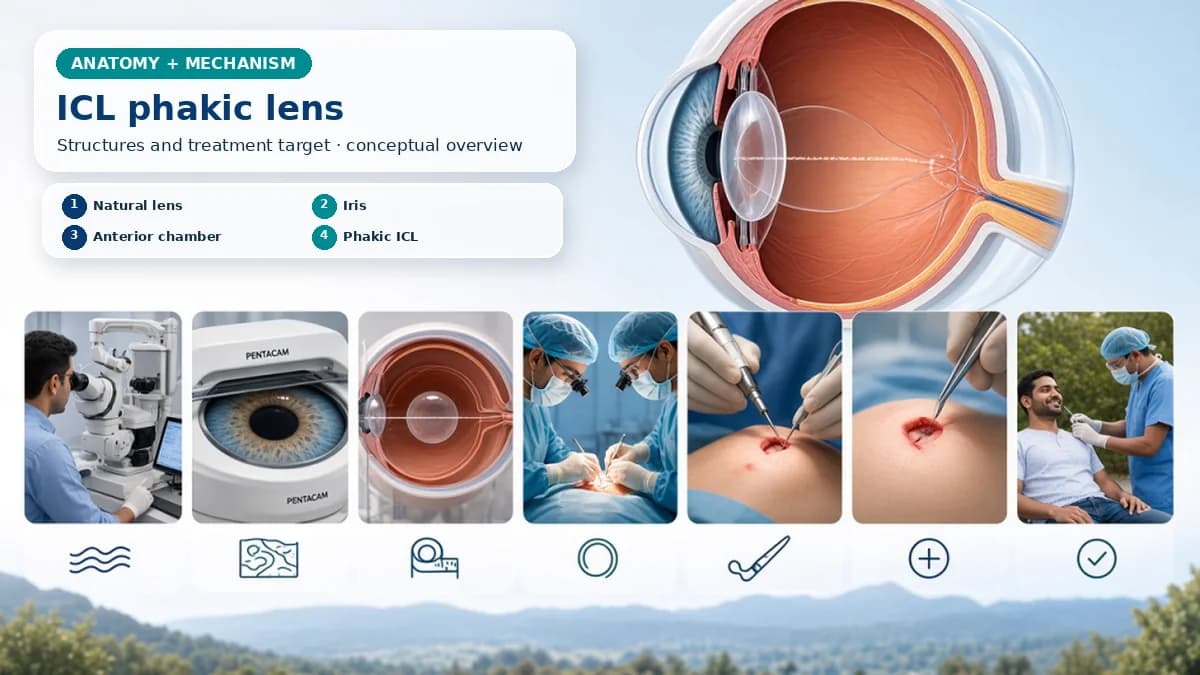
An ICL is a phakic lens placed behind the iris and in front of the natural crystalline lens, leaving the natural lens inside the eye.
ICL is a phakic intraocular implant, not LASIK or SMILE corneal tissue removal and not cataract surgery replacing the natural lens.
Ophthalmic terms can describe different tissue layers, disease mechanisms and treatment goals. The written plan should use the exact term rather than a broader eye-surgery label.
When Might ICL (Implantable Collamer Lens) Be Considered?
It may suit selected refractive errors when corneal laser is unsuitable or not preferred and anterior-chamber depth, angle, endothelium and lens are appropriate.
Symptoms alone or an image alone may not establish candidacy. The clinician should connect examination and functional impact, consider alternatives and explain uncertainty from coexisting corneal, lens, pressure, retinal, optic-nerve, eyelid, orbital or systemic disease.
How the operation is performed, recovery and variations →
ICL (Implantable Collamer Lens) cost in India
$1,800–$3,800 per eye is the stored national planning range per eye; $4,000–$8,000 per eye is a comparison reference using the catalog's stated unit. Neither is a tariff, acceptance decision or final bill.
The quotation should identify ICL (Implantable Collamer Lens), diagnosis, eye or laterality, clinician, campus, approach, anaesthesia, named devices, donor tissue or medicines, observation, reviews and exclusions.
Cost drivers include icl model and power, sizing measurements, toric alignment, pressure monitoring, diagnostic scope, facility, medical needs, altered findings and follow-up. Ask what triggers another procedure, device, injection, admission or visit.
Keep flights, visa, insurance, airport and local transfers, companion support, suitable lodging, meals, take-home medicines, extra nights and ophthalmology follow-up outside the clinical total unless expressly included.
Planning Range ≠ Final Hospital Quotation. Records review and an in-person ophthalmic assessment are required before candidacy, treatment scope, risks and an itemized offer are meaningful.
Planning range or quotation?
The $1,800–$3,800 per eye figure is an indicative planning range. A final hospital quotation is itemised, issued after a consultant reviews your records, and still subject to what is found clinically.
Get a Personalized Cost Estimate
What is usually included in a ICL (Implantable Collamer Lens) package?
No two hospitals draw the line in the same place, so read an estimate for what it excludes as carefully as for what it covers. The pattern below is what listed campuses typically bundle into a surgical estimate for this procedure. Anything not written into your estimate should be assumed to be extra until the hospital confirms otherwise.
Usually included
Usually included
Procedure-specific assessment
Named refractive surgeon experienced in phakic IOL implantation review, examination and stated diagnostic tests.
Usually included
Consented treatment
ICL (Implantable Collamer Lens), laterality and technique exactly as written.
Usually included
Facility and anaesthesia
Stated day-care or theatre use, anaesthesia, monitoring and recovery.
Usually included
Named device, tissue or medicine
Model, donor tissue, laser, tamponade or drug when relevant.
Usually included
Routine consumables and medicines
Only supplies and peri-procedure medicines listed in the offer.
Usually included
Early review and handover
Scheduled checks, treatment note, warning signs and home plan.
May be charged separately
May be separate
Additional diagnostics
Unlisted imaging, laboratory, functional testing or specialist review.
May be separate
Changed or combined treatment
A different technique, added procedure or staged care unless itemized.
May be separate
Extra devices or medicines
Unlisted implant, donor tissue, tamponade, injection or take-home drug.
May be separate
Complication care
Extra visits, admission, re-operation or prolonged treatment unless covered.
May be separate
Travel and living
Flights, visa, insurance, transfers, lodging, meals and companion costs.
Catalog inclusions listed for this pathway: ophthalmology consultation and records review; named consultant on camera before travel; biometry, tomography or oct as indicated; lens, graft, laser or implant as quoted; discharge summary to your home physician.
What can increase the cost?
These are the drivers that actually move a bill for this operation, in rough order of how often they do it. Most of them are clinical decisions rather than commercial ones, which is why an honest estimate is written after a records review rather than before it.
- ICL model and power
- ICL model and power changes the procedure-specific planning, resources or follow-up for implantable collamer lens surgery.
- Sizing measurements
- Sizing measurements changes the procedure-specific planning, resources or follow-up for implantable collamer lens surgery.
- Toric alignment
- Toric alignment changes the procedure-specific planning, resources or follow-up for implantable collamer lens surgery.
- Pressure monitoring
- Pressure monitoring changes the procedure-specific planning, resources or follow-up for implantable collamer lens surgery.
- Diagnostic scope
- Examination, imaging and functional tests must match the indication.
- Named clinician and facility
- Professional, day-care, theatre and monitoring scope can differ.
- Anaesthesia and medical needs
- Cooperation, age and comorbidity can change support and observation.
- Devices, tissue and medicines
- Implants, donor tissue, laser, tamponade or drugs must be itemized.
- Changed findings
- New examination or operative findings can alter or stage treatment.
- Follow-up and complications
- Included reviews and unplanned treatment vary between quotations.
Approaches and alternatives for ICL (Implantable Collamer Lens)
Approaches are clinical choices, not a quality ladder. Anatomy, disease mechanism, severity, previous treatment, ocular health, general health and clinician judgment guide selection.
ICL is a phakic intraocular implant, not LASIK or SMILE corneal tissue removal and not cataract surgery replacing the natural lens. Ask why the proposed approach fits and what finding would change, postpone or stop it.
Swipe to compare surgical approaches →
| Approach | Relative complexity | GAF planning range | Notes |
|---|---|---|---|
| Phakic ICL | Suitability follows procedure-specific examination | No separate GAF sheetRelative complexity only | Implant behind iris with natural lens retained. |
| Corneal laser | Suitability follows procedure-specific examination | No separate GAF sheetRelative complexity only | LASIK, SMILE or surface treatment when suitable. |
| Lens replacement or optical correction | Suitability follows procedure-specific examination | No separate GAF sheetRelative complexity only | Different risk profile or non-surgical alternative. |
Planning ranges appear only where GAF Healthcare already publishes a cost sheet for that operation. Other rows describe relative clinical complexity and should not be read as prices.
Anatomy and indication for ICL (Implantable Collamer Lens)
An ICL is a phakic lens placed behind the iris and in front of the natural crystalline lens, leaving the natural lens inside the eye. It may suit selected refractive errors when corneal laser is unsuitable or not preferred and anterior-chamber depth, angle, endothelium and lens are appropriate.
The assessment should identify the structure causing symptoms or risk and document important neighbouring tissue. Coexisting disease can change expected benefit, technique and follow-up.
The clinical distinction that changes the quote
ICL is a phakic intraocular implant, not LASIK or SMILE corneal tissue removal and not cataract surgery replacing the natural lens.
Do not compare a broad package with a procedure-specific plan. Hold laterality, diagnosis, approach, device or medicine, anaesthesia, setting, monitoring and reviews constant.
How implantable collamer lens surgery is performed
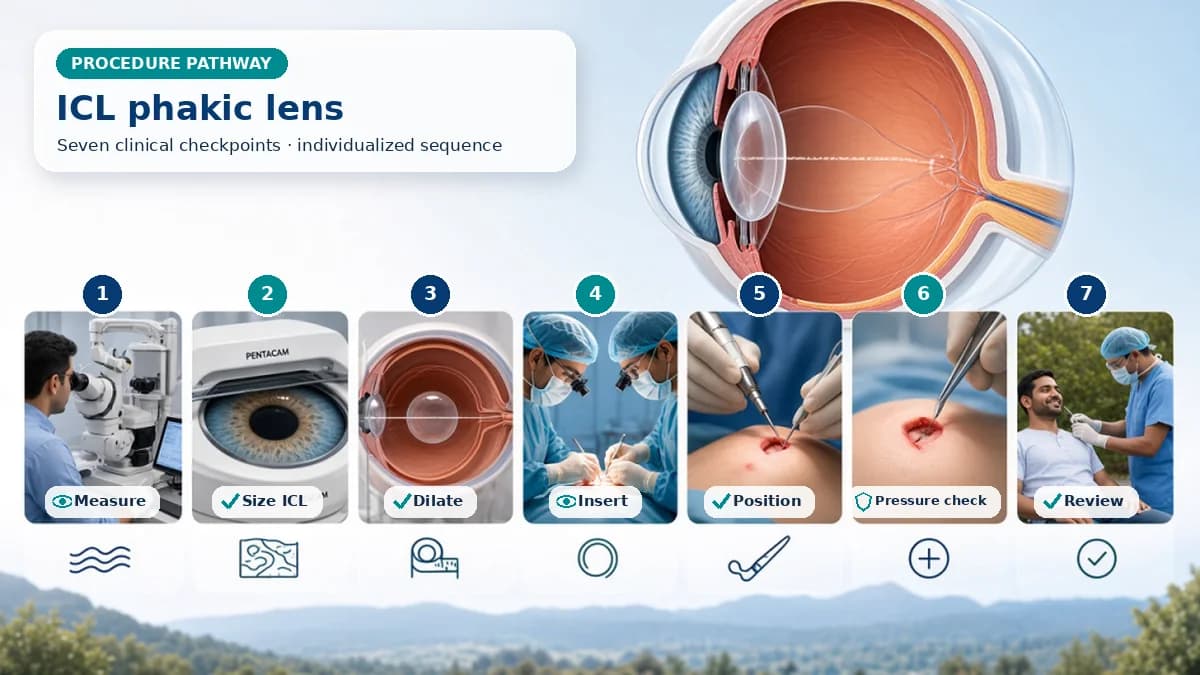
Through a small incision, the folded lens enters the anterior chamber and is positioned behind the iris; centration, vault and pressure are checked.
A safe sequence includes verification, consent, sterile preparation, procedure-specific monitoring, documented treatment and discharge criteria. Added work needs separate clinical justification.
Risks, limitations and urgent review
Procedure-specific risks include infection, inflammation, pressure rise, angle narrowing, endothelial loss, cataract formation, incorrect vault, lens rotation, glare, residual refractive error and removal or exchange
Urgent review is needed for pain, blurred or reduced vision, halos with nausea, redness, discharge, injury or sudden new floaters. The patient should know the named contact and where an examination can occur after hours.
Recovery, monitoring and continuity
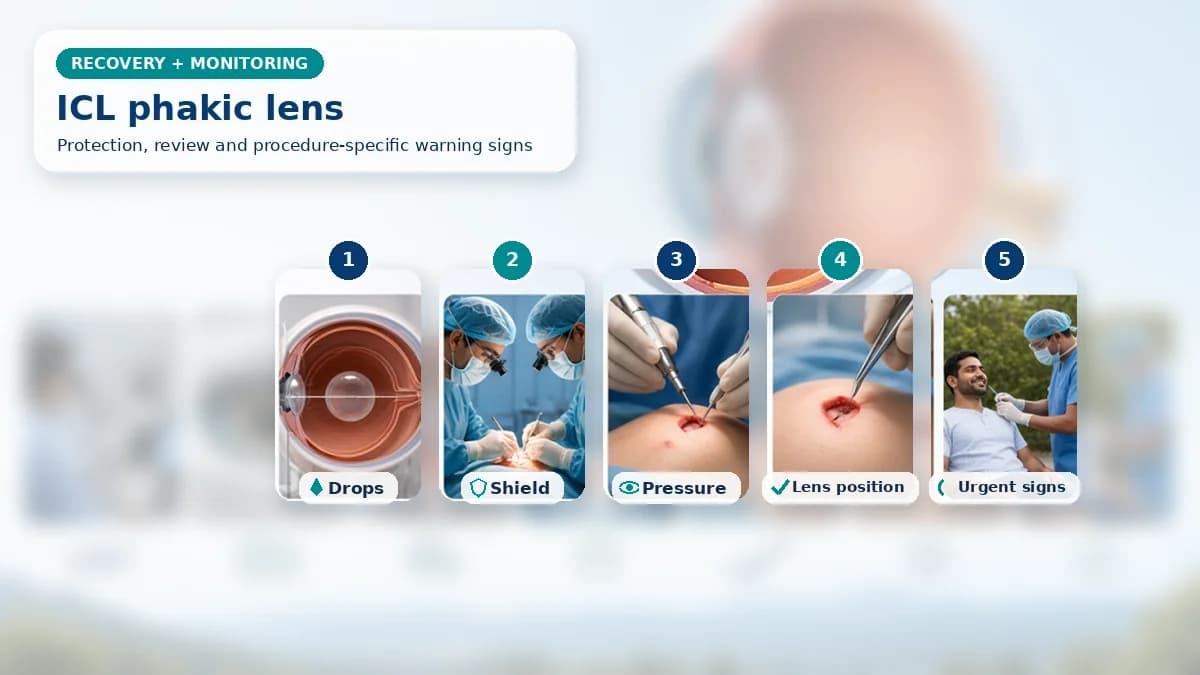
Use drops and shield and attend early IOP, inflammation, vault, angle and lens-position checks before driving, exercise or travel.
Carry the examination findings, procedure note, device or tissue label, medicine list and review plan home. Local follow-up should be arranged before travel, especially when serial imaging, pressure checks, suture care or repeated treatment may be needed.
ICL (Implantable Collamer Lens) cost: India vs other medical tourism destinations
India and United States values use stored catalog references for implantable collamer lens surgery. Other countries require direct quotations because comparable procedure-specific scope is not reliably stored.
Compare the same diagnosis, laterality, per eye basis, technique, clinician, facility, device or medicine, monitoring and follow-up.
Swipe to compare destinations →
| Country | Approximate cost | Relative cost position | Important cost considerations |
|---|---|---|---|
| India | $1,800–$3,800 per eye | Baseline | GAF catalog planning range. The stored India figure is a national per eye planning range for implantable collamer lens surgery, not a quotation or acceptance decision. |
| Turkey | Confirmation requiredIndicative planning estimate* | Higher than India | Quotation required. Request a direct per eye quotation for implantable collamer lens surgery; diagnosis, technique, devices, medicines and follow-up may not be comparable. |
| Thailand | Confirmation requiredIndicative planning estimate* | Higher than India | Quotation required. Request a direct per eye quotation for implantable collamer lens surgery; diagnosis, technique, devices, medicines and follow-up may not be comparable. |
| United Arab Emirates | Confirmation requiredIndicative planning estimate* | Higher than India | Quotation required. Request a direct per eye quotation for implantable collamer lens surgery; diagnosis, technique, devices, medicines and follow-up may not be comparable. |
| Singapore | Confirmation requiredIndicative planning estimate* | Higher than India | Private self-pay varies. Request a direct per eye quotation for implantable collamer lens surgery; diagnosis, technique, devices, medicines and follow-up may not be comparable. |
| Germany | Confirmation requiredIndicative planning estimate* | Higher than India | Private billing varies. Request a direct per eye quotation for implantable collamer lens surgery; diagnosis, technique, devices, medicines and follow-up may not be comparable. |
| United Kingdom | Confirmation requiredIndicative planning estimate* | Higher than India | Private self-pay varies. Request a direct per eye quotation for implantable collamer lens surgery; diagnosis, technique, devices, medicines and follow-up may not be comparable. |
| United States | $4,000–$8,000 per eye | ≈2.1× India | Stored self-pay reference. $4,000–$8,000 per eye is the stored comparison reference for implantable collamer lens surgery; professional, facility, device, medicine and follow-up billing may differ. |
International figures are indicative. Currency, changed findings, staged treatment, complications and length of stay can change the final bill.
Why do international patients consider India for implantable collamer lens surgery?
Some international patients consider India for access to named refractive surgeon experienced in phakic IOL implantation care, diagnostic infrastructure and a national self-pay planning range. Price alone is not a clinical reason to travel.
Evaluate licensure, named campus, procedure-specific experience, equipment, device, tissue or medicine traceability, infection controls, urgent support and home handover.
No provider is ranked and no outcome is promised. Unstable disease, urgent local needs, inadequate records or appropriate dependable care near home may make elective travel unsuitable.
ICL (Implantable Collamer Lens) hospitals and eye units in Chennai
Cards follow exact live CMS relationships for ICL (Implantable Collamer Lens). A general eye-care label does not establish current acceptance, resources or results.
Campuses for this pathway are being confirmed. Ask the desk which houses currently quote it.
ICL (Implantable Collamer Lens) ophthalmologists in Chennai
Profiles require an exact current CMS relationship for ICL (Implantable Collamer Lens). Verify clinician, scope, campus and availability; placement is not a ranking or outcome claim.
Named consultants for this pathway are being matched. Request a dossier and we will advise which campuses can quote it.
ICL (Implantable Collamer Lens) cost by city in India
Five city overlays retain $1,800–$3,800 per eye because no verified city tariff is stored for implantable collamer lens surgery. They add local campus, airport, lodging, climate and review logistics without inventing prices or capabilities.
Cards require an exact current CMS relationship for ICL (Implantable Collamer Lens); missing mappings remain empty rather than borrowing generic Ophthalmology entities.
Swipe to compare Indian cities →
Delhi NCR
$1,800–$3,800 per eye
India planning band — not a city quote
Typical stay Outpatient
No verified Delhi NCR-only tariff is stored for implantable collamer lens surgery. Use $1,800–$3,800 per eye as the national per eye planning range until a named provider issues an itemized estimate; it is not a city price.
5 hospitals · 9 doctors
Mumbai
$1,800–$3,800 per eye
India planning band — not a city quote
Typical stay Outpatient
No verified Mumbai-only tariff is stored for implantable collamer lens surgery. Use $1,800–$3,800 per eye as the national per eye planning range until a named provider issues an itemized estimate; it is not a city price.
1 hospital · 1 doctor
Bengaluru
$1,800–$3,800 per eye
India planning band — not a city quote
Typical stay Outpatient
No verified Bengaluru-only tariff is stored for implantable collamer lens surgery. Use $1,800–$3,800 per eye as the national per eye planning range until a named provider issues an itemized estimate; it is not a city price.
0 hospitals · consultant match on request
Chennai
$1,800–$3,800 per eye
India planning band — not a city quote
Typical stay Outpatient
No verified Chennai-only tariff is stored for implantable collamer lens surgery. Use $1,800–$3,800 per eye as the national per eye planning range until a named provider issues an itemized estimate; it is not a city price.
0 hospitals · consultant match on request
Hyderabad
$1,800–$3,800 per eye
India planning band — not a city quote
Typical stay Outpatient
No verified Hyderabad-only tariff is stored for implantable collamer lens surgery. Use $1,800–$3,800 per eye as the national per eye planning range until a named provider issues an itemized estimate; it is not a city price.
2 hospitals · 2 doctors
Costs vary considerably by hospital, specialist, clinical complexity, insurance, room or day-care category, and what is included in the package.
Choosing a city for implantable collamer lens surgery
What should international patients budget beyond the ophthalmology procedure?
International care starts with complete records and a named clinical question, not a package reservation.
Acceptance remains provisional until examination confirms diagnosis, suitability and scope.
- Submit records
- Send notes, imaging, tests and prior treatment.
- Named review
- A refractive surgeon experienced in phakic IOL implantation assesses the request.
- Confirm diagnosis
- Complete procedure-specific examination and imaging.
- Compare alternatives
- Discuss observation and other suitable treatments.
- Define scope
- Name eye, side, technique, device, tissue or medicine.
- Itemize estimate
- Use the correct per eye basis and exclusions.
- Plan travel
- Arrange flexible travel, companion and nearby lodging.
- Reassess arrival
- Update examination, tests and consent.
- Complete treatment
- Perform only the consented procedure-specific scope.
- Monitor recovery
- Follow written protection, medicine and review instructions.
- Review safety
- Check for pain, blurred or reduced vision, halos with nausea, redness, discharge, injury or sudden new floaters.
- Handover home
- Transfer records and ongoing review plan.
- Treatment episode$1,800–$3,800 per eye
- Pre-operative testsOften inside the estimate — confirm
- Hospital stayOutpatient typically bundled
- Additional procedures or extended careQuoted separately if advised
- Accommodation for companionVaries by city and length of stay
- Local transportationAirport and daily hospital transfers
- FlightsDepends on origin
- Medical visaFee set by the issuing consulate
Planning estimate — not a hospital quotation.
Get a Personalized Treatment Estimate
What does medical travel for implantable collamer lens surgery in India involve?
The sequence below is how a records-first pathway normally runs. The order matters: everything before arrival exists so that you are not making decisions in an unfamiliar hospital corridor with a suitcase beside you.
Define concern
Document symptoms, diagnosis and eye or side.
Gather records
Collect images, tests and prior treatment.
Identify clinician
Confirm the refractive surgeon experienced in phakic IOL implantation.
Review remotely
Check whether travel assessment is reasonable.
Examine in person
Confirm anatomy, diagnosis and suitability.
Discuss alternatives
Compare reasonable non-surgical and procedural options.
Write treatment plan
Name technique and all material inputs.
Compare estimates
Hold the per eye scope constant.
Plan trip
Keep flights and lodging flexible.
Confirm consent
Review risks and possible plan changes.
Treat and monitor
Complete consented scope and immediate checks.
Complete handover
Carry records, warnings and follow-up.
Documents to prepare
- Ophthalmology consultation and symptom history
- Visual acuity, refraction and slit-lamp findings when relevant
- Procedure-specific imaging and original test outputs
- Intraocular-pressure, optic-nerve and retinal findings when relevant
- Previous eye operation, laser, injection and implant records
- Current eye drops and systemic medicines with doses
- Allergies, anaesthesia history and relevant medical conditions
- Passport, visa, companion and local follow-up details
Clinical detail
How the procedure is performed
Through a small incision, the folded lens enters the anterior chamber and is positioned behind the iris; centration, vault and pressure are checked.
Before treatment, the team confirms identity, eye or side, consent, allergies, medicines and equipment. Anaesthesia and monitoring follow age, cooperation, procedure and medical risk.
Unexpected anatomy, tissue behaviour, pressure, bleeding, visualization or safety concern may limit, alter or stage treatment. The consent and quotation should explain the relevant contingency.
Main variations
- Phakic ICL
- Implant behind iris with natural lens retained.
- Corneal laser
- LASIK, SMILE or surface treatment when suitable.
- Lens replacement or optical correction
- Different risk profile or non-surgical alternative.
Preparation
Refraction, anterior-chamber depth, white-to-white or other sizing, endothelial count, angle and IOP assessment, pupil and retinal checks guide lens selection.
Send original imaging and test printouts, prior operative notes, implant or injection records, current prescriptions, allergies and medical conditions. Repeat testing may be needed when measurements are old, incomplete or inconsistent.
Follow only the treating team's medicine, fasting, contact-lens, hygiene and drop instructions. Arrange a responsible companion when dilation, sedation, anaesthesia or reduced vision makes independent travel unsafe.
Hospital stay and recovery
Use drops and shield and attend early IOP, inflammation, vault, angle and lens-position checks before driving, exercise or travel.
Use drops, tablets, shield, positioning or wound care exactly as prescribed. Avoid rubbing, contamination and activity that the clinician restricts; do not infer permission to drive or fly from discharge alone.
Risks include infection, inflammation, pressure rise, angle narrowing, endothelial loss, cataract formation, incorrect vault, lens rotation, glare, residual refractive error and removal or exchange Risk varies with the individual eye and procedure; consent should cover likely consequences, alternatives and possible additional treatment.
Seek urgent ophthalmic assessment for pain, blurred or reduced vision, halos with nausea, redness, discharge, injury or sudden new floaters. Sudden symptoms require an examination rather than reliance on remote messaging.
How to compare ICL (Implantable Collamer Lens) quotes from Indian hospitals
Print these and work through them on the video call. A house that answers without hedging is telling you something useful about how it will behave when something goes wrong.
- Why is implantable collamer lens surgery considered, and what alternatives remain?
- What exact diagnosis, eye or side is documented?
- Who is the named refractive surgeon experienced in phakic IOL implantation, and at which campus?
- Which examination findings establish candidacy?
- Is $1,800–$3,800 per eye applied per eye?
- What exact technique is planned?
- Which finding could change or stop treatment?
- Which device, tissue, laser, tamponade or medicine is assumed?
- Which clinician, facility and anaesthesia fees are included?
- Which consumables and routine medicines are included?
- What observation or admission is assumed?
- Which alternatives were considered and why?
- What coexisting eye disease could limit benefit?
- How are additional treatment and complications billed?
- Which drops, wound care or positioning instructions apply?
- Which warning signs require urgent examination?
- Which scheduled reviews and tests are included?
- When may I work, exercise, drive and fly?
- Could treatment be staged, repeated or revised?
- Who coordinates follow-up after I return home?
Frequently asked questions
How much does implantable collamer lens surgery cost in Chennai?
$1,800–$3,800 per eye is the stored national per eye planning range. No verified Chennai-only tariff is stored; request an itemized quotation.
Who should assess implantable collamer lens surgery in Chennai?
A named refractive surgeon experienced in phakic IOL implantation should assess it. Dynamic cards require exact CMS relationships and are not recommendations.
Where should a patient stay in Chennai?
Use air-conditioned, flexible lodging near the named unit, with easy vehicle access and clean storage for drops and the protective shield. Some eye-care corridors have comparatively direct airport access, but the exact campus still controls transfer time for measurements, surgery and review.
When can an international patient travel onward?
There is no universal date. Use drops and shield and attend early IOP, inflammation, vault, angle and lens-position checks before driving, exercise or travel. The treating clinician must review fitness.
What should the local estimate name?
It should name diagnosis, eye or side, clinician, campus, technique, devices or medicines, reviews, exclusions and changed-scope terms.
How much does implantable collamer lens surgery cost in India?
$1,800–$3,800 per eye is a national per eye planning range, not a quotation. Tests, exact scope, facility and follow-up determine the offer.
What is implantable collamer lens surgery?
ICL (Implantable Collamer Lens) treats the procedure-specific anatomy described above; the written plan must name its exact scope.
Who may be considered?
A named refractive surgeon experienced in phakic IOL implantation confirms indication after examination, testing, alternatives and individual eye risks are reviewed.
What assessment is needed?
Procedure-specific examination, imaging or functional testing must confirm diagnosis, anatomy, laterality and relevant coexisting eye disease.
How is the treatment performed?
Through a small incision, the folded lens enters the anterior chamber and is positioned behind the iris; centration, vault and pressure are checked.
What is the most important distinction?
ICL is a phakic intraocular implant, not LASIK or SMILE corneal tissue removal and not cataract surgery replacing the natural lens.
What alternatives should be discussed?
The options include Phakic ICL, Corneal laser, Lens replacement or optical correction according to examination and goals.
What are the important risks?
infection, inflammation, pressure rise, angle narrowing, endothelial loss, cataract formation, incorrect vault, lens rotation, glare, residual refractive error and removal or exchange
What does recovery involve?
Use drops and shield and attend early IOP, inflammation, vault, angle and lens-position checks before driving, exercise or travel.
Which symptoms need urgent review?
Seek prompt ophthalmic assessment for pain, blurred or reduced vision, halos with nausea, redness, discharge, injury or sudden new floaters.
Is the result guaranteed?
No. Individual anatomy, disease, healing and coexisting eye conditions create uncertainty; the clinician should explain realistic aims without promising an outcome.
When can an international patient fly home?
There is no universal date. The treating clinician must review stability, medicines, restrictions, scheduled follow-up and access to urgent care.
Dr. Shabnam Choudhary, BDS, is a dental professional who graduated from Al-Ameen Medical College, Bijapur, Karnataka. She contributes to the curation and development of medically informative healthcare content, helping ensure that information is structured clearly and presented in a patient-friendly manner.
Content Curator
Dr. Shabnam Choudhary
BDS
Al-Ameen Medical College, Bijapur, Karnataka
Rajiv Gandhi University of Health Sciences (RGUHS), Bengaluru

Dr. Saffiyyah Chaudhary, BDS, is a dental professional who graduated from Al-Ameen Medical College, Bijapur, Karnataka. She provides medical review of healthcare content to help ensure that clinical information is accurate, understandable, and appropriately presented for patients and their families.
Medically Reviewed By
Dr. Saffiyyah Chaudhary
BDS
Al-Ameen Medical College, Bijapur, Karnataka
Rajiv Gandhi University of Health Sciences (RGUHS), Bengaluru

Related treatment costs
LASIK Eye Surgery cost in India
$700–$1,800 per eye · stay Outpatient
SMILE Eye Surgery cost in India
$1,000–$2,500 per eye · stay Outpatient
Cataract Surgery cost in India
$800–$2,500 per eye · stay Outpatient or 1 night
Cost note
Cost ranges on this page are for preliminary planning and comparison only. The final treatment cost depends on the patient's diagnosis, treatment plan, hospital, doctor, procedure complexity and other clinical factors. A personalized quotation should be obtained before making treatment or travel decisions.
This page is general information about treatment costs and pathways. It is not a diagnosis, a treatment recommendation or a substitute for an individualised medical opinion. Decisions about whether this procedure is appropriate for you belong to a qualified doctor who has reviewed your records.
Last updated 13 September 2026. Cost data is maintained separately from this article and refreshed as listed campuses revise their planning ranges.
ICL (Implantable Collamer Lens) cost sheet · All treatment costs in India · Ophthalmology costs