Last updated: 12 September 2026 · Content curated by Dr. Shabnam Choudhary · Medically reviewed by Dr. Saffiyyah Chaudhary
Quick Answer
LVAD Implantation in India is typically planned at $70,000–$140,000. The stored stay is 3–8 weeks with device training, but preoperative optimization, intensive care, complications and discharge readiness determine the actual episode.
The surgeon implants an inflow cannula in the left ventricle and an outflow graft to the aorta; the pump connects through a driveline to external controllers and batteries. The patient and caregiver must learn power, alarms, driveline care and emergencies. Commonly discussed pathways include Bridge to transplant, Destination therapy, Temporary support or biventricular strategy; they are selected from anatomy, disease and patient goals rather than price.
- India cost range
- $70,000–$140,000
- Typical starting point
- $70,000
- Typical hospital stay
- 3–8 weeks with device training
- Procedure time
- often about 4–8 hours for implantation, followed by weeks of recovery and device training
- Recovery
- Recovery includes physical rehabilitation and demonstrated competence with controller changes, batteries, alarms, driveline dressing and emergency plans. The device and anticoagulation require lifelong specialist access.
Major cost factors: device model and complete equipment kit, bridge versus destination pathway, right-heart failure risk, icu recovery and rehabilitation. International patients should also budget for accommodation, airport transfers, a medical visa, medicines and follow-up.
Often quoted separately: temporary rvad, ecmo or biventricular support; pump exchange or major complication care; long-term driveline supplies and equipment replacement; lifelong anticoagulation and device-clinic monitoring; transplant evaluation or surgery.
Why request a cost through GAF rather than a hospital?
Writing to one campus gets you that campus’s package. A GAF request is reviewed against your records and returned as suitable doctor and hospital options with an indicative, itemised estimate. There is no obligation to book.
- Doctor review first. The number follows a reading of your imaging, test results and clinical records, not a brochure range.
- Hospital options. You can compare listed campuses before you travel, instead of starting over with each international desk.
- International-patient coordination. Visa letters, records routing and companion logistics sit with the same request.
An LVAD is a durable mechanical pump that moves blood from the left ventricle to the aorta for selected advanced heart-failure patients as a bridge to transplant, bridge to decision or destination therapy. Implantation may be considered when advanced heart failure remains severe despite optimized treatment and the multidisciplinary team judges that expected benefit, right-heart function, adherence and support justify device therapy.
Assessment includes hemodynamics, right- and left-heart function, coronary and valve disease, kidney, liver, lung and neurological status, infection and nutrition, bleeding and thrombosis risk, psychosocial readiness, caregiver capacity and goals. Irreversible severe right-heart, neurological, hepatic or renal dysfunction, active infection, prohibitive bleeding risk, inability to manage equipment or absent reliable caregiver and follow-up can make LVAD unsafe.
The surgeon implants an inflow cannula in the left ventricle and an outflow graft to the aorta; the pump connects through a driveline to external controllers and batteries. The patient and caregiver must learn power, alarms, driveline care and emergencies. The decision belongs to a multidisciplinary cardiac team and informed consent, not to a package label.
The catalog supplies $70,000–$140,000 for India, $250,000–$600,000 for typical US self-pay and 3–8 weeks with device training for broad planning. Tokens prevent editorial prices from drifting; they are not acceptance, outcomes, city tariffs or final bills.
What Is LVAD Implantation?
An LVAD is a durable mechanical pump that moves blood from the left ventricle to the aorta for selected advanced heart-failure patients as a bridge to transplant, bridge to decision or destination therapy.
The surgeon implants an inflow cannula in the left ventricle and an outflow graft to the aorta; the pump connects through a driveline to external controllers and batteries. The patient and caregiver must learn power, alarms, driveline care and emergencies.
Irreversible severe right-heart, neurological, hepatic or renal dysfunction, active infection, prohibitive bleeding risk, inability to manage equipment or absent reliable caregiver and follow-up can make LVAD unsafe.

When Is LVAD Implantation Considered?
Implantation may be considered when advanced heart failure remains severe despite optimized treatment and the multidisciplinary team judges that expected benefit, right-heart function, adherence and support justify device therapy.
Assessment includes hemodynamics, right- and left-heart function, coronary and valve disease, kidney, liver, lung and neurological status, infection and nutrition, bleeding and thrombosis risk, psychosocial readiness, caregiver capacity and goals.
How the operation is performed, recovery and variations →
LVAD Implantation cost in India
The $70,000–$140,000 value is the national catalog planning range for left ventricular assist device implantation. It applies only to the procedure name and assumptions written in a hospital letter; it is not a guaranteed package or a tariff for any provider or city.
Important drivers are device model and complete equipment kit, bridge versus destination pathway, right-heart failure risk, icu recovery and rehabilitation, lifelong anticoagulation and device clinic. An added graft, prosthesis, reconstruction, prolonged ICU stay or changed access can describe a different clinical episode.
Compare itemized quotations using the same diagnosis and procedure scope. Never derive separate Delhi NCR, Mumbai, Bengaluru, Chennai or Hyderabad prices from this national token, and keep flights, lodging, rehabilitation and care after return outside the comparison.
ICU management balances pump speed, right-heart function, bleeding, anticoagulation, rhythm and end-organ recovery; temporary right-ventricular or other support may be required. Recovery includes physical rehabilitation and demonstrated competence with controller changes, batteries, alarms, driveline dressing and emergency plans. The device and anticoagulation require lifelong specialist access. International travel should remain flexible until the treating team documents fitness.
LVAD Implantation cost breakdown in India
Component prices are rarely published as a public tariff. The lines below describe what typically sits inside a surgical estimate, not a dollar amount for each row.
- Advanced heart-failure evaluation
- Hemodynamic, organ, psychosocial and caregiver assessment.
- Named LVAD and equipment
- Pump and exact controller, battery and backup inventory.
- Implantation, anaesthesia and perfusion
- The planned device episode.
- Quoted ICU, ward and rehabilitation
- Defined support and training period.
- Patient and caregiver device training
- Competency and emergency teaching within scope.
Planning range or quotation?
The $70,000–$140,000 figure is an indicative planning range. A final hospital quotation is itemised, issued after a consultant reviews your records, and still subject to what is found clinically.
Get a Personalized Cost Estimate
What is usually included in a LVAD Implantation package?
No two hospitals draw the line in the same place, so read an estimate for what it excludes as carefully as for what it covers. The pattern below is what listed campuses typically bundle into a cardiac procedure estimate for this procedure. Anything not written into your estimate should be assumed to be extra until the hospital confirms otherwise.
Usually included
Usually included
Advanced heart-failure evaluation
Hemodynamic, organ, psychosocial and caregiver assessment.
Usually included
Named LVAD and equipment
Pump and exact controller, battery and backup inventory.
Usually included
Implantation, anaesthesia and perfusion
The planned device episode.
Usually included
Quoted ICU, ward and rehabilitation
Defined support and training period.
Usually included
Patient and caregiver device training
Competency and emergency teaching within scope.
May be charged separately
May be separate
Temporary RVAD, ECMO or biventricular support
Separate rescue or additional support unless stated.
May be separate
Pump exchange or major complication care
Thrombosis, bleeding, stroke or deep infection.
May be separate
Long-term driveline supplies and equipment replacement
Dressings, batteries, controllers and repairs after included period.
May be separate
Lifelong anticoagulation and device-clinic monitoring
Medicines, INR and specialist follow-up.
May be separate
Transplant evaluation or surgery
A separate program and episode if bridge therapy succeeds.
Catalog inclusions listed for this pathway: cardiac surgery consultation and records review; named surgeon on camera before travel; theatre, anaesthesia, cardiopulmonary bypass and cardiac icu as quoted; device or prosthesis as indicated; discharge summary to your home cardiologist.
What can increase the cost?
These are the drivers that actually move a bill for this operation, in rough order of how often they do it. Most of them are clinical decisions rather than commercial ones, which is why an honest estimate is written after a records review rather than before it.
- Device model and complete equipment kit
- Pump, controllers, batteries, charger and backup equipment must be named.
- Bridge versus destination pathway
- Goals and long-term program responsibilities differ.
- Right-heart failure risk
- Temporary RV support or biventricular therapy can transform the episode.
- ICU recovery and rehabilitation
- Bleeding, organ function and training determine stay.
- Lifelong anticoagulation and device clinic
- Monitoring and consumables continue beyond implantation.
Approaches related to LVAD Implantation
The surgeon implants an inflow cannula in the left ventricle and an outflow graft to the aorta; the pump connects through a driveline to external controllers and batteries. The patient and caregiver must learn power, alarms, driveline care and emergencies. The options below are clinical strategies, not consumer upgrades.
A named Advanced heart-failure and LVAD specialist should explain why the proposed approach fits, what alternatives were considered and what finding could change the plan.
Swipe to compare surgical approaches →
| Approach | Relative complexity | GAF planning range | Notes |
|---|---|---|---|
| Bridge to transplant | Selected from anatomy, disease, fitness and goals | No separate GAF sheetRelative complexity only | Supports an eligible listed or potentially eligible patient while donor timing remains uncertain. |
| Destination therapy | Selected from anatomy, disease, fitness and goals | No separate GAF sheetRelative complexity only | Long-term support when transplantation is not planned, with lifelong device-clinic care. |
| Temporary support or biventricular strategy | Selected from anatomy, disease, fitness and goals | No separate GAF sheetRelative complexity only | Shock or severe right-heart failure may require different temporary or additional support, not a routine LVAD package. |
Planning ranges appear only where GAF Healthcare already publishes a cost sheet for that operation. Other rows describe relative clinical complexity and should not be read as prices.
Risks and recovery after LVAD Implantation
Risks include major bleeding, pump or systemic thrombosis, stroke, driveline or deep infection, right-heart failure, arrhythmia, hemolysis, device malfunction, gastrointestinal bleeding, reoperation and death.
This is not an exhaustive consent list and assigns no probability. Risk depends on current anatomy, urgency, prior operations, frailty, other organs and the actual technique.
Recovery includes physical rehabilitation and demonstrated competence with controller changes, batteries, alarms, driveline dressing and emergency plans. The device and anticoagulation require lifelong specialist access. No article can promise technical success, survival, a complication-free course or a fixed return date.
LVAD Implantation cost: India vs other medical tourism destinations
India and United States values use stored GAF catalog ranges. Other country rows are explicitly modelled relative private-care bands, not official tariffs, provider quotes or evidence that a program will accept the case.
A valid comparison holds procedure scope, implant or graft assumptions, ICU coverage and follow-up constant. Currency and billing structures can still make rows unlike.
Swipe to compare destinations →
| Country | Approximate cost | Relative cost position | Important cost considerations |
|---|---|---|---|
| India | $70,000–$140,000 | Baseline | GAF catalog planning range. The stored India value is a national planning band. A named Heart Team must review the diagnosis, anatomy, fitness and proposed procedure before a hospital can issue an itemized estimate. |
| Turkey | $115,500–$189,000Indicative planning estimate* | ≈1.4× India | Private international-care market. Compare the exact operation, prosthesis or device, intensive-care allowance, complications and follow-up rather than headline cardiac packages. |
| Thailand | $136,500–$231,000Indicative planning estimate* | ≈1.8× India | Private international hospitals. International coordination does not establish candidacy, implant availability, surgeon responsibility or a safe handover after return. |
| United Arab Emirates | $231,000–$378,000Indicative planning estimate* | ≈2.9× India | Regional premium private care. Travel may be shorter for some families, while professional, implant, ICU and rehabilitation charges may remain separate. |
| Singapore | $294,000–$504,000Indicative planning estimate* | ≈3.8× India | High-cost specialist private care. Request an international self-pay estimate tied to current imaging and the exact cardiac pathway, not a general surgery bundle. |
| Germany | $262,500–$472,500Indicative planning estimate* | ≈3.5× India | European specialist cardiac care. International acceptance, professional billing, implant rules and postoperative arrangements vary and must be established before travel. |
| United Kingdom | $231,000–$420,000Indicative planning estimate* | ≈3.1× India | Private self-pay for many visitors. Overseas patients should verify clinical acceptance, quote boundaries and who provides anticoagulation, wound and cardiac follow-up. |
| United States | $250,000–$600,000 | ≈4× India | Stored self-pay reference. Hospital, surgeon, anaesthesia, implant, imaging and rehabilitation bills may be separate; $250,000–$600,000 is a stored comparison range, not one guaranteed quotation. |
*Figures other than India and the United States are modelled planning estimates scaled from the India catalog band, not hospital quotations. All values are planning information. Anatomy, urgency, implants, clinical course, complications, currency and length of stay can change the final bill; no country row predicts availability, safety or outcome.
Why do international patients consider India for left ventricular assist device implantation?
Some international patients compare India for access to a named Advanced heart-failure and LVAD specialist and a national self-pay planning range below typical United States figures. Price alone is not a clinical reason to travel.
Responsible selection requires case acceptance, an exact procedure and implant plan, critical-care support, an itemized estimate, a safe companion and continuity after return. These points need direct confirmation.
Emergency disease, clinical instability, inability to sustain follow-up or appropriate funded care near home may make international travel unsuitable. This article names no best provider and makes no outcome claim.
Hospitals for left ventricular assist device implantation in India
Hospital cards must follow exact live procedure relationships. General cardiac branding or accreditation does not prove current program capability, implant stock, critical-care availability, volume or outcomes; absent mappings stay empty.
Apollo Hospital, Jubilee Hills, Hyderabad
 JCI Accredited
 NABH Accredited
- Radiation Oncology
- Surgical Oncology
- Medical Oncology
- Hematology
1 listed doctor for this pathway
Languages listed: English, Telugu, Hindi
Apollo Hospitals, Bannerghatta Road
- JCI Accredited
- NABH Accredited
- Radiation Oncology
- Surgical Oncology
- Medical Oncology
- Hematology
1 listed doctor for this pathway
Languages listed: English, Kannada, Hindi
Artemis Hospital
- JCI Accredited
- NABH Accredited
- DHADHA
- Radiation Oncology
- Surgical Oncology
- Medical Oncology
- Hematology
2 listed doctors for this pathway
Languages listed: English, Hindi
Max Super Speciality Hospital, Saket
- JCI Accredited
- NABH Accredited
 NABL Accredited
- Radiation Oncology
- Surgical Oncology
- Medical Oncology
- Hematology
1 listed doctor for this pathway
Languages listed: English, Hindi
Medanta - The Medicity
- JCI Accredited
- NABH Accredited
- NABL Accredited
- Radiation Oncology
- Surgical Oncology
- Medical Oncology
- Hematology
1 listed doctor for this pathway
Languages listed: English, Hindi
MGM Healthcare, Chennai
- JCI Accredited
- NABH Accredited
- NABL Accredited
- Radiation Oncology
- Surgical Oncology
- Medical Oncology
- Hematology
1 listed doctor for this pathway
Languages listed: English, Tamil, Hindi
Paras Hospitals, Gurugram
- JCI Accredited
- NABH Accredited
- NABL Accredited
- Radiation Oncology
- Surgical Oncology
- Medical Oncology
- Hematology
1 listed doctor for this pathway
Languages listed: English, Hindi
Rela Hospital
- JCI Accredited
- NABH Accredited
- NABL Accredited
- DHADHA
- Radiation Oncology
- Surgical Oncology
- Medical Oncology
- Hematology
2 listed doctors for this pathway
Languages listed: English, Tamil, Hindi
LVAD Implantation hospitals in India · Talk to a treatment coordinator
Advanced heart-failure and LVAD specialists for left ventricular assist device implantation in India
Profiles must be rendered only when a live relationship exactly maps the clinician to LVAD Implantation. If no exact mapping exists, leave cards empty rather than borrowing a generic cardiologist or surgeon. Verify current role, responsibility, campus and availability; placement is not a ranking, volume or outcome claim.

Dr. Rajneesh Malhotra
Cardiac Surgery
35+ years Experience
Coronary Artery Bypass Grafting (CABG) · Minimally Invasive Cardiac Surgery · Robotic Cardiac Surgery
English, Hindi
Dr. A. S. Hariharan
Cardiac Surgery
12+ years Experience
Coronary Artery Bypass Grafting (CABG) · Aortic Aneurysm Repair · Aortic Root Replacement
English, Tamil, Hindi
Dr. Harsha Goutham H V
Cardiac Surgery
22+ years Experience
Coronary Artery Bypass Grafting (CABG) · Minimally Invasive Cardiac Surgery · Heart Valve Repair Surgery
English, Kannada, Hindi
Dr. Nagaradona Sreedhar Reddy
Cardiac Surgery
32+ years Experience
Coronary Artery Bypass Grafting (CABG) · Redo CABG · Heart Valve Repair Surgery
English, Telugu, Hindi
Dr. Swarup Pal
Cardiac Surgery
28+ years Experience
Coronary Artery Bypass Grafting (CABG) · Heart Valve Repair Surgery · Heart Valve Replacement Surgery
English, Hindi, Marathi
Dr. (Brig) Sameer Kumar
Cardiac Surgery
38+ years Experience
Coronary Artery Bypass Grafting (CABG) · Heart Valve Replacement Surgery · Heart Valve Repair Surgery
English, Hindi
Dr. K R Balakrishnan
Cardiac Surgery
34+ years Experience
Heart Transplant Surgery · Lung Transplant Surgery · Heart-Lung Transplant
English, Tamil, Hindi
Dr. Sanjeev Kumar Khulbey
Cardiac Surgery
20+ years Experience
Coronary Artery Bypass Grafting (CABG) · Heart Valve Repair Surgery · Heart Valve Replacement Surgery
English, Telugu, Hindi
LVAD Implantation doctors in India (16 listed) · Get a personalized cost estimate
LVAD Implantation cost by city in India
Delhi NCR, Mumbai, Bengaluru, Chennai and Hyderabad use $70,000–$140,000 because the catalog contains no verified city tariff for these procedures. The overlays change airport, commute, climate, lodging and recovery logistics without inventing local prices.
Doctor and hospital cards must resolve only from exact live procedure relationships. Where mappings are absent they remain empty; this article supplies no generic substitutes, ranking, volume, capability or outcome claim.
Swipe to compare Indian cities →
Delhi NCR
$70,000–$140,000
India planning band — not a city quote
Typical stay 3–8 weeks with device training
No verified Delhi NCR-only tariff is stored for left ventricular assist device implantation. Use $70,000–$140,000 as the national planning range until a named hospital issues an itemized estimate; this is not a city price.
7 hospitals · 9 doctors
Mumbai
$70,000–$140,000
India planning band — not a city quote
Typical stay 3–8 weeks with device training
No verified Mumbai-only tariff is stored for left ventricular assist device implantation. Use $70,000–$140,000 as the national planning range until a named hospital issues an itemized estimate; this is not a city price.
1 hospital · 1 doctor
Bengaluru
$70,000–$140,000
India planning band — not a city quote
Typical stay 3–8 weeks with device training
No verified Bengaluru-only tariff is stored for left ventricular assist device implantation. Use $70,000–$140,000 as the national planning range until a named hospital issues an itemized estimate; this is not a city price.
1 hospital · 1 doctor
Chennai
$70,000–$140,000
India planning band — not a city quote
Typical stay 3–8 weeks with device training
No verified Chennai-only tariff is stored for left ventricular assist device implantation. Use $70,000–$140,000 as the national planning range until a named hospital issues an itemized estimate; this is not a city price.
2 hospitals · 3 doctors
Hyderabad
$70,000–$140,000
India planning band — not a city quote
Typical stay 3–8 weeks with device training
No verified Hyderabad-only tariff is stored for left ventricular assist device implantation. Use $70,000–$140,000 as the national planning range until a named hospital issues an itemized estimate; this is not a city price.
2 hospitals · 2 doctors
Costs vary considerably by hospital, specialist, clinical complexity, insurance, room or day-care category, and what is included in the package.
Choosing a city for left ventricular assist device implantation
What should international patients budget beyond the surgery?
A complete left ventricular assist device implantation budget extends beyond $70,000–$140,000. Include remote review, tests outside the estimate, companion travel, nearby lodging, medicines, rehabilitation, complication contingency and follow-up at home.
Travel follows written clinical acceptance and an itemized estimate. A visa invitation, directory profile or scheduled consultation is not medical clearance.
- Record and imaging review
- The Advanced heart-failure and LVAD specialist reviews diagnosis, source imaging, prior treatment and current stability.
- Multidisciplinary decision
- Confirm indication, alternatives, approach and what could alter or cancel left ventricular assist device implantation.
- Itemized clinical estimate
- Match professional, facility, implant or graft, ICU, ward, investigation and complication assumptions.
- Arrival and reassessment
- Repeat examination, imaging, laboratory and anaesthetic assessment as clinically indicated before final consent.
- Procedure and critical care
- The surgeon implants an inflow cannula in the left ventricle and an outflow graft to the aorta; the pump connects through a driveline to external controllers and batteries. The patient and caregiver must learn power, alarms, driveline care and emergencies. ICU management balances pump speed, right-heart function, bleeding, anticoagulation, rhythm and end-organ recovery; temporary right-ventricular or other support may be required.
- Ward recovery and rehabilitation
- Recovery includes physical rehabilitation and demonstrated competence with controller changes, batteries, alarms, driveline dressing and emergency plans. The device and anticoagulation require lifelong specialist access.
- Nearby review and handover
- Review wounds, rhythm, medicines and travel fitness, then provide records. Lifelong LVAD-program follow-up monitors pump parameters, anticoagulation, hemolysis, driveline infection, right-heart function, blood pressure, nutrition and equipment. A local team must be able to manage emergencies after return.
- Treatment episode$70,000–$140,000
- Pre-operative testsOften inside the estimate — confirm
- Hospital stay3–8 weeks with device training typically bundled
- Additional procedures or extended careQuoted separately if advised
- Accommodation for companionVaries by city and length of stay
- Local transportationAirport and daily hospital transfers
- FlightsDepends on origin
- Medical visaFee set by the issuing consulate
Planning estimate — not a hospital quotation.
Get a Personalized Treatment Estimate
What does medical travel for left ventricular assist device implantation in India involve?
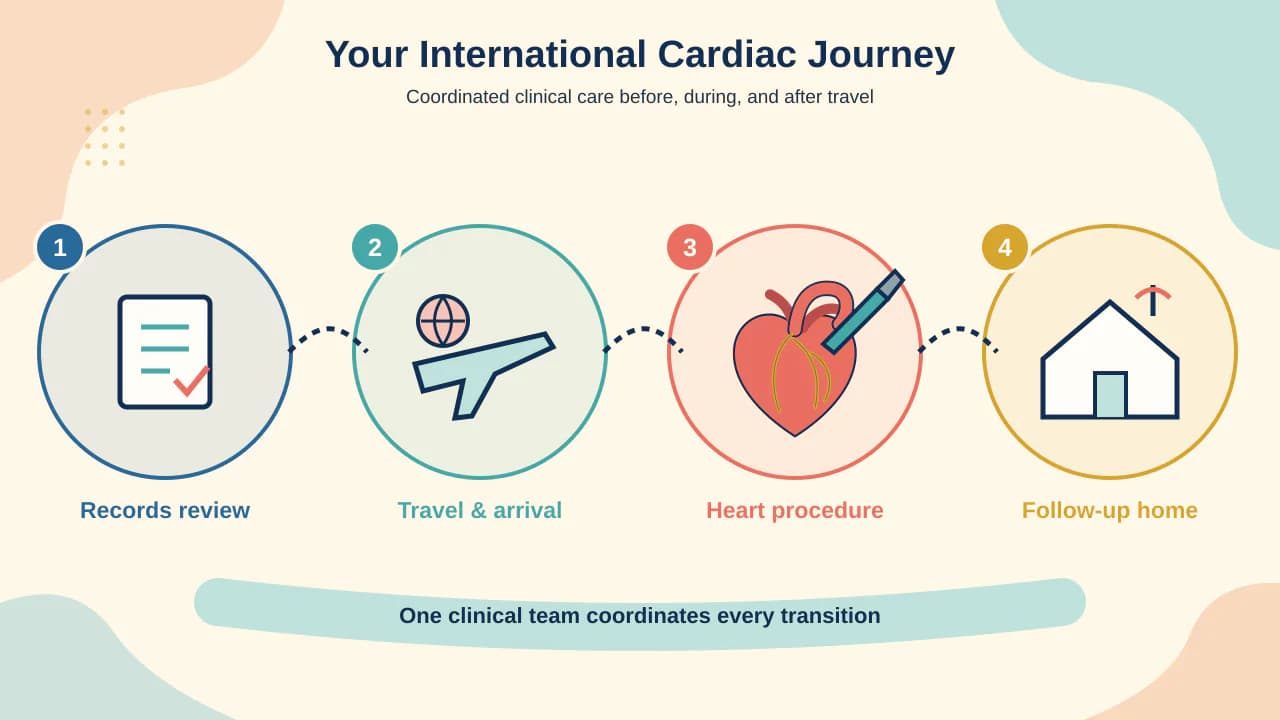
The sequence below is how a records-first pathway normally runs. The order matters: everything before arrival exists so that you are not making decisions in an unfamiliar hospital corridor with a suitcase beside you.
Send complete records
Complete advanced heart-failure history and imaging; Right-heart catheterization and hemodynamics; All implanted-device and prior cardiac-surgery records; Kidney, liver, lung and neurological assessments; Infection, bleeding, psychosocial and caregiver evaluations.
Obtain named-team review
A Advanced heart-failure and LVAD specialist confirms whether the records support further assessment and whether travel appears reasonable.
Discuss indication and alternatives
Irreversible severe right-heart, neurological, hepatic or renal dysfunction, active infection, prohibitive bleeding risk, inability to manage equipment or absent reliable caregiver and follow-up can make LVAD unsafe. Ask what new finding could change or cancel the plan.
Confirm exact entity mapping
Use only clinicians and hospitals currently mapped to LVAD Implantation; if none are mapped, leave entity cards empty rather than borrowing generic cardiac listings.
Compare itemized estimates
Use matching clinical assumptions and compare implants, grafts, operating resources, ICU days, exclusions and escalation terms.
Arrange documents and funding
Complete visa, companion, payment and contingency arrangements without treating a visa letter as clinical acceptance.
Book flexible travel and lodging
Use refundable flights and accessible lodging near the exact campus, allowing enough time for preoperative reassessment.
Repeat assessment after arrival
Assessment includes hemodynamics, right- and left-heart function, coronary and valve disease, kidney, liver, lung and neurological status, infection and nutrition, bleeding and thrombosis risk, psychosocial readiness, caregiver capacity and goals.
Give informed consent
Review the planned approach, alternatives, uncertainty, procedure-specific risks and the possibility that left ventricular assist device implantation cannot proceed as expected.
Complete treatment and monitored recovery
The surgeon implants an inflow cannula in the left ventricle and an outflow graft to the aorta; the pump connects through a driveline to external controllers and batteries. The patient and caregiver must learn power, alarms, driveline care and emergencies. ICU management balances pump speed, right-heart function, bleeding, anticoagulation, rhythm and end-organ recovery; temporary right-ventricular or other support may be required.
Learn discharge care
The patient and caregiver review wounds, medicines, mobility, diet, rehabilitation, warning signs and emergency contacts.
Complete nearby review
Remain nearby until the team reviews early recovery and explicitly discusses fitness to fly.
Carry a complete handover
Take the operative or procedure note, implant and graft details, imaging, discharge summary, medicine list and follow-up plan.
Continue care at home
Lifelong LVAD-program follow-up monitors pump parameters, anticoagulation, hemolysis, driveline infection, right-heart function, blood pressure, nutrition and equipment. A local team must be able to manage emergencies after return.
Documents to prepare
- Complete advanced heart-failure history and imaging
- Right-heart catheterization and hemodynamics
- All implanted-device and prior cardiac-surgery records
- Kidney, liver, lung and neurological assessments
- Infection, bleeding, psychosocial and caregiver evaluations
- Current medication list, including anticoagulants and antiplatelet medicines
- Allergies, blood group, recent blood tests and infection history
- Passport, visa and companion documents needed for travel
Clinical detail
How the operation is performed
The surgeon implants an inflow cannula in the left ventricle and an outflow graft to the aorta; the pump connects through a driveline to external controllers and batteries. The patient and caregiver must learn power, alarms, driveline care and emergencies.
Possible forms include Bridge to transplant, Destination therapy, Temporary support or biventricular strategy. They are not interchangeable quote labels.
ICU management balances pump speed, right-heart function, bleeding, anticoagulation, rhythm and end-organ recovery; temporary right-ventricular or other support may be required. The stated procedure time is often about 4–8 hours for implantation, followed by weeks of recovery and device training.

Main variations
- Bridge to transplant
- Supports an eligible listed or potentially eligible patient while donor timing remains uncertain.
- Destination therapy
- Long-term support when transplantation is not planned, with lifelong device-clinic care.
- Temporary support or biventricular strategy
- Shock or severe right-heart failure may require different temporary or additional support, not a routine LVAD package.
Preparation
Assessment includes hemodynamics, right- and left-heart function, coronary and valve disease, kidney, liver, lung and neurological status, infection and nutrition, bleeding and thrombosis risk, psychosocial readiness, caregiver capacity and goals.
The receiving Advanced heart-failure and LVAD specialist should review complete source imaging, reconcile anticoagulants, antiplatelets and other medicines, assess infection and organ function, and explain alternatives and consent.
Do not stop anticoagulation or antiplatelet treatment without the prescribing and procedural teams. New chest pain, fainting, breathlessness, fever or instability requires prompt local assessment rather than waiting for travel.
Hospital stay and recovery
ICU management balances pump speed, right-heart function, bleeding, anticoagulation, rhythm and end-organ recovery; temporary right-ventricular or other support may be required. Recovery includes physical rehabilitation and demonstrated competence with controller changes, batteries, alarms, driveline dressing and emergency plans. The device and anticoagulation require lifelong specialist access.
The catalog stay 3–8 weeks with device training is an orientation, not a discharge date. Wound condition, rhythm, oxygen need, kidney and neurological function, mobility and reliable medicines affect readiness.
Risks include major bleeding, pump or systemic thrombosis, stroke, driveline or deep infection, right-heart failure, arrhythmia, hemolysis, device malfunction, gastrointestinal bleeding, reoperation and death.
Lifelong LVAD-program follow-up monitors pump parameters, anticoagulation, hemolysis, driveline infection, right-heart function, blood pressure, nutrition and equipment. A local team must be able to manage emergencies after return. Seek urgent clinical help for any device alarm, power interruption, collapse, new neurological symptoms, bleeding, dark urine, fever, driveline redness or drainage, severe breathlessness or rapidly increasing swelling; follow the treating team's own emergency thresholds.
How to compare LVAD Implantation quotes from Indian hospitals
Print these and work through them on the video call. A house that answers without hedging is telling you something useful about how it will behave when something goes wrong.
- Why is left ventricular assist device implantation being considered now, and what are the alternatives?
- Which imaging, anatomy or physiological finding drives the recommendation?
- Who is the named Advanced heart-failure and LVAD specialist responsible for the plan?
- At which exact campus will the procedure and critical care occur?
- Does the quotation use the exact catalog procedure name?
- What could postpone, change or cancel treatment after arrival?
- Which consultations, imaging and laboratory tests are included?
- Which anaesthesia, perfusion, catheter-lab or hybrid-room resources are included?
- Which grafts, prostheses, devices, patches or conduits are assumed?
- Which blood products and routine inpatient medicines are included?
- How many ventilation, ICU and ward days are allowed?
- How are extra days, major bleeding, infection, organ support and reintervention billed?
- Which surgeon, anaesthetist, perfusion, imaging or other professional fees are separate?
- Which discharge medicines, rehabilitation and first follow-up are included?
- What anticoagulation or antiplatelet plan applies before and after treatment?
- What warning signs require immediate local care or return to the hospital?
- What caregiver skills and accessible accommodation are required?
- When and by whom will fitness to fly be assessed?
- Which records and implant identifiers will be supplied at discharge?
- Who accepts clinical responsibility after the patient returns home?
- Which LVAD model and full backup-equipment inventory are included?
- Is the goal bridge to transplant or destination therapy?
- What is the right-heart support contingency?
- How long are rehabilitation and caregiver training funded?
- Who supplies driveline materials, batteries, repairs and 24-hour emergency support after return?
Frequently asked questions
How much does left ventricular assist device implantation cost in India?
LVAD Implantation is typically planned at $70,000–$140,000. This national catalog range is not a quotation; anatomy, approach, implants, ICU use and hospital terms determine the final bill.
What is left ventricular assist device implantation?
An LVAD is a durable mechanical pump that moves blood from the left ventricle to the aorta for selected advanced heart-failure patients as a bridge to transplant, bridge to decision or destination therapy.
When is left ventricular assist device implantation considered?
Implantation may be considered when advanced heart failure remains severe despite optimized treatment and the multidisciplinary team judges that expected benefit, right-heart function, adherence and support justify device therapy.
Who may need a different plan or delay?
Irreversible severe right-heart, neurological, hepatic or renal dysfunction, active infection, prohibitive bleeding risk, inability to manage equipment or absent reliable caregiver and follow-up can make LVAD unsafe.
What evaluation is needed before acceptance?
Assessment includes hemodynamics, right- and left-heart function, coronary and valve disease, kidney, liver, lung and neurological status, infection and nutrition, bleeding and thrombosis risk, psychosocial readiness, caregiver capacity and goals.
How is the procedure performed?
The surgeon implants an inflow cannula in the left ventricle and an outflow graft to the aorta; the pump connects through a driveline to external controllers and batteries. The patient and caregiver must learn power, alarms, driveline care and emergencies.
Which approaches may be discussed?
Bridge to transplant, Destination therapy, Temporary support or biventricular strategy. Selection is clinical, not a package upgrade.
How long does the procedure and admission take?
often about 4–8 hours for implantation, followed by weeks of recovery and device training. The stored 3–8 weeks with device training is a broad travel guide, not a promised discharge date.
What are the important risks?
Risks include major bleeding, pump or systemic thrombosis, stroke, driveline or deep infection, right-heart failure, arrhythmia, hemolysis, device malfunction, gastrointestinal bleeding, reoperation and death.
What can change the estimate?
Important drivers include device model and complete equipment kit, bridge versus destination pathway, right-heart failure risk, icu recovery and rehabilitation, lifelong anticoagulation and device clinic.
What does early recovery involve?
ICU management balances pump speed, right-heart function, bleeding, anticoagulation, rhythm and end-organ recovery; temporary right-ventricular or other support may be required. Recovery includes physical rehabilitation and demonstrated competence with controller changes, batteries, alarms, driveline dressing and emergency plans. The device and anticoagulation require lifelong specialist access.
When can an international patient fly home?
Only after the treating team reviews clinical stability, wounds or access site, rhythm, oxygenation, mobility and the follow-up plan; there is no universal date.
What follow-up is required?
Lifelong LVAD-program follow-up monitors pump parameters, anticoagulation, hemolysis, driveline infection, right-heart function, blood pressure, nutrition and equipment. A local team must be able to manage emergencies after return.
Dr. Shabnam Choudhary, BDS, is a dental professional who graduated from Al-Ameen Medical College, Bijapur, Karnataka. She contributes to the curation and development of medically informative healthcare content, helping ensure that information is structured clearly and presented in a patient-friendly manner.
Content Curator
Dr. Shabnam Choudhary
BDS
Al-Ameen Medical College, Bijapur, Karnataka
Rajiv Gandhi University of Health Sciences (RGUHS), Bengaluru

Dr. Saffiyyah Chaudhary, BDS, is a dental professional who graduated from Al-Ameen Medical College, Bijapur, Karnataka. She provides medical review of healthcare content to help ensure that clinical information is accurate, understandable, and appropriately presented for patients and their families.
Medically Reviewed By
Dr. Saffiyyah Chaudhary
BDS
Al-Ameen Medical College, Bijapur, Karnataka
Rajiv Gandhi University of Health Sciences (RGUHS), Bengaluru

Related treatment costs
Heart Transplant Surgery cost in India
$45,000–$95,000 · stay 6–12 weeks nearby after listing
CABG (Coronary Artery Bypass Grafting) cost in India
$5,500–$14,000 · stay 7–14 nights, then nearby recovery
Heart Valve Repair cost in India
$6,500–$16,500 · stay 7–14 nights
Redo CABG cost in India
$8,500–$20,000 · stay 10–18 nights
Cost note
Cost ranges on this page are for preliminary planning and comparison only. The final treatment cost depends on the patient's diagnosis, treatment plan, hospital, doctor, procedure complexity and other clinical factors. A personalized quotation should be obtained before making treatment or travel decisions.
This page is general information about treatment costs and pathways. It is not a diagnosis, a treatment recommendation or a substitute for an individualised medical opinion. Decisions about whether this procedure is appropriate for you belong to a qualified doctor who has reviewed your records.
Last updated 12 September 2026. Cost data is maintained separately from this article and refreshed as listed campuses revise their planning ranges.
LVAD Implantation cost sheet · All treatment costs in India · Cardiac Surgery costs