Last updated: 12 September 2026 · Content curated by Dr. Shabnam Choudhary · Medically reviewed by Dr. Saffiyyah Chaudhary
Quick Answer
Palliative Chemotherapy in Bengaluru is planned against $1,500–$7,000, with Outpatient · goal is control, not cure stored for broad travel planning. No verified city-only tariff is stored, and this is not a final quotation.
Lower-intensity or standard regimen-specific cycles may be infused or taken orally. Treatment continues only while benefit and tolerance justify the burden. Symptoms, function, blood tests and interval imaging are reviewed. A scan is not the only measure: treatment burden and the patient's goals matter.
- India cost range
- $1,500–$7,000
- Typical starting point
- $1,500
- Typical hospital stay
- Outpatient · goal is control, not cure
- Treatment timeline
- outpatient cycles with explicit response and stop checkpoints rather than a guaranteed fixed course
- Recovery
- Symptoms, function, blood tests and interval imaging are reviewed. A scan is not the only measure: treatment burden and the patient's goals matter.
Major cost factors: regimen intensity, number of cycles before reassessment, symptom and supportive care, admission risk. International patients should also budget for accommodation, airport transfers, a medical visa, medicines and follow-up.
Often quoted separately: additional pathology, imaging or molecular testing; extra cycles, dose changes or a new regimen; unlisted supportive medicines and blood products; emergency admission or complication care; travel, lodging and care after return.
Why request a cost through GAF rather than a hospital?
Writing to one campus gets you that campus’s package. A GAF request is reviewed against your records and returned as suitable doctor and hospital options with an indicative, itemised estimate. There is no obligation to book.
- Doctor review first. The number follows a reading of your imaging, test results and clinical records, not a brochure range.
- Hospital options. You can compare listed campuses before you travel, instead of starting over with each international desk.
- International-patient coordination. Visa letters, records routing and companion logistics sit with the same request.
Palliative Chemotherapy in Bengaluru
It may be considered for advanced or recurrent cancer when expected benefit, symptoms, performance status and the patient's goals support treatment. The oncologist should state the treatment goal, chance of meaningful benefit in plain language, alternatives and the point at which treatment would stop. Pathology and biomarkers still matter.
Bengaluru has oncology hospitals and molecular-diagnostics services, but this page does not infer that every campus dispenses every anticancer medicine. The named regimen, pharmacy availability and procedure-tagged oncologist remain the evidence.
The airport is north of the city while many cancer units are south or east. Whitefield, Bannerghatta Road and central Bengaluru are different commutes for a patient returning for blood counts and infusions. Book after the campus is confirmed. Milder weather may help a longer stay, but traffic and food hygiene still shape the practical recovery week after a cycle.
The current GAF entity graph has no clinician tagged to Palliative Chemotherapy in Bengaluru. The page therefore leaves doctor and hospital cards empty instead of borrowing a generic oncology profile. This is a catalog gap, not proof that the treatment is unavailable across the city.
Share complete pathology, imaging, prior treatment and available biomarker reports before making non-refundable travel arrangements. The regimen may change after pathology review or examination.
What palliative chemotherapy typically costs in Bengaluru
The amount can move with regimen intensity, number of cycles before reassessment, symptom and supportive care, admission risk. It should not be divided into an invented per-cycle price without a named regimen and dose.
Ask the hospital to identify the medical oncologist, exact medicines, brand or biosimilar assumption, dose basis, cycle count, day-care fees, supportive drugs, laboratory schedule and emergency-admission exclusions.
Outside the hospital letter, budget for travel through Kempegowda International Airport, lodging near the unit, meals suited to treatment, local transport, visa needs and flexible return flights.
What moves the quote in Bengaluru
- Regimen intensity
- Single-agent symptom-control treatment and a multi-drug regimen are different budgets.
- Number of cycles before reassessment
- Stop rules should be explicit.
- Symptom and supportive care
- Pain, nutrition, drainage or transfusion support may exceed the day-care fee.
- Admission risk
- Advanced disease can turn outpatient planning into inpatient care.
Medical travel through Bengaluru
Send pathology, scans, treatment summaries and molecular reports before travel to Bengaluru.
Arrive with time for pathology reconciliation, blood tests and a medical-oncology review. A remote opinion can change when the original tissue, current scan or organ function is reassessed.
Book after the campus is confirmed. Milder weather may help a longer stay, but traffic and food hygiene still shape the practical recovery week after a cycle. Decide with the treating team whether later cycles can safely continue at home before buying a long stay.
Hospitals and units listed in Bengaluru
The current GAF entity graph has no clinician tagged to Palliative Chemotherapy in Bengaluru. The page therefore leaves doctor and hospital cards empty instead of borrowing a generic oncology profile. This is a catalog gap, not proof that the treatment is unavailable across the city.
Confirm that the named campus can source the quoted medicine and manage infusion reactions or treatment-related complications. A general oncology label does not establish current stock, price or expertise.
Palliative Chemotherapy doctors in Bengaluru · Palliative Chemotherapy hospitals in Bengaluru · Palliative Chemotherapy cost in India
What Is Palliative Chemotherapy?
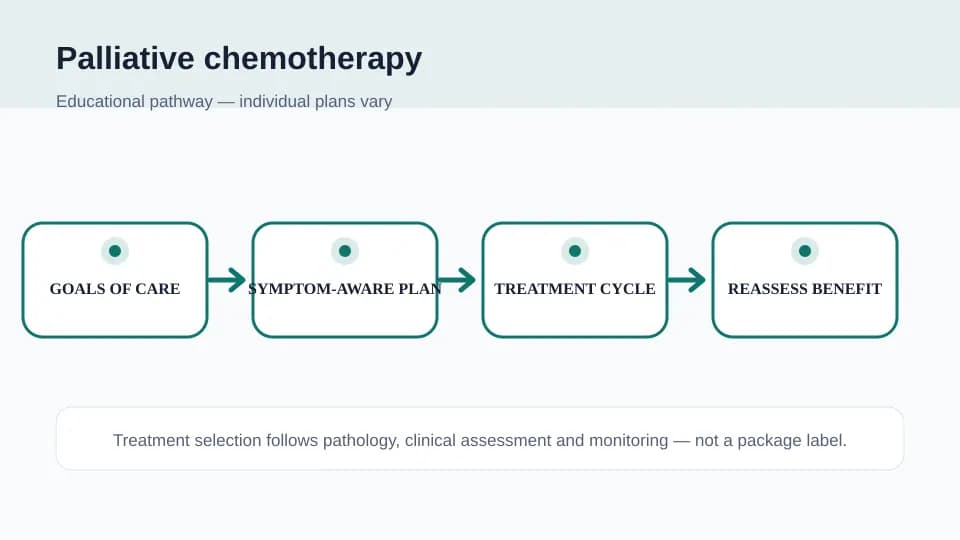
Palliative chemotherapy uses anticancer medicines when the stated goal is disease control, symptom relief or longer life rather than cure.
Lower-intensity or standard regimen-specific cycles may be infused or taken orally. Treatment continues only while benefit and tolerance justify the burden.
Symptoms, function, blood tests and interval imaging are reviewed. A scan is not the only measure: treatment burden and the patient's goals matter.
When Is Palliative Chemotherapy Recommended?
It may be considered for advanced or recurrent cancer when expected benefit, symptoms, performance status and the patient's goals support treatment.
More treatment is not always better: frailty, rapid decline, severe toxicity, low expected benefit or a preference for comfort-focused care can make chemotherapy inappropriate.
How treatment is given, monitored and adapted →
Palliative Chemotherapy cost in India
The $1,500–$7,000 figure is the GAF national planning band for palliative chemotherapy. It may describe consultation, a stated medicine plan, day-care and scheduled monitoring, but it does not establish what one hospital will charge.
Important cost drivers include regimen intensity, number of cycles before reassessment, symptom and supportive care, admission risk, travel burden. Medicine acquisition can dominate the invoice, so a quote without drug names, dose and cycle count is not comparable.
No separate Delhi NCR, Mumbai, Bengaluru, Chennai or Hyderabad price is shown unless verified city data exists. This system currently inherits the national band and labels that limitation plainly.
Usually outpatient, but advanced disease and complications make admission more likely. Symptom control and palliative-care access should exist alongside day-care. International travel can consume time and energy. Compare the clinical value of care near home with any cost or access advantage before committing to repeated cycles abroad.
Palliative Chemotherapy cost breakdown in India
Component prices are rarely published as a public tariff. The lines below describe what typically sits inside a treatment estimate, not a dollar amount for each row.
- Medical oncologist and pathology review
- Confirmation of diagnosis, stage, intent and whether palliative chemotherapy is supported by the available evidence.
- Biomarker or molecular testing when relevant
- Immunohistochemistry, molecular profiling or germline testing only when clinically indicated. Ask whether tissue review and the test itself are included.
- Named anticancer medicines
- The written regimen, dose basis, brand or biosimilar assumption, vial use and number of cycles. A generic 'drug package' is insufficient.
- Infusion or dispensing
- Usually outpatient, but advanced disease and complications make admission more likely. Symptom control and palliative-care access should exist alongside day-care. Confirm day-care nursing, pharmacy preparation and any oral-drug dispensing fees.
- Supportive medicines
- Anti-nausea treatment, hydration, growth-factor support, infection prevention or blood products only when prescribed and explicitly listed.
- Monitoring and follow-up
- Symptoms, function, blood tests and interval imaging are reviewed. A scan is not the only measure: treatment burden and the patient's goals matter. Confirm which blood tests, scans and consultations sit inside the package window.
Planning range or quotation?
The $1,500–$7,000 figure is an indicative planning range. A final hospital quotation is itemised, issued after a consultant reviews your records, and still subject to what is found clinically.
Get a Personalized Cost Estimate
What is usually included in a Palliative Chemotherapy package?
No two hospitals draw the line in the same place, so read an estimate for what it excludes as carefully as for what it covers. The pattern below is what listed campuses typically bundle into a medical oncology estimate for this treatment. Anything not written into your estimate should be assumed to be extra until the hospital confirms otherwise.
Usually included
Usually included
Named medical-oncology assessment
A consultation tied to the oncologist expected to lead the plan, where bundled.
Usually included
Documented regimen and cycle allowance
The estimate should use the exact treatment name Palliative Chemotherapy and state medicine, dose basis and number of administrations.
Usually included
Quoted medicine and day-care
Only the brands, biosimilars, vials, pharmacy preparation and infusion visits written into the letter are included.
Usually included
Quoted baseline and on-treatment tests
Blood counts, organ-function tests and response imaging only to the extent listed.
Usually included
Quoted supportive care
Anti-emetics, hydration and other prescribed support only when itemized.
May be charged separately
May be separate
Additional pathology, imaging or molecular testing
Repeat biopsy, outside-slide review, NGS or new imaging may be separate when results are incomplete or the disease has changed.
May be separate
Extra cycles, dose changes or a new regimen
Treatment beyond the stated cycle allowance or a switch after progression or toxicity requires a revised estimate.
May be separate
Unlisted supportive medicines and blood products
Growth factors, antimicrobials, transfusions and symptom-control medicines are not automatically bundled.
May be separate
Emergency admission or complication care
Neutropenic fever, severe immune toxicity, dehydration or organ injury can require inpatient care outside a day-care letter.
May be separate
Travel, lodging and care after return
Flights, visas, companion stay, local transport and monitoring by the home oncology team are normally outside the hospital quote.
Catalog inclusions listed for this pathway: medical oncology consultation and records review; named consultant on camera before travel; protocol, cycles and supportive medicines as quoted; on-treatment reviews and toxicity management; discharge summary to your home oncologist.
What can increase the cost?
These are the drivers that actually move a bill for this procedure, in rough order of how often they do it. Most of them are clinical decisions rather than commercial ones, which is why an honest estimate is written after a records review rather than before it.
- Regimen intensity
- Single-agent symptom-control treatment and a multi-drug regimen are different budgets.
- Number of cycles before reassessment
- Stop rules should be explicit.
- Symptom and supportive care
- Pain, nutrition, drainage or transfusion support may exceed the day-care fee.
- Admission risk
- Advanced disease can turn outpatient planning into inpatient care.
- Travel burden
- Companion time and flexible return plans are clinically relevant costs.
Treatment approaches related to Palliative Chemotherapy
The oncologist should state the treatment goal, chance of meaningful benefit in plain language, alternatives and the point at which treatment would stop. Pathology and biomarkers still matter. The rows below are clinical alternatives or neighbouring pathways, not consumer upgrades.
A medical oncologist should explain why the proposed approach fits the pathology and treatment goal, and what result would trigger a change.
Swipe to compare treatment approaches →
| Approach | Relative complexity | GAF planning range | Notes |
|---|---|---|---|
| Chemotherapy | Selected by pathology, stage, biomarkers and treatment intent | $1,500–$8,000+Catalog planning range | The parent treatment family; this pathway is defined by non-curative intent. |
| Targeted Therapy | Selected by pathology, stage, biomarkers and treatment intent | $8,000–$30,000Catalog planning range | A possible alternative when an actionable target and evidence exist. |
| Supportive care without anticancer medicine | Selected by pathology, stage, biomarkers and treatment intent | No separate GAF sheetRelative complexity only | A valid clinical option that should not be hidden from the discussion. |
Planning ranges appear only where GAF Healthcare already publishes a cost sheet for that procedure. Other rows describe relative clinical complexity and should not be read as prices.
Side effects and considerations during Palliative Chemotherapy
Fatigue, nausea, cytopenias, infection, neuropathy or appetite change may reduce quality of life. The balance between benefit and burden must be revisited.
Effects vary by medicine, dose, combination, treatment site, previous therapy and individual health. Not every patient experiences every listed effect, and this is not an exhaustive consent list.
The treating medical oncologist should explain expected effects, urgent warning signs, monitoring and when a dose should be held. No page can promise response, cure or a mild treatment course.
Palliative Chemotherapy cost: India vs other medical tourism destinations
India and United States values come from the stored GAF registry. Other rows are explicitly modelled from relative private-care levels and are not official drug tariffs or evidence that a medicine is available.
International comparisons fail when the drug, dose, cycle count, biomarker testing and supportive care differ. Obtain like-for-like written estimates after records review.
Swipe to compare destinations →
| Country | Approximate cost | Relative cost position | Important cost considerations |
|---|---|---|---|
| India | $1,500–$7,000 | Baseline | GAF catalog planning range. The stored India figure is a comparison band. A named medical oncologist must review pathology, stage, biomarkers, dose and cycle assumptions before a hospital issues an itemized estimate. |
| Turkey | $4,700–$7,700Indicative planning estimate* | ≈1.4× India | Private international oncology market. Compare the exact medicines, dose basis, number of cycles, laboratory monitoring and supportive drugs rather than a general cancer package. |
| Thailand | $5,500–$9,400Indicative planning estimate* | ≈1.8× India | Private international hospitals. International desks may coordinate care, but medicine acquisition, biomarker testing, day-care fees and lodging between cycles need written confirmation. |
| United Arab Emirates | $9,400–$15,500Indicative planning estimate* | ≈2.9× India | Regional premium private care. Travel may be shorter for Gulf families; pharmacy, infusion, specialist and monitoring charges may still be billed separately. |
| Singapore | $12,000–$20,500Indicative planning estimate* | ≈3.8× India | High-cost specialist private care. Ask for a self-pay estimate tied to drug names, vial use, dose, cycles and biomarker assumptions rather than a broad medical-oncology label. |
| Germany | $10,500–$19,000Indicative planning estimate* | ≈3.5× India | European specialist oncology care. International access, medicine reimbursement, professional billing and follow-up arrangements vary by centre and patient status. |
| United Kingdom | $9,400–$17,000Indicative planning estimate* | ≈3.1× India | Private self-pay for many visitors. Overseas patients should confirm eligibility, private pharmacy pricing, infusion fees and who manages toxicity after they return home. |
| United States | $8,000–$35,000 | ≈5.1× India | Stored self-pay reference. Hospital, oncologist, laboratory, imaging and drug bills may come from different entities. $8,000–$35,000 is a catalog comparison band, not one bundled quotation. |
*Figures other than India and the United States are modelled planning estimates scaled from the India catalog band, not hospital quotations. All figures are planning information. Cancer type, stage, regimen, drug origin, dose, cycles, tests, supportive care, hospital terms and currency can change the final amount; no row predicts outcome.
The point of this table is not that one country is better. Cost level and treatment-market structure are different things. Compare the named hospital, multidisciplinary support, included care and follow-up pathway as carefully as the headline figure.
Which destination is right for you?
Use this only as a reading guide for the table above. It is not a medical recommendation, and it does not rank countries.
Looking for the lowest overall treatment cost?
IndiaLooking for premium private hospital infrastructure?
Singapore / UAELooking for proximity from the Middle East?
UAE / India / TurkeyLooking for established European oncology systems?
Germany / UK
Why do international patients consider India for palliative chemotherapy?
Some international patients consider India for access to medical oncology review, hospital day-care and a self-pay planning band below typical United States figures. Cost alone is not a reason to travel.
The useful comparison is a named oncologist, evidence-based regimen, medicine source, dose and cycle transparency, toxicity cover and a handover that the home team can continue.
No hospital or clinician is described as best. Urgent disease, poor fitness to fly, unstable complications or funded care near home may make international travel inappropriate.
Hospitals for Palliative Chemotherapy in Bengaluru
Hospital cards follow exact live treatment and clinician relationships. Accreditation or a general oncology label does not prove current drug availability, molecular-testing access, treatment volume, clinical-trial access or outcomes.
Campuses for this pathway are being confirmed. Ask the desk which houses currently quote it.
Palliative Chemotherapy medical oncologists in Bengaluru
Profiles are pulled dynamically only when Palliative Chemotherapy appears in the clinician's current CMS relationships. Verify role, treatment relevance, availability and campus. Placement is not a ranking and this article adds no experience, drug-stock or outcome claim.
Named consultants for this pathway are being matched. Request a dossier and we will advise which campuses can quote it.
Palliative Chemotherapy cost by city in India
Delhi NCR, Mumbai, Bengaluru, Chennai and Hyderabad inherit the stored India planning band because no verified city-only tariff is held for these Medical Oncology treatments. A national range is not a local quotation.
Doctor and hospital cards resolve only from exact live CMS relationships. This module names no medicine stock, clinical-trial access, volume, rating or outcome, and an empty card area remains visibly empty.
Swipe to compare Indian cities →
Delhi NCR
$1,500–$7,000
India planning band — not a city quote
Typical stay Outpatient · goal is control, not cure
No verified Delhi NCR-only tariff is stored for palliative chemotherapy. Use $1,500–$7,000 as the national planning band until a named hospital supplies a regimen-specific quotation.
2 hospitals · 4 doctors
Mumbai
$1,500–$7,000
India planning band — not a city quote
Typical stay Outpatient · goal is control, not cure
No verified Mumbai-only tariff is stored for palliative chemotherapy. Use $1,500–$7,000 as the national planning band until a named hospital supplies a regimen-specific quotation.
1 hospital · 1 doctor
Bengaluru
$1,500–$7,000
India planning band — not a city quote
Typical stay Outpatient · goal is control, not cure
No verified Bengaluru-only tariff is stored for palliative chemotherapy. Use $1,500–$7,000 as the national planning band until a named hospital supplies a regimen-specific quotation.
0 hospitals · consultant match on request
Chennai
$1,500–$7,000
India planning band — not a city quote
Typical stay Outpatient · goal is control, not cure
No verified Chennai-only tariff is stored for palliative chemotherapy. Use $1,500–$7,000 as the national planning band until a named hospital supplies a regimen-specific quotation.
0 hospitals · consultant match on request
Hyderabad
$1,500–$7,000
India planning band — not a city quote
Typical stay Outpatient · goal is control, not cure
No verified Hyderabad-only tariff is stored for palliative chemotherapy. Use $1,500–$7,000 as the national planning band until a named hospital supplies a regimen-specific quotation.
0 hospitals · consultant match on request
Costs vary considerably by hospital, specialist, clinical complexity, insurance, room or day-care category, and what is included in the package.
Choosing a city for palliative chemotherapy
Patients usually pick the treating team first and the city second. The city still affects daily travel, accommodation, companion arrangements and access to follow-up. Here is what genuinely differs between the five cities we list.
What should international patients budget beyond the treatment medicine?
A complete palliative chemotherapy budget includes more than the $1,500–$7,000 planning band: pathology reconciliation, tests, medicines, infusion or dispensing, supportive care, monitoring, companion travel, lodging and contingency for a delayed or changed cycle.
Travel should follow written clinical acceptance and an itemized estimate. A visa letter or directory card is not medical clearance.
- Records, pathology and prior-treatment review
- Share biopsy, immunohistochemistry, scans, treatment summaries, medicine doses and toxicity history.
- Biomarker review when relevant
- Confirm whether existing tissue is adequate, whether testing could change the plan, and who interprets the result.
- Regimen and itemized estimate
- Match medicine, dose, cycle count, day-care, tests, supportive drugs and emergency exclusions.
- Arrival and baseline assessment
- Allow time for examination, pathology reconciliation and regimen-specific organ-function tests before the first administration.
- Treatment and monitoring
- Lower-intensity or standard regimen-specific cycles may be infused or taken orally. Treatment continues only while benefit and tolerance justify the burden. Symptoms, function, blood tests and interval imaging are reviewed. A scan is not the only measure: treatment burden and the patient's goals matter.
- Handover and return-home plan
- Travel should occur only when symptoms are stable and care is arranged at home. A deteriorating patient may be safer receiving treatment and palliative support locally. Carry the treatment summary, doses, toxicity record and next monitoring date.
- Treatment episode$1,500–$7,000
- Pre-operative testsOften inside the estimate — confirm
- Hospital stayOutpatient · goal is control, not cure typically bundled
- Additional procedures or extended careQuoted separately if advised
- Accommodation for companionVaries by city and length of stay
- Local transportationAirport and daily hospital transfers
- FlightsDepends on origin
- Medical visaFee set by the issuing consulate
Planning estimate — not a hospital quotation.
Get a Personalized Treatment Estimate
What does medical travel for palliative chemotherapy in India involve?
The sequence below is how a records-first pathway normally runs. The order matters: everything before arrival exists so that you are not making decisions in an unfamiliar hospital corridor with a suitcase beside you.
Send complete oncology records
Provide pathology, immunohistochemistry, imaging files, prior regimens, dose dates, discharge summaries and molecular reports.
Confirm clinical acceptance
A named medical oncologist reviews diagnosis, intent, evidence, travel safety and whether the hospital can source the proposed medicines.
Hold a remote consultation
Ask why this approach is proposed, what alternatives exist, what remains uncertain and who will manage toxicity.
Compare itemized estimates
Use the same medicine, dose and cycle assumptions; do not compare one vial with a whole course.
Plan flexible travel
Obtain required documents and book refundable travel near the exact campus, with contingency for delayed blood counts or extra review.
Repeat necessary baseline checks
The team may reconcile pathology and repeat laboratory, imaging or organ-function tests before treatment.
Receive treatment
Lower-intensity or standard regimen-specific cycles may be infused or taken orally. Treatment continues only while benefit and tolerance justify the burden. The plan can change for toxicity, response or new pathology information.
Monitor between administrations
Symptoms, function, blood tests and interval imaging are reviewed. A scan is not the only measure: treatment burden and the patient's goals matter.
Review fitness to travel
Travel should occur only when symptoms are stable and care is arranged at home. A deteriorating patient may be safer receiving treatment and palliative support locally.
Continue care at home
Transfer the regimen, doses, adverse-event record and scan schedule to the local team. Each review should ask whether treatment is helping the outcomes that matter to the patient. Home palliative and emergency contacts should be arranged before return.

Documents to prepare
- Current staging, symptom and performance-status summary
- Prior treatment benefit, toxicity and reason for stopping
- Complete pathology report and immunohistochemistry; original slides or blocks if requested
- Recent CT, MRI or PET files rather than phone photographs
- All prior systemic-treatment names, doses, dates and reasons for stopping
- Molecular or germline reports where relevant, including laboratory and specimen details
- Current medicines, allergies, recent blood counts and organ-function tests
Clinical detail
How the treatment is delivered
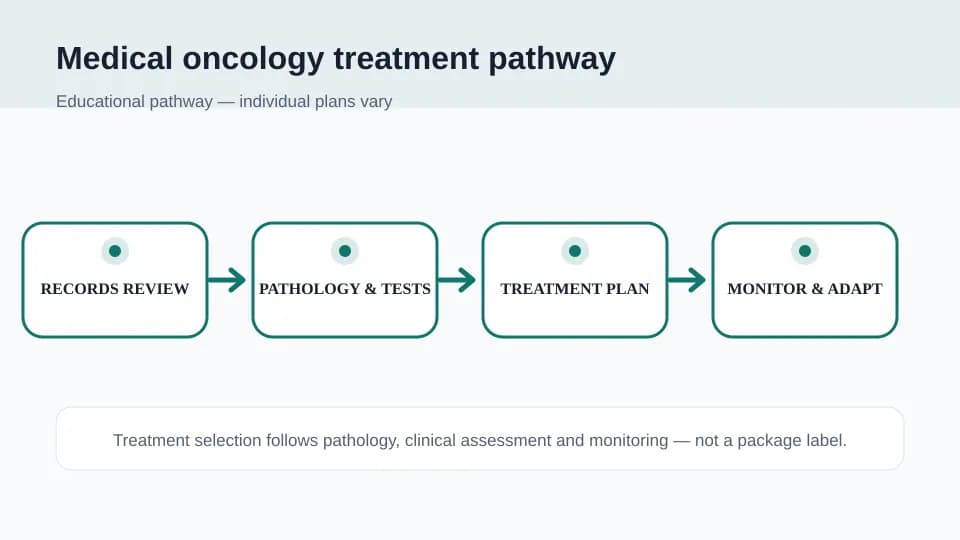
The oncologist should state the treatment goal, chance of meaningful benefit in plain language, alternatives and the point at which treatment would stop. Pathology and biomarkers still matter.
Lower-intensity or standard regimen-specific cycles may be infused or taken orally. Treatment continues only while benefit and tolerance justify the burden. Commonly discussed approaches include Chemotherapy, Targeted Therapy, Supportive care without anticancer medicine.
Usually outpatient, but advanced disease and complications make admission more likely. Symptom control and palliative-care access should exist alongside day-care. Symptoms, function, blood tests and interval imaging are reviewed. A scan is not the only measure: treatment burden and the patient's goals matter.
Main variations
- Chemotherapy
- The parent treatment family; this pathway is defined by non-curative intent.
- Targeted Therapy
- A possible alternative when an actionable target and evidence exist.
- Supportive care without anticancer medicine
- A valid clinical option that should not be hidden from the discussion.
Preparation
The oncologist should state the treatment goal, chance of meaningful benefit in plain language, alternatives and the point at which treatment would stop. Pathology and biomarkers still matter. Send complete reports and imaging files rather than a photograph of a prescription.
Before treatment, the team may repeat blood counts, kidney or liver tests, infection screening, cardiac assessment or pregnancy testing according to the proposed medicine. These are regimen-specific, not universal.
Hospital stay and recovery
Usually outpatient, but advanced disease and complications make admission more likely. Symptom control and palliative-care access should exist alongside day-care. Fatigue, nausea, cytopenias, infection, neuropathy or appetite change may reduce quality of life. The balance between benefit and burden must be revisited.
Symptoms, function, blood tests and interval imaging are reviewed. A scan is not the only measure: treatment burden and the patient's goals matter.
The catalog's Outpatient · goal is control, not cure is a broad planning guide, not a promise that the patient can fly or stop monitoring on a fixed date.
Each review should ask whether treatment is helping the outcomes that matter to the patient. Home palliative and emergency contacts should be arranged before return. Seek urgent clinical help for fever, breathing difficulty, new confusion, severe diarrhoea, uncontrolled vomiting, bleeding or any warning sign specified by the treating team.
How to compare Palliative Chemotherapy quotes from Indian hospitals
Print these and work through them on the video call. A house that answers without hedging is telling you something useful about how it will behave when something goes wrong.
- Why is palliative chemotherapy being considered now, and what alternatives were discussed?
- Has the pathology been reviewed, and is the stage current?
- Is biomarker, molecular or germline testing clinically relevant, and is it included?
- Who is the named medical oncologist, and at which exact campus is treatment delivered?
- Are pathology-review charges included, and are original slides or blocks needed?
- Which medicines, brands or biosimilars are quoted?
- How is the dose calculated, and how many cycles or months are included?
- Are pharmacy preparation, infusion day-care and nursing included?
- Are anti-nausea medicines, hydration and other supportive medicines included?
- Are growth factors or blood products included if prescribed?
- Which blood tests and scans are included?
- What is charged if the dose is held, reduced or changed?
- What happens if additional cycles are recommended?
- Are emergency admission and complication care excluded?
- Are any planned hospital-admission or observation charges included?
- Can later cycles or monitoring continue safely at home?
- Which follow-up consultation and written handover are included?
- What costs are explicitly excluded from the treatment package?
- What is the stated goal and the first stop-or-continue checkpoint?
- Is palliative and symptom support included or separately arranged?
Frequently asked questions
How much does palliative chemotherapy cost in Bengaluru?
Use $1,500–$7,000 as the stored India planning range. No verified Bengaluru-only tariff is stored. Final pricing requires the drug, dose, number of cycles and an itemized hospital letter.
Which Bengaluru medical oncologists provide palliative chemotherapy?
Only profiles dynamically matched to this exact CMS procedure should appear. If no card appears, that is a catalog gap rather than a hidden list or ranking.
What should a Bengaluru quotation name?
The regimen, medicine names, brand or biosimilar basis, dose, cycle count, day-care, tests, supportive medicines and emergency-admission policy.
Where should an international patient stay in Bengaluru?
Book after the campus is confirmed. Milder weather may help a longer stay, but traffic and food hygiene still shape the practical recovery week after a cycle. Keep the booking flexible until the first toxicity review.
Can later cycles continue at home?
Travel should occur only when symptoms are stable and care is arranged at home. A deteriorating patient may be safer receiving treatment and palliative support locally.
How much does palliative chemotherapy cost in India?
Palliative Chemotherapy is typically planned at $1,500–$7,000. This is a stored comparison range, not a quotation; medicine, dose, cycles, testing and hospital terms determine the final amount.
What is palliative chemotherapy?
Palliative chemotherapy uses anticancer medicines when the stated goal is disease control, symptom relief or longer life rather than cure.
When is palliative chemotherapy considered?
It may be considered for advanced or recurrent cancer when expected benefit, symptoms, performance status and the patient's goals support treatment.
Does every patient with this cancer need the same treatment?
More treatment is not always better: frailty, rapid decline, severe toxicity, low expected benefit or a preference for comfort-focused care can make chemotherapy inappropriate. Selection requires individual medical-oncology and multidisciplinary review.
Do biomarker or molecular tests affect treatment selection?
The oncologist should state the treatment goal, chance of meaningful benefit in plain language, alternatives and the point at which treatment would stop. Pathology and biomarkers still matter.
How is the treatment given?
Lower-intensity or standard regimen-specific cycles may be infused or taken orally. Treatment continues only while benefit and tolerance justify the burden.
How long does palliative chemotherapy take?
outpatient cycles with explicit response and stop checkpoints rather than a guaranteed fixed course. Outpatient · goal is control, not cure is the catalog travel-planning assumption, not a fixed course.
Are anticancer medicines included in the hospital package?
Only medicines named in the itemized estimate are included. Confirm the drug, brand or biosimilar, dose, vial use and cycle allowance.
What can make the quotation change?
Important drivers include regimen intensity, number of cycles before reassessment, symptom and supportive care, admission risk, travel burden.
What monitoring is usually needed?
Symptoms, function, blood tests and interval imaging are reviewed. A scan is not the only measure: treatment burden and the patient's goals matter.
Can the regimen change after arrival?
Yes. Pathology review, examination, organ function, toxicity or new imaging can change the medicine, dose or timing. The hospital should revise the estimate in writing.
How should an international patient choose a medical oncologist?
Verify the clinician's role, exact procedure relationship, proposed regimen, communication, toxicity cover and handover. Directory placement is not a ranking.
Can later treatment continue after returning home?
Travel should occur only when symptoms are stable and care is arranged at home. A deteriorating patient may be safer receiving treatment and palliative support locally.
What follow-up is required?
Each review should ask whether treatment is helping the outcomes that matter to the patient. Home palliative and emergency contacts should be arranged before return.
Dr. Shabnam Choudhary, BDS, is a dental professional who graduated from Al-Ameen Medical College, Bijapur, Karnataka. She contributes to the curation and development of medically informative healthcare content, helping ensure that information is structured clearly and presented in a patient-friendly manner.
Content Curator
Dr. Shabnam Choudhary
BDS
Al-Ameen Medical College, Bijapur, Karnataka
Rajiv Gandhi University of Health Sciences (RGUHS), Bengaluru

Dr. Saffiyyah Chaudhary, BDS, is a dental professional who graduated from Al-Ameen Medical College, Bijapur, Karnataka. She provides medical review of healthcare content to help ensure that clinical information is accurate, understandable, and appropriately presented for patients and their families.
Medically Reviewed By
Dr. Saffiyyah Chaudhary
BDS
Al-Ameen Medical College, Bijapur, Karnataka
Rajiv Gandhi University of Health Sciences (RGUHS), Bengaluru

Related treatment costs
Chemotherapy cost in India
$1,500–$8,000+ · stay Outpatient cycles · 3–6 months typical
Targeted Therapy cost in India
$8,000–$30,000 · stay Oral or infusion · months of therapy
Immunotherapy cost in India
$15,000–$45,000 · stay Outpatient q2–6 weeks
Maintenance Therapy cost in India
$4,000–$18,000 · stay Lower-intensity cycles after induction
Cost note
Cost ranges on this page are for preliminary planning and comparison only. The final treatment cost depends on the patient's diagnosis, treatment plan, hospital, doctor, procedure complexity and other clinical factors. A personalized quotation should be obtained before making treatment or travel decisions.
This page is general information about treatment costs and pathways. It is not a diagnosis, a treatment recommendation or a substitute for an individualised medical opinion. Decisions about whether this procedure is appropriate for you belong to a qualified doctor who has reviewed your records.
Last updated 12 September 2026. Cost data is maintained separately from this article and refreshed as listed campuses revise their planning ranges.
Palliative Chemotherapy cost sheet · All treatment costs in India · Medical Oncology costs